Why English is important: what it really opens up, and where it stops helping
By the SpeakWisely team · Published · 9 min read

English is important because it is the language most likely to be shared between people who have no other language in common, so it widens your options at work, in education, online and abroad. In India it is also linked to higher average pay. It is not a guarantee of anything, though, and in plenty of jobs and countries it is not enough on its own.
This guide takes the five places where English makes a real difference, gives the evidence for each with its source and its year, and then sets out the limits. If you are deciding how much time to give to English, you should see both sides.
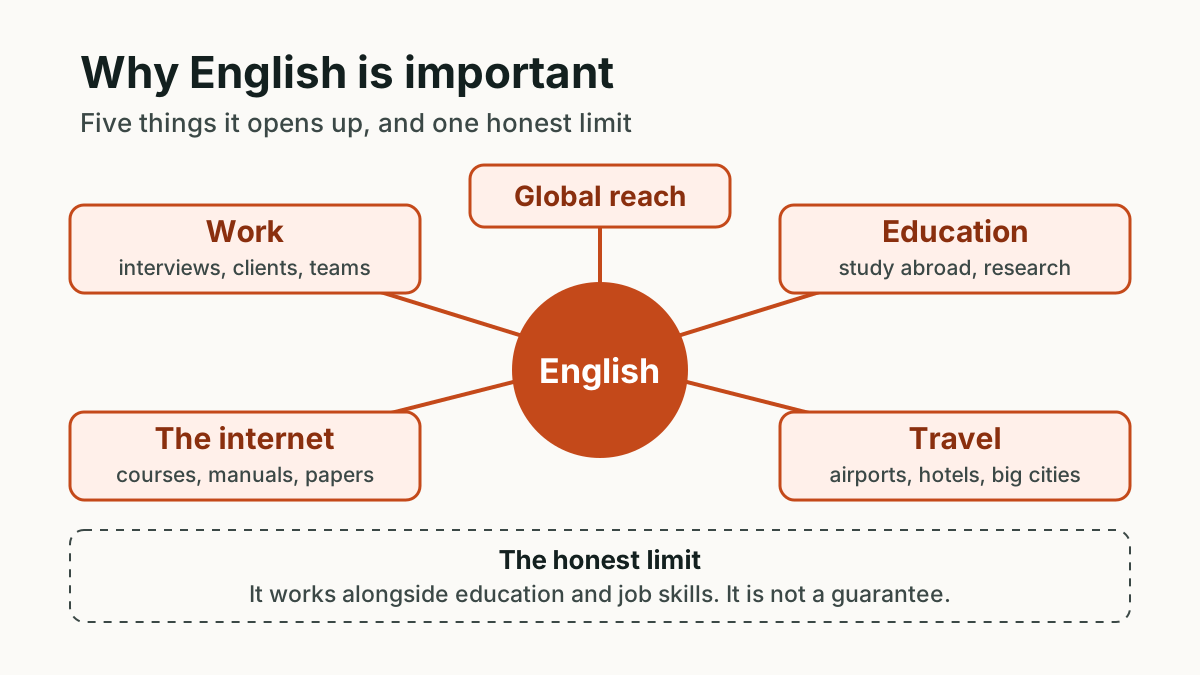
Why is English important in today's world?
The plainest reason is reach. Ethnologue data for 2025, as reported by Voronoi, puts English at over 1.5 billion total speakers, the most of any language when native and non-native speakers are counted together. Many of those people learned it as an additional language, which is why it works as a bridge: a Gujarati engineer and a Dutch client can both use it without either being at home in it.
That bridge exists well beyond English-speaking countries. In a European Union survey carried out in 2023, 47% of Europeans said they could speak English, making it the most common foreign language across the 27 member states. Our guide to the countries where English is spoken separates where it is the main language, where it is official and where it is simply widely used.
Why is English important in India?
In India, English is both widely valued and fairly scarce, and that combination gives it its worth. The India Human Development Survey of 2005 found that 4% of Indians reported speaking fluent English and another 16% a little. The 2011 Census counted about 10.6% of the population as English speakers across first, second and third languages. The two figures measure different things, but both show that most Indians do not speak it, so those who do stand out.
The best-known estimate of what that is worth comes from economists Azam, Chin and Prakash, using the same 2005 data. After controlling for education, age, social group, district and test scores, men who spoke fluent English earned on average 34% more per hour than men who spoke none, and 13% more with a little English. For women the figures were 22% and 10%. These numbers are about twenty years old and they are averages, not a promise, as our post on English and salary in India explains.
There is also a confidence gap worth noticing. On the EF English Proficiency Index page for India, the country ranks 74th with a score of 484, against a global average of 488. EF tests are taken online by people who choose to sit them, so this is not a national sample. Even so, India does not trail the world by much, and its speaking score of 500 is above its listening score of 457. Many Indian learners know more English than they feel able to use.
How does English help you at work?
At work, English matters most in the moments when someone is judging you quickly: the interview, the client call, the update to a manager in another city. In many Indian companies these moments happen in English even when the rest of the day does not. If you can give a clear answer aloud, people notice your ability instead of your hesitation.
It also opens particular kinds of work. Voice roles in outsourcing depend on it directly, and our guide to English for BPO and call centre jobs covers what those employers test. Remote jobs for English speakers are real too, though many are limited to certain countries. And some people want to work overseas, where the picture varies a great deal by country, as our guide to English-speaking jobs abroad shows.
Why is English important for students?
For students, English affects both what you can read and where you can apply. Universities and visa systems in English-speaking countries often set a measured level. The UK Student visa asks for CEFR level B2 for degree-level study and above, and B1 below degree level. According to ielts.org, an overall IELTS band of 5.5 to 6.5 corresponds to B2, though it notes there is no one-to-one match between the two scales.
Beyond admission, much academic work happens in English, and the cost of weak English is measurable. A 2023 study in PLOS Biology surveyed 908 environmental scientists in eight countries. It reported that non-native speakers can need up to twice as long to read and write papers and prepare presentations in English, and that their papers were 2.5 times more likely to be rejected because of the written English. The study covers one field of science and relies on what researchers reported about themselves, but it shows why time spent on English early can pay back later.
How much of the internet is in English?
About half of it, by one widely used measure. W3Techs reported on 3 November 2026 that 49.5% of the websites it surveys, where the content language is known, use English. Spanish came next at 6.1% and German at 5.9%. Hindi was in the group below 0.1%. This counts websites, not how much people read them, but in practical terms it means that a course, a software manual or a research paper you need is more likely to exist in English.
The picture for everyday use in India is quite different, and it is an honest counterweight. The Internet in India Report 2024 by IAMAI and Kantar, as reported by Storyboard18 in January 2025, found that 98% of internet users accessed content in Indic languages, and that 57% of urban users preferred regional languages. You can live a full online life in India without English. What you lose is the long tail: specialist material, international communities and most of the world’s technical documentation.
Does English help when you travel?
Generally, yes, especially in airports, hotels and major tourist areas, where staff are used to speaking with visitors in English. The further you go from those places, the less you can rely on it, and in much of the world a translation app and a few local phrases will still be useful.
Aviation offers a formal example of how seriously shared English is taken. The language scale used by the International Civil Aviation Organization describes its Operational Level 4 as the minimum level determined to be safe for air traffic control communications. That same scale also accepts a marked accent at Level 4, as long as the message is understood. It is a useful reminder for every learner: the goal is to be clear, not to sound like someone else.
Where does English stop helping?
A fair answer to "why is English important" has to include this section. English is one skill among several, and the evidence is more mixed than the slogans suggest.
- It does not replace education or job skills. Azam, Chin and Prakash found the wage return to fluency was about as large as completing secondary school and about half that of an undergraduate degree. They also found no wage gain for younger men who had not completed secondary school, and they caution that teaching English to adults "may not necessarily raise their wages".
- Its value falls where it is common. The same study found lower returns in districts with more English speakers. As more people learn it, it stands out less.
- Abroad, it is often not enough. Germany’s Federal Employment Agency says "English alone is often not enough" and that many companies expect at least basic German. A guide from Japan’s student services organisation, citing a 2024 survey, says about 70% of companies seek at least intermediate business Japanese from international students at the time of a job offer.
- Many good careers do not need it. Plenty of successful businesses, trades and public roles in India run in Hindi, Gujarati, Tamil and other languages. Your first language is an asset, not something English should replace.
- Reading English is not the same as speaking it. Years of school English may not help in a live conversation if you have rarely spoken it aloud, which is why many learners feel stuck.
Where to start: a few lines to say aloud
Most of the benefits above depend on speaking and understanding in real time, so the most useful habit is short, regular practice out loud. Choose one situation you actually face and prepare a few sentences you can use. These are good lines to start with. Say each one aloud twice, then change the details so they are true for you.
- At work
- Could I give you a quick update on where this stands?
- In an interview
- I chose this field because I enjoy solving problems for customers. In my last role, I handled about twenty requests a day.
- At college
- Sorry, I didn't follow the last part. Could you explain it once more?
- Travelling
- Excuse me, could you tell me how to get to the main station?
If you are not sure where you stand, the English speaking level check is a simple starting point, and our conversation practice questions give you plenty to talk about.
SpeakWisely gives you one short speaking task a day in your browser, then shows what to fix in your own words. Create a free account; there is no card and nothing to install.
Start practising freeCommon questions about the importance of English
Why is English important in our life?
Why is English important for students?
What are the main benefits of learning English?
Will learning English get me a better job?
Is English necessary to be successful in India?
English is worth learning for what it lets you do, not because it makes anyone better than anyone else. If you have decided it is worth your time, read how to speak English fluently for a practical plan.
Your recording is used only to transcribe your answer, then deleted within 15 minutes. We keep your transcript and results, never the audio.
Sources
- The World’s Most Spoken Languages by Total Speakers, Ethnologue 2025 data (Voronoi)
- Europeans and their languages, 2024 Eurobarometer news (European Education Area)
- Does it pay to speak English in India? Azam, Chin and Prakash (Ideas for India)
- List of languages by number of speakers in India, 2011 Census table (Wikipedia)
- EF English Proficiency Index: India
- Student visa: knowledge of English (GOV.UK)
- Everything you need to know about IELTS and the CEFR (ielts.org)
- The cost of being a non-native English speaker in science, PLOS Biology study (EurekAlert)
- Usage statistics of content languages for websites (W3Techs)
- Internet in India Report 2024, IAMAI and Kantar, as reported by Storyboard18
- ICAO Language Proficiency Requirements (IATA)
- How well do I need to know German? (Federal Employment Agency, Germany)
- Job Hunting Guide for International Students 2027 (JASSO)
Keep reading
 English and careers6 min read
Does English increase your salary in India? What the evidence shows
Research links fluent English in India to higher average wages, but the main study uses 2005 data and the gain varies a lot. Here is what it does and does not show.
 English and careers7 min read
English-speaking jobs abroad: Germany, the Netherlands, Ireland, the UK and Japan
English can get you a skilled job abroad, but how far it goes varies by country. Here are the official visa rules and what employers still expect.
 Spoken English10 min read
How to speak English fluently: 7 steps and an honest 30-day routine
Fluency is using what you already know, smoothly and out loud. Here are seven steps, a four-week routine, and a straight answer on what 30 days can and cannot do.
 English and careers6 min read
Countries where English is spoken: main language, official and widely used
There are three different answers: where English is the main language, where it is official, and where people simply use it widely. Here are all three.