IDP vs British Council IELTS Speaking: what's the same and what's different
By the SpeakWisely team · Published · 8 min read
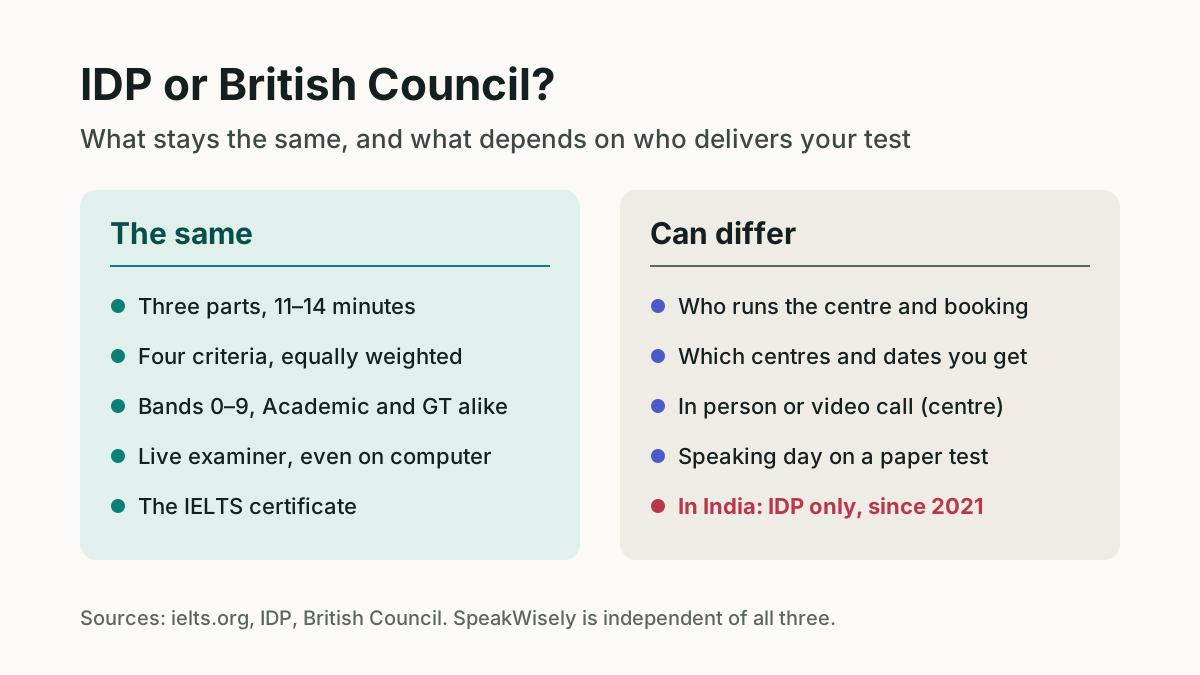
The IELTS Speaking test is the same test whether IDP or the British Council delivers it: the same three parts, the same 11 to 14 minutes, the same four marking criteria and the same certificate. What differs is the organisation that runs your test centre and takes your booking. In India the question does not arise any more: IDP has delivered all IELTS tests in India since 2021, after the British Council sold its Indian IELTS business to IDP.
This guide sets out what is identical, what genuinely varies from centre to centre, how paper and computer delivery affect Speaking, what IELTS One Skill Retake is, and how to book in India.
Is the Speaking test different with IDP and the British Council?
No. IELTS is one test owned jointly by the British Council, IDP and Cambridge University Press & Assessment, and both delivery organisations run that same test. Outside India, both IDP and the British Council deliver IELTS, and the test, the scoring and the certificate are the same whichever one delivers yours.
For Speaking, that means the format below applies everywhere. If you want the full walk-through, read our guide to the IELTS Speaking test format, part by part.
- Part 1, 4 to 5 minutes: short questions about you, your home, work or studies and everyday topics.
- Part 2, 3 to 4 minutes: a task card, one minute to prepare with pencil and paper, up to two minutes of speaking, then perhaps one or two short questions.
- Part 3, 4 to 5 minutes: a discussion of wider ideas linked to your Part 2 topic.
- Recorded, with a real examiner: the test is recorded, and a certificated IELTS examiner talks with you and assesses you throughout.
- Same for Academic and General Training: both versions of IELTS use the same Speaking test and criteria.
Is marking stricter at IDP or at the British Council?
This is the question people ask most, and the official answer is that there is one marking scheme. Every Speaking test is rated on four criteria that count equally: fluency and coherence, lexical resource, grammatical range and accuracy and pronunciation, on a band scale from 0 to 9. Nothing in IDP or British Council information describes a different scale, different criteria or different weighting for either organisation.
Stories about one being "easier" usually come from comparing two people, or two test days, rather than two organisations. Your band depends on how you speak on the day. If you want to know what moves a band up, the four criteria are explained in plain English in our guide to the IELTS Speaking band descriptors.
So what actually differs?
The differences are practical, not academic. They affect how you book and where you sit the test, never what the examiner asks or how you are marked.
- Who runs the centre and the booking. You book, pay, reschedule and get support through the delivering organisation’s own website and staff.
- Which centres and dates are near you. Each organisation has its own network of centres, so the dates and cities on offer are different.
- Face to face or video call. At some centres the Speaking examiner joins you by video call instead of sitting in the room. IDP says both versions have the same content, timing and marking. The centre decides which you get, not you.
- When Speaking happens. On a computer-delivered test, IDP says Speaking is on the same day as the other sections. On a paper test it can be the same day or up to about a week before or after, depending on the centre.
Who runs IELTS in India: IDP or the British Council?
IDP. On 1 July 2021 the British Council announced that it was selling its IELTS business in India to IDP, and since then IDP has delivered all IELTS tests in India. If you are taking the test in India, there is no British Council option to compare: every centre, every booking and every Speaking test in the country runs through IDP.
That is worth knowing if you read older blog posts or forum threads. Advice from before 2021 that compares Indian British Council and IDP centres describes a choice that no longer exists. Outside India, both organisations still deliver IELTS.
Does the Speaking test change on paper or on computer?
No. On IELTS on Computer, Listening, Reading and Writing move to a screen, but Speaking is still a live conversation with an examiner. You do not talk to a computer, and you do not record answers into a microphone on your own. The questions, the timing and the marking are the same as on a paper test.
What can change is the day. IDP says that on a computer-delivered test, Speaking is on the same day as the other sections. If you are sitting a paper test, check your booking confirmation for the Speaking date and time, because it may be up to about a week before or after the written sections.
What if my Speaking test is by video call?
Video-call Speaking is not a test from home. IDP India describes it this way: you go to an IELTS test centre, a staff member takes you to the Speaking room, and a certified examiner based at another test centre talks with you over a live video call. IDP says it is the same as the in-person test in content, scoring, timing and question format. The centre decides the format, so you cannot request one or the other.
If you are nervous about talking to a screen, practise exactly that. Answer questions out loud to a laptop, look at the camera rather than your notes, and get used to keeping going when there is no nodding or eye contact to reassure you.
Whoever delivers your test, the examiner asks the same kind of questions. Practise them out loud with Clara, an AI examiner who runs all three parts in about fifteen minutes and gives you an estimated band with your mistakes quoted.
Practise a Speaking mock with ClaraWhat is IELTS One Skill Retake, and does it include Speaking?
IELTS One Skill Retake lets you retake one section of the test instead of all four. According to ielts.org, you can use it if you took a full IELTS on Computer test at a centre that offers it, and you sit the retake within 60 days of that test. You can retake any one section, Speaking included, and only once for each full test.
In India, IDP has introduced One Skill Retake at selected IELTS on Computer centres. It is not available after a paper-based test, and not every centre offers it.
A retake is still a full Speaking test, with all three parts and the same marking. If Speaking is the section holding you back, the 60 days are best spent fixing the specific problems in your answers, not repeating the same practice. Start with the part that hurt most: planning a Part 2 cue card in one minute is the usual weak spot.
How do you book the IELTS Speaking test in India?
You book the whole IELTS test, not Speaking on its own, through IDP. IDP’s official India site is IDP IELTS India; IDP’s global address for India, ielts.idp.com/india, redirects there. On the booking form you choose:
- The test type: IELTS Academic or IELTS General Training. Your university, employer or visa route tells you which one you need.
- The format: IELTS on Computer, or IELTS (Writing on Paper) as IDP India labels the paper test. Speaking is with a live examiner either way.
- Your city and a test date. Your confirmation then gives the date and time of your Speaking test.
Because fees, centres and dates change, take them from IDP’s site at the time you book rather than from a blog post, this one included. Make sure the page you pay on is IDP’s own.
How should you prepare, whoever runs your test?
- Practise out loud. Speaking is a physical skill. Answers you have only thought through come out slower and with more pauses.
- Cover all three parts. Part 1 needs short natural answers, Part 2 needs two minutes on one topic, and Part 3 needs opinions with reasons. Our list of common IELTS Speaking Part 1 questions is a good place to start.
- Record yourself. Listen for long pauses, "um" and repeated words. They are much easier to hear on a recording.
- Sit at least one full mock. Doing all three parts in order, without stopping, is a different experience from practising them one at a time.
SpeakWisely runs a full spoken IELTS Speaking mock with Clara and gives you an estimated band on the four criteria. It is a practice estimate, not an official result, and how SpeakWisely estimates your band explains exactly how it is worked out and where its limits are.
Common questions about IDP and the British Council
Is the IELTS Speaking test easier with IDP?
No. IDP and the British Council deliver the same IELTS test, marked on the same four criteria on the same 0 to 9 band scale. Your band depends on how you speak, not on which organisation runs the centre.
Can I take IELTS with the British Council in India?
No. The British Council sold its IELTS business in India to IDP, announced in July 2021, and since then IDP has delivered all IELTS tests in India.
Is an IDP IELTS certificate different from a British Council one?
No. The test, the scoring and the certificate are the same whichever organisation delivers it. Always check the band your university, employer or visa route asks for.
Can I choose a face-to-face Speaking test instead of a video call?
No. The format depends on the test centre, not on the candidate. IDP says both versions have the same content, timing and marking.
Is SpeakWisely part of IDP or the British Council?
No. SpeakWisely is an independent practice tool with no connection to either organisation. Its bands are AI estimates for practice, not official IELTS results.
AI-estimated assessment inspired by IELTS speaking criteria. Not an official IELTS or IDP result.
Your recording is processed and then deleted. It is never stored — only your transcript and results are kept.
Sources
- IELTS Academic Speaking test format (ielts.org)
- IELTS Speaking test content and assessment criteria (IDP)
- IELTS Speaking: test day and format (IDP)
- IELTS Speaking preparation: same criteria for Academic and General Training (IELTS Australia)
- British Council: IDP to acquire British Council IELTS business in India (July 2021)
- IELTS Video Call Speaking test (IDP IELTS India)
- IELTS One Skill Retake: eligibility (ielts.org)
- IELTS One Skill Retake launches in India (IDP)
- IDP IELTS India: booking and One Skill Retake
Keep reading
- IELTS Speaking test format: Parts 1, 2 and 3 explained
Eleven to fourteen minutes, three parts, one examiner. What happens in each part, how long you speak, and what to practise for each.
- IELTS Speaking band descriptors in plain English: what band 6, 7 and 8 actually sound like
Fluency, vocabulary, grammar and pronunciation at bands 6, 7 and 8, in everyday words, with example answers that make the difference easy to hear.
- How SpeakWisely estimates your IELTS Speaking band (and its limits)
Your speech is measured, the AI finds quoted evidence, and a fixed rubric with no AI in it sets the band. Here is every step, and what an estimate cannot tell you.