English conversation practice: 49 everyday questions to answer out loud
By the SpeakWisely team · Published · 7 min read
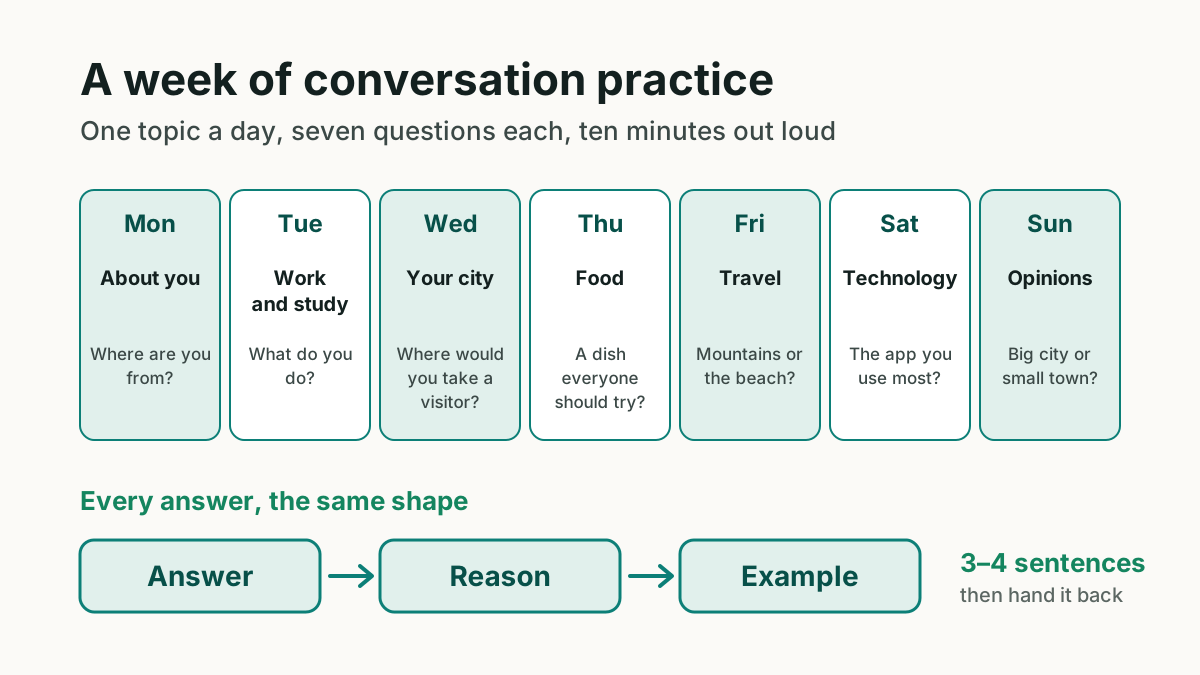
The best way to practise English conversation is to answer real, everyday questions out loud, every day, using a simple shape: give your answer, add a reason, then one example from your own life. Below are 49 English conversation questions in seven topics, sample answers you can adapt, and a 7-day routine that takes ten minutes a day.
These are the questions people actually ask: at a new job, on a video call with a colleague abroad, in an interview waiting room or at a cousin’s wedding when someone’s friend from London asks what you do. If you can answer them calmly, you can hold a conversation.
How should you answer English conversation questions?
One-word answers stop a conversation; five-minute answers exhaust it. Aim for three or four sentences, built like this:
- Answer: reply to the question directly in the first sentence.
- Reason: say why, in one sentence.
- Example: add one concrete detail: a name, a place, a time, a number.
- (Optional) Hand it back: in a real conversation, ask the other person something: "What about you?"
- Question
- Do you like cooking?
- Weak
- Yes.
- Better
- Yes, but only on weekends. During the week I'm too tired after the commute. On Sundays I make rajma chawal for the whole family, and it's the one dish everyone agrees on. Do you cook?
Questions about you
- Where are you from, and what is it known for?
- How would your friends describe you?
- What do you usually do on a weekday evening?
- What is something you are good at?
- What did you want to be when you were a child?
- How do you like to relax after a long day?
- What is a habit you are trying to build this year?
- Sample
- I'm from Surat, which is famous for diamonds, textiles and very good street food. I moved to Mumbai for work three years ago, but I still go back for Diwali every year.
Questions about work and study
- What do you do, and what does a normal day look like?
- What do you enjoy most about your job or course?
- What is the hardest part of your work?
- Why did you choose your field?
- Would you rather work from home or in an office? Why?
- What is one skill you would like to learn for your career?
- Tell me about a project you are proud of.
- Sample
- I work in customer support for a software company in Hyderabad. The best part is solving a problem on the first call, because the customer is relieved and so am I. The hardest part is night shifts when we support clients in the US.
Work questions are where conversation practice meets interview practice. Once these feel easy, try the longer version: how to answer "Tell me about yourself" in a job interview.
Questions about your city and home
- Describe the area where you live.
- What is the best time of year to visit your city?
- How do you usually travel around your city?
- What would you change about your city if you could?
- Is your city a good place for young people? Why or why not?
- Where would you take a visitor on their first day?
- How has your neighbourhood changed in the last few years?
- Sample
- I'd take them to the old city in Ahmedabad first, especially the pol houses, because you see how people lived together for centuries. Then dinner at Manek Chowk, which turns from a market into a food street at night.
Questions about food
- What did you eat for breakfast today?
- What is a dish from your region that everyone should try?
- Do you prefer eating at home or eating out?
- What is the best meal you have ever had?
- Is there a food you disliked as a child but like now?
- How often do you order food online?
- Do you think people eat more healthily now than ten years ago?
Questions about travel
- Where did you go on your last trip?
- Do you prefer the mountains or the beach?
- What is the longest journey you have ever taken?
- Do you like to plan a trip in detail or decide as you go?
- Which place in India would you most like to visit next?
- What do you always pack when you travel?
- Is it better to travel alone or with friends?
- Sample
- I prefer the mountains. Beaches are lovely, but I can't take the heat for long. Last year I went to Manali with two college friends, and walking in cold air with chai every two hours was exactly what I needed.
Questions about technology
- Which app do you use the most, and why?
- How much time do you spend on your phone each day?
- Has technology made your work easier or harder?
- Do you prefer reading on paper or on a screen?
- What is one gadget you could not live without?
- Should children have smartphones? At what age?
- Have you used AI tools? What for?
Opinion questions for deeper conversation
These are harder because there is no right answer. That is exactly why they are good practice: you have to give a view, a reason and an example without preparing. They are also close to the discussion questions in IELTS Speaking Part 3.
- Is it better to live in a big city or a small town?
- Should everyone learn to cook?
- Is social media good or bad for friendships?
- Should public transport be free?
- Is it more important to enjoy your job or to earn well?
- Do people today have less free time than their parents did?
- Should English be taught from the first year of school?
- Question
- Is it better to live in a big city or a small town?
- Sample
- For me, a big city is better in your twenties and a small town later. Cities like Bengaluru have far more jobs and people to learn from. But my parents moved back to Nashik after retiring, and they say the slower pace and cleaner air were worth it. So it depends on the stage of life you're in.
How do you practise English conversation every day?
One topic a day, ten minutes, your phone’s voice recorder. Short and regular beats long and occasional.
- Monday, about you. Answer three questions from the first list. Record and listen to one.
- Tuesday, work and study. Answer three, and add a question back to the listener at the end of each.
- Wednesday, your city. Describe your area for a full minute without stopping. Pause instead of saying "um".
- Thursday, food. Answer three, and include one detail in each: a dish, a place, a person.
- Friday, travel. Use past tenses carefully: "I went", "we stayed", "it was". Listen back for slips.
- Saturday, technology. Answer, then argue the opposite side for 30 seconds.
- Sunday, opinions. Pick two opinion questions you have never seen and answer with no preparation.
Then start the week again with new questions from each list. After two weeks, go back to Monday’s first recording and compare. Practising alone is fine; our guide to practising English speaking alone has ways to make it feel more like a real conversation.
Want a partner who replies? SpeakWisely’s Daily coach gives you one short speaking task a day and a follow-up question about what you said, and Role-play lets you have the whole conversation with a partner whose level moves with you.
Start a free conversationHow can you sound more natural in English conversation?
- Use contractions. "I'm", "it's", "didn't" sound natural; "I am not able to" in every sentence sounds stiff.
- React before you answer. "Oh, good question." "Hmm, that's hard." It sounds human and buys a second.
- Keep your tenses steady. Past events stay in the past tense; our guide to English tenses for speaking covers the ones you really need.
- Think in chunks, not words. Learn phrases such as "to be honest", "the thing is", "as far as I know" as single units.
- Keep it short and clear. Saying less, with a clear point, is what we mean by speaking wisely.
Common questions about conversation practice
How can I practise English conversation without a partner?
Answer questions out loud and record yourself. Listen back for one thing at a time: fillers, tense slips or whether your point came first. An AI speaking coach can also ask follow-up questions about what you said, which is the closest thing to a real partner.
How long should my answers be?
For everyday conversation, three or four sentences: an answer, a reason and an example. That is long enough to be interesting and short enough to let the other person speak.
What are good English speaking topics for beginners?
Start with yourself, your daily routine, your city and food. You already know the facts, so all your attention can go on the English. Move on to opinion questions once those feel easy.
How many minutes a day should I practise speaking?
Ten minutes every day works better than an hour once a week. The habit of speaking without preparation builds through frequent, short practice.
Should I translate from Hindi or Gujarati in my head?
At first that is normal. Over time, try to think in short English chunks instead. Practising the same everyday topics repeatedly helps, because the phrases start coming as whole pieces.
Your recording is used only to transcribe your answer, then deleted within 15 minutes. We keep your transcript and results, never the audio.
Keep reading
- How to speak wisely: 7 habits of clear, confident speakers
Speaking wisely is not about big words. It is choosing one clear point, saying it simply, pausing on purpose and listening before you answer.
- How to practise speaking English alone, with nothing but your phone
No partner needed: a six-step, 15-minute routine for speaking English alone at home, with 30 topics to talk about and a simple way to measure progress.
- IELTS Speaking Part 1: common questions with natural sample answers
Typical Part 1 questions on familiar topics, natural two-to-four-sentence answers, and the simple formula that keeps every answer the right length.