IELTS Speaking test format: Parts 1, 2 and 3 explained
By the SpeakWisely team · Published · 6 min read
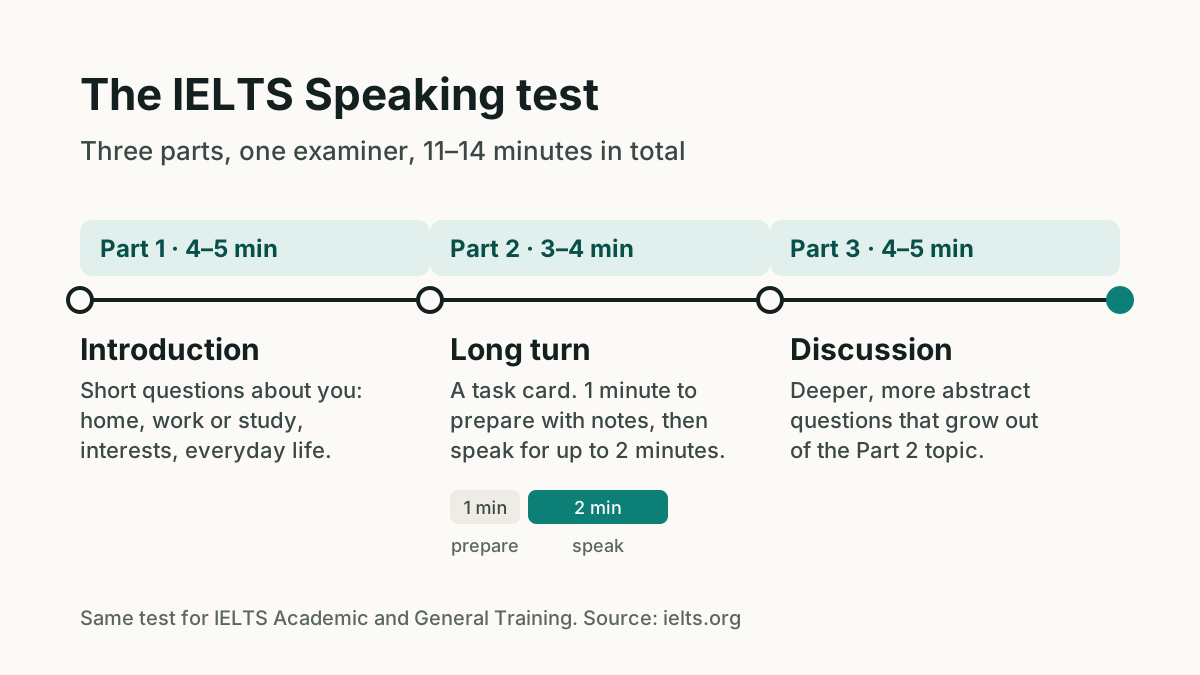
The IELTS Speaking test is a conversation with a trained examiner that lasts 11 to 14 minutes and has three parts: a short interview about you, a two-minute talk on a topic from a task card, and a deeper discussion that grows out of that topic. It is the same test whether you take IELTS Academic or General Training, and it is marked on four criteria: fluency and coherence, lexical resource, grammatical range and accuracy, and pronunciation.
This guide walks through each part in order: what the examiner asks, how long you speak, what catches people out, and how to practise it out loud rather than on paper.
How long is the IELTS Speaking test?
The whole test takes 11 to 14 minutes. Part 1 lasts 4 to 5 minutes, Part 2 lasts 3 to 4 minutes including your preparation time, and Part 3 lasts 4 to 5 minutes. The examiner keeps time, so you never need to watch the clock; your job is to keep talking naturally until you are moved on.
The test is recorded. You speak with a real examiner, either face to face or, at some test centres, by video call. IDP says both versions have the same content, timing and marking, and which one you get depends on the centre, not on you.
Part 1: introduction and interview (4–5 minutes)
The examiner introduces themselves, checks your identity and then asks general questions on familiar topics: your home, family, work or studies, and interests such as music, food or how you spend weekends. The questions are short and so are good answers: two to four sentences, not a single word and not a speech.
- Examiner
- Do you work or are you a student?
- Too short
- I am a student.
- Better
- I'm a student. I'm in the final year of a commerce degree in Ahmedabad, and I'm hoping to do a master's abroad next year.
Part 1 rewards answers that sound like conversation: answer the question directly, add a reason or a detail, then stop. Memorised answers tend to sound flat and examiners notice them. For practice questions and natural sample answers, see IELTS Speaking Part 1 common questions.
Part 2: the long turn (3–4 minutes)
The examiner gives you a task card with a topic and three or four prompts, such as "Describe a place you visited that you would like to go back to. You should say: where it is, when you went there, what you did there, and explain why you would like to return."
- One minute to prepare. You get pencil and paper for notes. Write keywords, not sentences.
- Up to two minutes to speak. Keep going until the examiner stops you. Running out after 50 seconds is the most common problem in Part 2.
- One or two follow-up questions. The examiner may ask something short about what you said before moving on.
The prompts on the card are there to help you, not a checklist you lose marks for. Use them to plan an order: set the scene, tell what happened, then explain why it mattered to you. That last prompt usually gives you the most to say. Our step-by-step guide to planning a cue card in one minute shows a full worked example.
The fastest way to get used to speaking for two minutes is to do it. Clara hands you a task card, gives you a minute with space for notes, and times your talk exactly like the test.
Try a Part 2 cue card with ClaraPart 3: discussion (4–5 minutes)
Part 3 links back to your Part 2 topic but moves away from your own experience into wider ideas. If you described a place you would like to revisit, Part 3 might ask why people travel more than they used to, or whether tourism does more good than harm to a city.
Answers here are longer than in Part 1: give an opinion, explain it, and support it with an example or a comparison. It is fine to think aloud and to say that an issue has two sides, as long as you say what they are.
- Examiner
- Why do you think people travel more than in the past?
- Answer
- I think the main reason is cost. Flights within India have become much cheaper, so a trip that my parents would have planned for years is now a long weekend. Social media plays a part too, because people see a place online and want to go there themselves.
How is the Speaking test marked?
The examiner rates your speaking on four criteria, which count equally towards your Speaking band:
- Fluency and coherence: how smoothly you keep going and how easy your ideas are to follow.
- Lexical resource: the range and accuracy of your vocabulary, including how you get around a word you do not know.
- Grammatical range and accuracy: whether you use a mix of sentence structures, and how often they are correct.
- Pronunciation: how easy you are to understand. Having an accent is not a problem; being unclear is.
Bands run from 0 to 9. What each band sounds like in practice is the subject of our guide to the IELTS Speaking band descriptors in plain English.
How should you practise each part?
- Practise out loud, never only in your head. Fluency is a physical skill. Answers you have only thought about come out slower and with more pauses.
- Record yourself and listen back. Count the "um"s and the long pauses. They are easier to hear on a recording than while speaking.
- Time your Part 2. Use a real one-minute timer for notes and a two-minute timer for speaking until two minutes feels normal.
- Practise Part 3 with "why" questions. For any topic, ask yourself why, and answer with a reason and an example.
- Sit a full mock before test day. Doing all three parts in one go, in order, is a different experience from practising them separately.
SpeakWisely runs a full spoken IELTS speaking mock with Clara, an AI examiner, in about fifteen minutes, and ends with an estimated band on the four criteria and a list of what to fix. You can also practise a single part when you are short on time.
Common questions about the Speaking test
Is the Speaking test the same for Academic and General Training?
Yes. Both versions of IELTS use the same Speaking test, with the same three parts and the same marking criteria.
Can I ask the examiner to repeat a question?
Yes. Asking for a question to be repeated is normal, especially in Part 1. It is better to ask than to answer a question you did not understand.
Is the Speaking test on the same day as the other sections?
It depends on the test centre. On a paper test it can be the same day or up to about a week before or after the other sections; IDP says that on a computer-delivered test it is the same day. Your booking confirmation gives the exact date and time.
Does IDP or British Council run a different Speaking test?
No. The test is the same whoever delivers it. In India, IDP has delivered all IELTS tests since 2021. Read more in IDP vs British Council IELTS Speaking.
AI-estimated assessment inspired by IELTS speaking criteria. Not an official IELTS or IDP result.
Your recording is processed and then deleted. It is never stored — only your transcript and results are kept.
Sources
- IELTS Academic Speaking test format (ielts.org)
- IELTS Speaking test content and assessment criteria (IDP)
- IELTS Speaking: test day and format (IDP)
- IELTS Speaking preparation: same criteria for Academic and General Training (IELTS Australia)
- British Council: IDP to acquire British Council IELTS business in India (July 2021)
Keep reading
- IELTS Speaking Part 2 cue cards: how to plan in one minute and speak for two
A note layout that fits in the one-minute preparation, a full worked cue card with a two-minute model answer, and what to do when you run dry.
- IELTS Speaking band descriptors in plain English: what band 6, 7 and 8 actually sound like
Fluency, vocabulary, grammar and pronunciation at bands 6, 7 and 8, in everyday words, with example answers that make the difference easy to hear.
- IELTS Speaking Part 1: common questions with natural sample answers
Typical Part 1 questions on familiar topics, natural two-to-four-sentence answers, and the simple formula that keeps every answer the right length.