How long does it take to learn English? An honest answer in hours
By the SpeakWisely team · Published · 7 min read

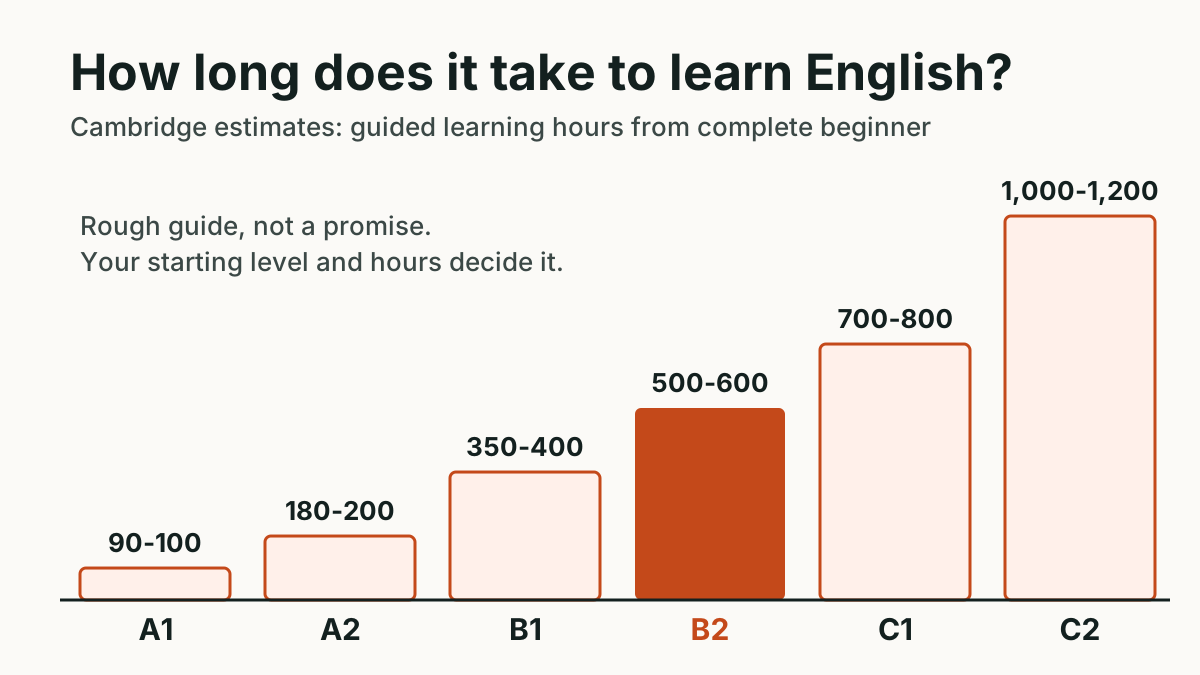
From complete beginner, Cambridge estimates about 350 to 400 guided learning hours to reach B1, 500 to 600 to reach B2, and 700 to 800 to reach C1. At an hour a day, every day, B2 works out at roughly a year and a half. These are rough planning figures, not promises, and if you studied English at school you are not starting from zero. Learning English in 30 days is not realistic; a useful improvement in 30 days or 3 months is.
It does depend on you, but we can do better than "it depends". This guide gives the published numbers, turns them into months, and answers the 30-day and 3-month questions directly.
How many hours does it take to learn English?
A useful set of numbers comes from Cambridge. An introductory guide published by Cambridge University Press in 2013 gives Cambridge English Language Assessment's estimates. "Guided learning hours" means time in lessons plus the tasks a teacher sets you. Read them as running totals from complete beginner:
- A1: about 90 to 100 hours. Can communicate in basic English with help from the listener.
- A2: about 180 to 200 hours. Can communicate within a limited range of contexts.
- B1: about 350 to 400 hours. Can communicate essential points and ideas in familiar contexts.
- B2: about 500 to 600 hours. Can use English effectively, with some fluency, in a range of contexts.
- C1: about 700 to 800 hours. Able to use English fluently and flexibly in a wide range of contexts.
- C2: about 1,000 to 1,200 hours. Highly proficient: can use English very fluently, precisely and sensitively in most contexts.
A 2018 Cambridge University Press paper gives a similar picture with wider ranges, for example 530 to 750 hours to B2, for adults whose first language uses the same script as English, with good motivation, resources and teachers. It gives higher figures for less favourable situations, and it is open about the limits: its examples are based on experience and expert views and "have not been validated through empirical research". Treat all of these as careful estimates, not measurements of you.
How long is that in months?
Here is our own arithmetic using the figures above, starting from zero and assuming you really study every day. Real life has exams, weddings and illness, so expect it to take longer.
- 30 minutes a day: B1 in about 2 years; B2 in about 3 years.
- 1 hour a day: B1 in about a year; B2 in about 16 to 20 months.
- 2 hours a day: B1 in about 6 months; B2 in about 8 to 10 months.
If you are already part-way, use the 2018 paper's level-to-level ranges for adults in good conditions: about 160 to 240 hours from A2 to B1, 180 to 260 from B1 to B2, and 200 to 300 from B2 to C1. At an hour a day, that is very roughly five to ten months per level. Higher levels take more hours, and the paper describes a familiar plateau at intermediate level.
How long does it take to learn English fluently?
It depends on what you mean by fluent, so define it first. The CEFR describes B2 as interacting "with a degree of fluency and spontaneity that makes regular interaction with native speakers quite possible without strain for either party", and C1 as expressing yourself "fluently and spontaneously without much obvious searching for expressions". For most working situations, B2 is a sensible target. On the figures above, that means about 500 to 600 hours from zero, or a few hundred if you already have a base.
Check it against your actual goal. UK rules, for example, ask for CEFR B2 for a Student visa at degree level and above, and B1 below degree level. On IELTS, ielts.org treats an overall 5.5 to 6.5 as equivalent to B2 and 7 to 8 as C1, while noting that there is no one-to-one match between tests and levels. Rules change, so always confirm on the official page. For the bigger picture on work and study, see why English is important.
Can I learn English in 30 days?
No, not if "learn English" means speaking it comfortably from a low starting point. An hour a day for 30 days is 30 hours, about a third of the 90 to 100 hours estimated for A1 alone. Be careful with any course that promises fluency in a month. The 2018 Cambridge University Press paper looks at claims of accelerated learning and concludes that substantially more research is needed before reduced timelines can be used as advice.
What 30 days can do is still worth having. If you already know some English:
- You can get noticeably smoother at talking about topics you have practised.
- You can prepare well for one specific event, such as an interview or a presentation.
- You can build a daily speaking habit and find out which mistakes you repeat.
If you are a complete beginner, 30 days can give you greetings, simple questions and basic facts about yourself. Our 30-day routine in the guide to speaking fluently shows how to spend the month.
Can I learn English in 3 months?
You can make real progress in 3 months, but you will probably not go from zero to fluent. Ninety days at an hour a day is about 90 hours, which is close to the A1 estimate. At two hours a day it is about 180 hours, close to the A2 estimate from zero, or the lower end of the 160 to 240 hours estimated from A2 to B1. So one level in three months is possible for a learner who is already part-way and studies seriously every day. It is at the fast end, not the typical case.
Even full-time study takes time. The 2018 paper cites research by Elder and O'Loughlin (2003) on students in intensive English courses in Australia and New Zealand: full-time learners in an English-rich setting generally moved up about half an IELTS band after 10 to 12 weeks, or 200 to 240 hours of instruction. That is one older study of a particular group, but it is a helpful reality check if you are planning around a test date.
- Instead of
- I will learn English in 3 months.
- Try
- In 3 months, I will be able to explain my job clearly for two minutes.
- Instead of
- I will become fluent by March.
- Try
- By March, I will have had one real English conversation every week.
What makes learning English faster or slower?
The 2018 paper lists many factors. These are the ones worth planning around:
- Regularity. The paper notes that programmes with just two hours a week, little self-study and long breaks are less effective than more intensive ones.
- Practice outside lessons. It says that learners who do significant extra self-study should progress faster.
- A clear goal. Learners with a clear picture of themselves using the language are likely to learn faster than those without one.
- Your beliefs. A belief like "I need to be accurate before I say anything" can slow you down. If that sounds familiar, read our guide to the fear of speaking English.
- Your first language and schooling. Greater distance between languages makes the task harder, especially early on, and previous education also matters. You cannot change these, but they explain why comparing yourself with a friend is rarely fair.
If speaking is your weak skill, your hours need to be spoken. SpeakWisely gives you one short speaking task a day, feedback on your own words and a way to see your progress over time.
Start practising freeQuestions about how long it takes to learn English
How long does it take to learn English from scratch?
How long does it take to become fluent in English?
Can I learn English in 30 days?
Can I learn English in 3 months?
Pick your target level, work out your weekly hours, and then stop counting and start speaking. Our guide to speaking English fluently shows how to spend those hours. If you are preparing for a test, try the IELTS speaking practice page.
Your recording is used only to transcribe your answer, then deleted within 15 minutes. We keep your transcript and results, never the audio.
Sources
Keep reading
 Spoken English10 min read
How to speak English fluently: 7 steps and an honest 30-day routine
Fluency is using what you already know, smoothly and out loud. Here are seven steps, a four-week routine, and a straight answer on what 30 days can and cannot do.
 Spoken English7 min read
How to practise speaking English alone, with nothing but your phone
No partner needed: a six-step, 15-minute routine for speaking English alone at home, with 30 topics to talk about and a simple way to measure progress.
 Spoken English7 min read
Fear of speaking English: why it happens and how to speak without it
Freezing when you have to speak English is common and has been studied for decades. Here is why it happens, and a ladder of small steps for speaking with less fear.
 English and careers9 min read
Why English is important: what it really opens up, and where it stops helping
English widens your options at work, in education, online and abroad. Here is the evidence, what it is worth in India, and where it stops helping.