Remote jobs for English speakers: what is real, and how to apply from India
By the SpeakWisely team · Published · 6 min read

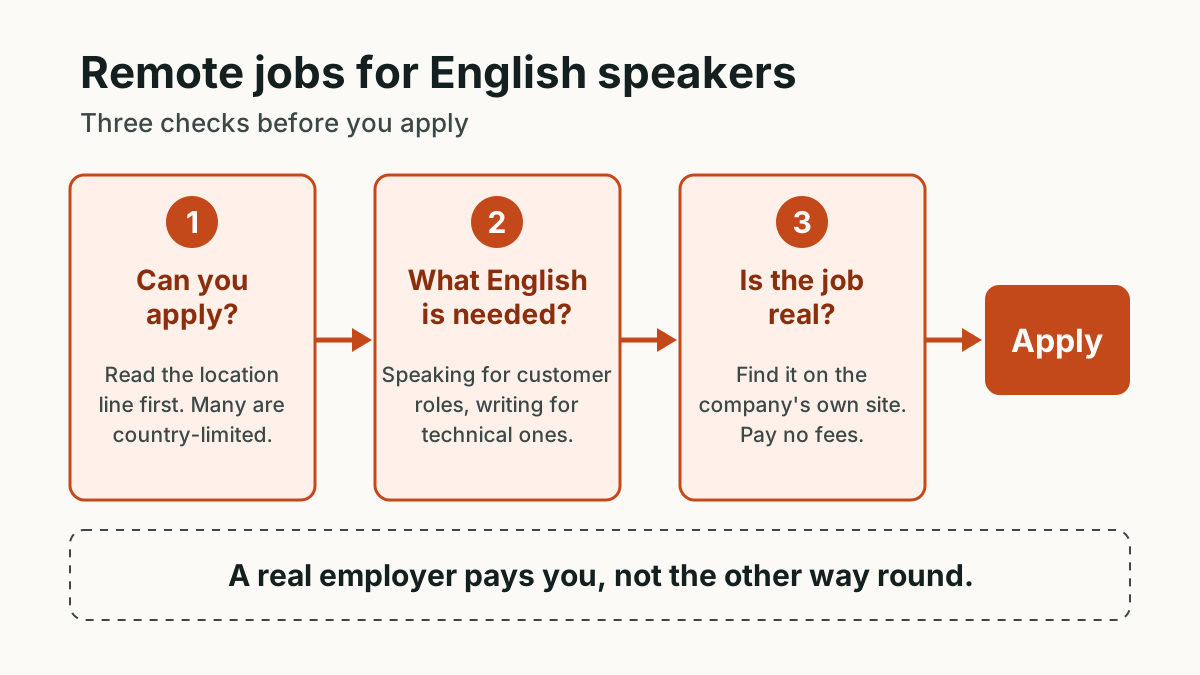
Yes, remote jobs for English speakers exist and you can apply for many of them from India, but a job being remote does not mean it is open worldwide, and no-experience roles are limited. Check three things before you apply: whether the employer accepts people in India, what English the work really needs, and whether the job is real. Good English helps you get through the door, but employers still hire for a job skill.
This guide gives you the honest picture, including what a real job board showed when we checked, and the lines worth practising for a remote interview.
How common are remote jobs now?
Less common than social media suggests, particularly in Asia. A Stanford-linked survey of 16,422 graduate workers in 40 countries, carried out from November 2024 to February 2025, found that across a panel of 22 countries, people worked from home an average of 1.27 days a week. English-speaking countries averaged about 1.5 to 2 days, while Asian countries were lowest at 0.5 to 1 day. The report gives no separate rate for India and notes that its Indian sample was smaller.
Fully remote work is more common in some fields. In Stack Overflow’s 2025 Developer Survey, 32.4% of respondents worked remotely. That is a survey of people who chose to answer, mostly software developers, so it does not describe the wider job market.
Can you apply from India to any remote job?
No. Many companies only hire in countries where they can pay and employ people legally, or where the work must be done within local time zones. On 3 November 2026 we looked at the first 20 listings in the customer support category of We Work Remotely, a remote job board. Ten were marked as open worldwide. Six were limited to certain places, such as the USA, North America or a list of mostly European countries. Four did not say.
That is one page on one day, not a statistic about the market, but it shows why you should read the location line first. Some "worldwide" roles there were also senior, such as a Senior Channel Account Manager. Also look for phrases such as "must have US work authorisation", "EU only" and overlap with specific time zones.
Which remote jobs need good spoken English?
The roles that rely most on spoken English are the ones where you talk to customers or clients all day. Those listings on We Work Remotely included customer service, technical support, account management, customer onboarding and business development. Others you will see elsewhere include online tutoring, recruiting and sales calls.
Other remote roles, such as software, design and data work, usually need less speaking but more writing, because teams spread across time zones rely on messages and documents. In those jobs, clear written English can count for more than your accent. Either way, there is no universal level. Each employer decides, and most judge it from your application and your interview.
Are there remote English-speaking jobs with no experience?
Some, but be realistic. Among the listings we checked, a few were marked entry-level or junior, such as an Entry-Level Account Manager and a CRM Retention Junior, but most asked for some experience. Beginner roles tend to attract many applicants, and a remote employer has less opportunity to train you closely.
A more dependable route is often to build experience first, then move to remote work:
- Take a customer-facing job in India. A support or sales role, including BPO and call centre work, gives you real experience of talking to customers in English.
- Learn the tools. Several of the listings we looked at named CRM software. Free courses from some software makers can help you speak about it with confidence.
- Build proof. Keep a record of what you achieved, such as customers handled or problems solved, using honest numbers.
- Apply widely but carefully. Filter by region, tailor your first few lines to each role and keep a list of who you contacted.
How do you spot a fake remote job?
Remote job scams target exactly the people searching for this, so treat this as seriously as the application itself. The basic rule is that a real employer pays you, not the other way round. Common warning signs, drawn from reports and advisories in India, include:
- A message out of nowhere. In 2021, Mumbai Police described job offers arriving with a link, leading to a WhatsApp chat and then a page asking for registration and payment, sometimes moving on to Telegram and investment schemes.
- Fees before you start. A 2024 Telangana Today report lists registration fees, processing fees, training costs and software purchases as common requests.
- Easy money for simple tasks. Offers to pay you for liking social media posts can be followed by pressure to invest, as in a case the same report describes.
- Requests for personal data. Some fake listings collect your details, then disappear.
The Press Information Bureau’s 2022 advice is still sound: do not click unconfirmed links, be careful about payments to people you do not know, and report and block suspicious numbers. Complaints can be filed at cybercrime.gov.in. Before you trust an offer, find the same job on the company’s own website and check that the email address matches its domain.
How do you prepare for a remote job interview in English?
A video interview tests your internet connection and your ability to manage a conversation when you cannot rely on body language. Have your introduction ready, plan how you will handle a bad line, and show you understand remote work. These lines are worth saying aloud a few times:
- Bad connection
- Sorry, you cut out for a moment. Could you repeat the last part?
- Time zones
- I am in India, so I can overlap with your team until about two in the afternoon, New York time.
- Working alone
- When I get stuck, I try for a while, write down what I tried, and then ask a clear question.
- Your question
- How does the team usually share updates: on calls, or mostly in writing?
For more on the first few minutes, read how to answer "Tell me about yourself", and if you tend to fill silences, try our guide on how to stop saying "um" and "like".
SpeakWisely runs in your browser, so you can rehearse an interview out loud with Role-play or Event prep and see notes on your pace, pauses, fillers and grammar.
Start practising freeCommon questions about remote jobs for English speakers
What remote jobs can I do if I speak English well?
Can I get a remote job with no experience?
Are remote jobs open to people in India?
How can I tell if a work from home job is fake?
What level of English do I need for a remote job?
Remote work can be a good option, but it rewards patience and care more than speed. If you are also weighing up a move overseas, read our guide to English-speaking jobs abroad.
Your recording is used only to transcribe your answer, then deleted within 15 minutes. We keep your transcript and results, never the audio.
Sources
- Working from Home in 2025: Five Key Facts (Stanford Institute for Economic Policy Research)
- 2025 Developer Survey (Stack Overflow)
- Remote customer support jobs (We Work Remotely)
- Mumbai Police job fraud advisory (Free Press Journal, December 2021)
- Surge in remote work scams puts job seekers at risk of online fraud (Telangana Today, January 2024)
- PIB safety advice on online job scams (Prag News, October 2022)
Keep reading
 English and careers7 min read
English for BPO and call centre jobs: the test, the interview and real call phrases
BPO employers want to know you can be understood on the phone, follow fast speech and stay polite. Here is what they test and how to practise it at home.
 English and careers7 min read
English-speaking jobs abroad: Germany, the Netherlands, Ireland, the UK and Japan
English can get you a skilled job abroad, but how far it goes varies by country. Here are the official visa rules and what employers still expect.
 Spoken English8 min read
12 common job interview questions and answers in English
Every interviewer asks some version of the same dozen questions. Here is what each one is testing, a sample answer for freshers and professionals, and how to rehearse out loud.
 Spoken English8 min read
How to answer "Tell me about yourself" in an English interview
Present, past, future, in about a minute. A structure for the first interview question, three sample answers, and the phrases that weaken an answer.