IELTS Speaking band descriptors in plain English: what band 6, 7 and 8 actually sound like
By the SpeakWisely team · Published · 9 min read
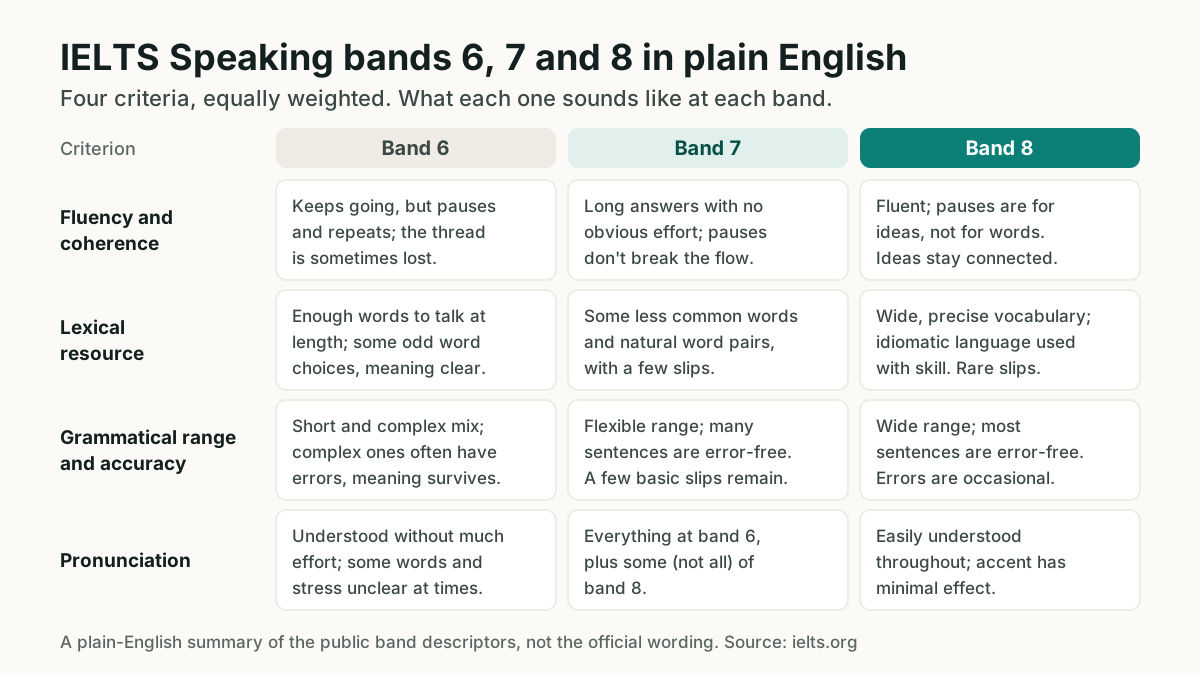
The IELTS Speaking band descriptors are the published table examiners use to mark your speaking on four equally weighted criteria: fluency and coherence, lexical resource, grammatical range and accuracy, and pronunciation. In plain English, band 6 means you can talk at length and be understood, but you hesitate, repeat yourself and make errors that are easy to hear. Band 7 means you give long answers without obvious effort, use some less common words and make errors that rarely get in the way. Band 8 means you speak fluently and precisely, most of your sentences are error-free and you are easy to understand throughout.
Below, each criterion at bands 6, 7 and 8 in everyday words, with short example answers that make the difference audible. The examples are our own illustrations, not official IELTS samples.
What are the IELTS Speaking band descriptors?
IELTS publishes a public version of the descriptors: a table with one column per criterion and one row per band from 0 to 9. The examiner gives you a band on each criterion, and they count equally: IDP describes each as 25% of your Speaking score, which is the average of the four. The descriptors are the same for Academic and General Training, across all three parts described in the IELTS Speaking test format.
Two notes at the bottom of the table matter more than most candidates realise:
- You must fully fit a band to get it. To be given band 7 on a criterion, your speaking has to show all the positive features of the band 7 description, not just some of them.
- You are rated on the whole test. The band reflects your average performance across Parts 1, 2 and 3, so one weak answer does not sink you and one brilliant answer does not carry you.
Fluency and coherence: what changes from band 6 to band 8?
This criterion asks whether you can keep talking without long stops, and whether a listener can follow your ideas. It is not about speed: fast speech full of "um" is less fluent than a steady pace with short, natural pauses.
- Band 6: you are willing to give long answers and you keep going, but hesitation, repetition or correcting yourself sometimes makes you lose the thread. You use linking words, though not always in the right place.
- Band 7: long answers come without noticeable effort. You may still pause mid-sentence to find a word or fix a mistake, but the listener never loses your point. You use connecting words and spoken markers such as "well", "actually" and "that said" flexibly.
- Band 8: you are fluent, with only the odd repetition or self-correction. When you pause, it is mostly to decide what to say next, not to search for a word or a grammar form. Your ideas come in a clear, relevant order.
- Examiner
- How do you usually spend your weekends?
- Band 6 (illustration)
- On weekends I usually go to, um, my uncle's house... because my cousins are there, so we, we play cricket and all. And also I watch, um, movies. Like that.
- Band 7 (illustration)
- I usually keep Saturdays for family. We often go over to my uncle's place because my cousins live there, and we end up playing cricket in the lane for hours. Sundays are quieter: I mostly catch up on sleep and, well, watch a film or two.
- Band 8 (illustration)
- It depends on the week, but Saturdays are usually family time. We tend to head over to my uncle's, where my cousins and I play cricket until it's too dark to see the ball. Sundays I keep deliberately slow, partly because the week ahead is always so packed.
The band 6 answer has reasonable content; the stop-start delivery and vague endings ("and all", "like that") hold it back. If fillers are your main problem, see how to stop saying um.
Lexical resource: do you need difficult words for band 7?
Lexical resource means your vocabulary: how much you have, how accurately you use it, and how you cope when you do not know a word. The short answer is no. Band 7 asks for some less common words and natural word partnerships (collocations), not rare words dropped in to impress.
- Band 6: you have enough words to talk about topics at length. Some word choices are wrong or slightly odd, but your meaning is still clear, and you can usually explain something another way when the exact word will not come.
- Band 7: you use vocabulary flexibly across a variety of topics, with some less common words and idiomatic phrases, and you show a feel for which words go together. There are still some slips. You paraphrase well.
- Band 8: you have a wide vocabulary and use it readily to say exactly what you mean, including less common and idiomatic language used with skill. Mistakes in word choice are occasional.
- Examiner
- Is it important for children to learn to cook?
- Band 6 (illustration)
- Yes, it is very important. Cooking is a very useful skill, and if children learn cooking from small age, they can make healthy food and they will not eat outside food every day.
- Band 7 (illustration)
- I'd say it's fairly important. Cooking is a basic life skill, and children who pick it up early tend to eat more healthily because they're not so dependent on takeaways.
- Band 8 (illustration)
- Very much so. It's one of those life skills you only appreciate once you move out and find yourself living on instant noodles. Children who learn early also get a feel for what actually goes into their food.
The band 6 answer leans on "very" and uses "outside food", which Indian listeners understand but which is not natural English. The band 7 answer brings in collocations such as "pick it up" and "dependent on takeaways". The band 8 answer uses not harder words, but more precise, idiomatic ones.
Grammatical range and accuracy: how many mistakes are allowed?
This criterion looks at two things together. Range is whether you use a mix of sentence types: simple sentences, clauses with "because", "although", "which" or "if", and different tenses. Accuracy is how many of your sentences are free of errors. Nobody needs to be perfect: even the band 8 description allows a few basic errors.
- Band 6: you mix short and complex sentences, but without much flexibility. Errors are frequent in the longer sentences, yet they rarely stop the listener understanding you.
- Band 7: you use a range of structures flexibly, and error-free sentences are frequent. A few basic errors keep appearing, such as a missing article or a wrong verb form.
- Band 8: you use a wide range of structures flexibly and most of your sentences are error-free. Errors happen occasionally rather than as a pattern, though a few basic slips may remain.
- Examiner
- How has technology changed the way people shop?
- Band 6 (illustration)
- Now people are buying everything online. Before, people go to market for buying things, but now if you have phone you can order and it will come next day. It is more easy, but small shops are losing business.
- Band 7 (illustration)
- Most people now buy a lot online. When I was younger, we went to the market for almost everything, whereas now you can order on your phone and it arrives the next day. It's more convenient, although smaller shops have lost a lot of customers.
- Band 8 (illustration)
- It's turned shopping from a trip into a habit. Ten years ago we'd have gone to the market for almost everything; now, if something runs out, it's been ordered before anyone has asked whether we need it. If local shops hadn't started delivering too, I suspect many of them would have closed.
The band 6 answer has some range (an "if" clause, a contrast), but the past tense is wrong ("people go"), articles are missing ("have phone") and "more easy" should be "easier". The band 8 answer uses a passive and a past conditional, and gets them right. If slips like "people go" sound familiar, see English tenses for speaking.
Want to know which of these bands your own answers sound like? Clara asks the questions out loud, and the report gives an estimated band on each of the four criteria, with your grammar and vocabulary mistakes quoted from what you said.
Get an estimated band from ClaraPronunciation: will an Indian accent lower your band?
No. Pronunciation is about how easily you are understood, not about sounding British or American. The descriptors mention accent only for its effect on being understood. The examiner listens for clear sounds, word and sentence stress, intonation (the rise and fall of your voice) and rhythm, including whether you group words into natural chunks.
- Band 6: you can generally be understood throughout without much effort. Some words or sounds are mispronounced, which occasionally makes you unclear. You use stress and intonation well at times but not consistently, and your rhythm may suffer if you speak very fast.
- Band 7: you show all the positive features of band 6 and some, but not all, of band 8. In practice, you are clear almost all the time, with a few lapses.
- Band 8: you are easy to understand throughout, keep a natural rhythm and use stress and intonation flexibly across long answers, with occasional lapses. Your accent has minimal effect on how easily you are understood.
Pronunciation is hard to show in writing, so record yourself answering any question above and play it back. If you have to replay a phrase to understand yourself, an examiner may struggle too.
How do you move from band 6 to band 7 in IELTS Speaking?
Read across the four columns and the jump from 6 to 7 tells the same story each time: what you can already do at band 6 starts to happen without effort and with fewer breakdowns. That suggests a practical order of work:
- Fix your repeated errors first. Band 7 allows a few basic errors; frequent ones keep you at 6. Find the two or three mistakes you make in almost every answer, such as articles or the past tense, and drill those.
- Make long answers normal. Practise Part 2 until two minutes feels short, using a method for planning a Part 2 cue card in one minute.
- Learn word partnerships, not word lists. "Pick up a skill", "pressed for time", "a heavy workload": collocations do more than rare single words.
- Use one or two complex structures naturally. A sentence with "whereas", "although" or "if I had…" shows range, as long as you get it right.
- Slow down slightly. The band 6 pronunciation description mentions rhythm suffering from fast speech, and a steady pace gives you a moment to choose your words.
How does SpeakWisely estimate your band?
SpeakWisely's IELTS speaking practice with Clara ends each mock with an estimated band on the same four criteria, plus an overall band. The AI model is not asked to guess a score. Your speech is measured (pace, pauses, filler words, repetition, vocabulary range, sentence complexity, linking words), grammar and vocabulary issues are quoted from your own transcript, and a fixed rubric turns that evidence into bands, so the same answer always gets the same band.
The result is an AI estimate inspired by the IELTS speaking criteria, not an official IELTS or IDP result. For the full method, read how SpeakWisely estimates your IELTS band.
Questions about the Speaking band descriptors
Is the Speaking band an average of the four criteria?
Yes. The four criteria count equally, and your Speaking band is the average of the four bands the examiner gives you.
Do I need idioms for band 7?
No. The band 7 vocabulary description mentions some less common and idiomatic language, but forced idioms usually sound unnatural. Natural collocations such as "make a decision" or "a tight deadline" do more for you than "it's raining cats and dogs".
Are the example answers in this post official samples?
No. They are our own illustrations of the differences between bands. The descriptors themselves are published by IELTS; the link is in the sources below.
AI-estimated assessment inspired by IELTS speaking criteria. Not an official IELTS or IDP result.
Your recording is processed and then deleted. It is never stored — only your transcript and results are kept.
Sources
Keep reading
- How SpeakWisely estimates your IELTS Speaking band (and its limits)
Your speech is measured, the AI finds quoted evidence, and a fixed rubric with no AI in it sets the band. Here is every step, and what an estimate cannot tell you.
- IELTS Speaking test format: Parts 1, 2 and 3 explained
Eleven to fourteen minutes, three parts, one examiner. What happens in each part, how long you speak, and what to practise for each.
- IELTS Speaking Part 2 cue cards: how to plan in one minute and speak for two
A note layout that fits in the one-minute preparation, a full worked cue card with a two-minute model answer, and what to do when you run dry.