Fear of speaking English: why it happens and how to speak without it
By the SpeakWisely team · Published · 7 min read

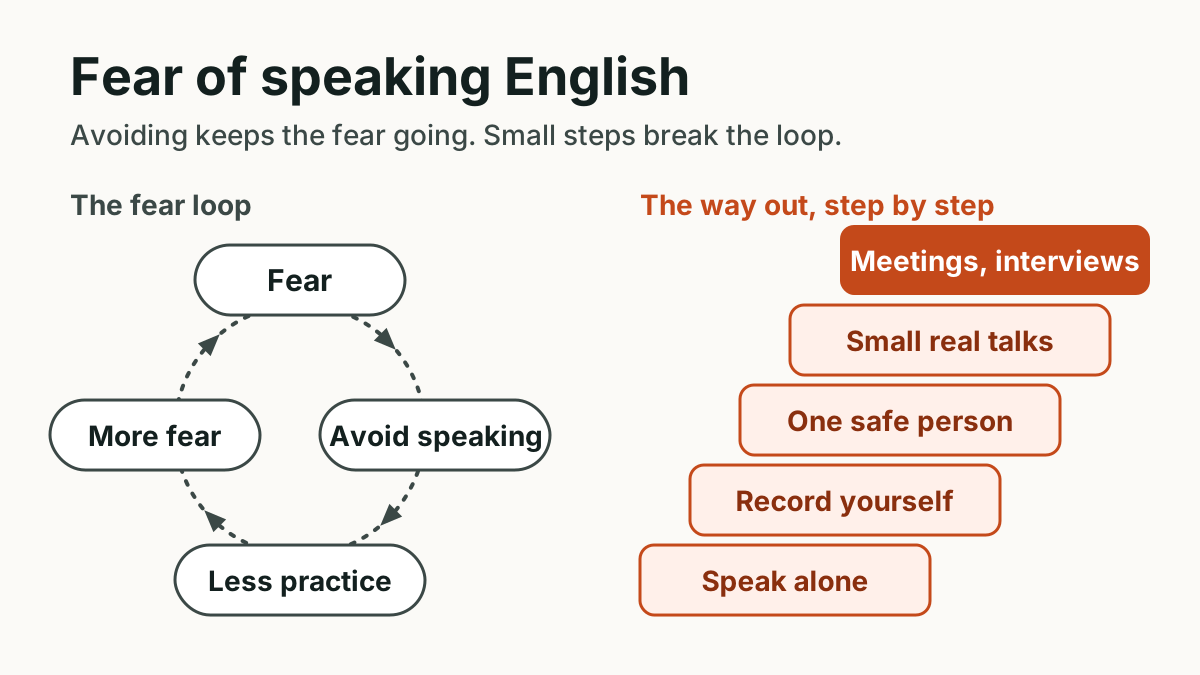
Fear of speaking English is common, it has a name in research (foreign language anxiety), and it usually eases through small, repeated, low-pressure speaking, not by waiting until your English is perfect. Waiting tends to make it worse, because avoiding speech means less practice, and less practice makes the next attempt feel more frightening. The way out is to make the first step small enough that you can do it while nervous.
If your mind goes blank when a manager asks you something in English, or you know the answer but stay quiet in class, nothing is wrong with you. This guide explains what researchers have found, then gives you a step-by-step ladder and phrases for the moments when you freeze.
Why am I afraid of speaking English?
The best-known paper on this is "Foreign Language Classroom Anxiety" by Elaine Horwitz, Michael Horwitz and Joann Cope, published in The Modern Language Journal in 1986. They link the fear to three familiar anxieties, while arguing that language anxiety is more than these three added together:
- Communication apprehension: fear of speaking with people at all, made stronger when you know you may not understand them or be understood.
- Test anxiety: fear of failure, the feeling that every sentence is being marked.
- Fear of negative evaluation: worry about what others will think of you, which they note can arise in any social situation, such as a job interview.
They also describe something that feels very true for many adults: the gap between your "true" self and the "more limited self" you can present in a new language. In your own language you are funny, sharp and well informed. In English you may feel like a simpler person, and that hurts. In India the feeling can be stronger, because English is often tied to education and status, so a mistake can feel like a judgement on you and not only on your grammar.
Is it normal to be scared of speaking English?
Yes. In the 1986 paper, 78 of 225 students in beginning language classes at the University of Texas in 1983 (over a third) said they would like to join a support group for language learners. They spoke of "freezing" in class and of standing outside the classroom door trying to find the courage to go in.
The same paper reports a survey of 75 university students in introductory Spanish classes: 49% agreed with "I start to panic when I have to speak without preparation in language class", and 33% agreed that they got nervous and confused when speaking in class. This is one small American study from the 1980s, about Spanish and not English, so do not read the numbers as true of learners in India. The point is simply that this reaction is old, widespread and well documented.
Does the fear really hold your English back?
There is a link, though it runs both ways. A 2019 meta-analysis by Teimouri, Goetze and Plonsky pooled 97 reports covering 19,933 learners in 23 countries and found an average correlation of r = −.36 between anxiety and language achievement. That is a real, moderate link, not a law of nature (a correction to the paper was issued later, so treat the exact figure with some care). A correlation also cannot say which comes first.
A 2023 review by Papi and Khajavy cautions that these relationships are usually reciprocal: anxiety can harm learning, and weak skills can feed anxiety. It also summarises studies in which more anxious learners saw the goal of speaking as avoiding mistakes and used the language only when they had to. Avoidance, more than the nerves themselves, is what you can start to change.
How do you speak English without fear?
Honestly, you may never lose all of it, and you do not need to. Plenty of people feel nervous and speak anyway. Work up the ladder below, staying on each step until it feels slightly boring. There is no set timetable, and it is fine to go back a step after a bad day.
- Speak alone, out loud. Nobody can judge you. Describe your room or your day for one minute. Our guide to practising English speaking alone has a full routine.
- Record yourself. It feels awful at first. One experiment summarised in the 2023 review found that a video camera made learners anxious and hurt their performance on a vocabulary task, but that the effect faded as they got used to it. Recording yourself may also feel less strange after a while.
- Practise with something that cannot laugh. An AI partner will not get bored or tell your cousin. Our guide to learning English with AI explains what it does well and what it does not.
- Talk to one safe person. Ask a friend or sibling for five minutes of English, with one rule: no correcting unless you ask.
- Try small real exchanges. Ask a question at a shop, order in a restaurant, or reply to a delivery person in English. They last ten seconds, and the stakes are almost nil.
- Say one thing in a group. In your next meeting or class, make one planned comment or ask one question early. Waiting makes it harder.
- Take on the bigger moments. Interviews and presentations, with preparation. Our guide to answering "Tell me about yourself" is a good first rehearsal.
SpeakWisely has a mode called Rehearse: you speak with nothing scored, and the audio stays in your browser unless you ask to see your words. When you are ready for feedback, Role-play gives you real situations with an AI partner, and you can turn the feedback off.
Start practising freeHow do you speak English without hesitation?
Some hesitation is normal in every language, and a short pause sounds thoughtful. What hurts is the panicked search for the perfect sentence. Nearly half the students in that 1986 survey agreed that they panic when speaking without preparation, so prepare what you can: know your first sentence before you walk in, and keep a few holding phrases ready. They buy you time, and they stop a pause from turning into a freeze.
- Buy time
- Let me think about that for a second.
- Buy time
- That's a good question. I'd say...
- Not catching it
- Sorry, could you say that again? I didn't catch it.
- Missing a word
- I can't think of the word, but it's a kind of...
- Starting over
- Sorry, let me say that another way.
- Being honest
- My English gets a bit slow when I'm nervous, so please bear with me.
If "um" and "like" fill every gap, our guide on how to stop saying "um" has a seven-day plan. And if you stall because you are translating, see how to think in English.
How do you gain confidence in speaking English?
Confidence comes mostly from evidence, meaning proof that you can do the thing. Three habits help you collect it:
- Question the rule in your head. Horwitz and her co-authors noticed that some students believed nothing should be said until it could be said correctly. Nobody learns to speak that way. Try a different rule: if the other person understood you, it worked.
- Keep a small log. Note one line a day: "Asked a question in the meeting." After a month you have a list of things you did while nervous, which is harder to argue with than a pep talk.
- Keep your old recordings. Comparing week one with week four shows change you cannot feel from day to day.
Questions about the fear of speaking English
How can I overcome my fear of speaking English?
How can I speak English without hesitation?
How do I gain confidence in speaking English?
Why can I understand English but not speak it?
Why do I feel nervous speaking English in front of Indians?
Pick the lowest rung of the ladder and do it today, for one minute. When you feel ready for a bigger plan, our guide on how to speak English fluently sets out four weeks of practice.
Your recording is used only to transcribe your answer, then deleted within 15 minutes. We keep your transcript and results, never the audio.
Sources
- Horwitz, E. K., Horwitz, M. B. and Cope, J. (1986). Foreign Language Classroom Anxiety. The Modern Language Journal, 70(2)
- Teimouri, Y., Goetze, J. and Plonsky, L. (2019). Second language anxiety and achievement: a meta-analysis. Studies in Second Language Acquisition
- Papi, M. and Khajavy, H. (2023). Second language anxiety: Construct, effects, and sources. Annual Review of Applied Linguistics
Keep reading
 Spoken English10 min read
How to speak English fluently: 7 steps and an honest 30-day routine
Fluency is using what you already know, smoothly and out loud. Here are seven steps, a four-week routine, and a straight answer on what 30 days can and cannot do.
 Spoken English7 min read
How to think in English and stop translating in your head
Thinking in English is not a switch you flip. It grows with use. Here are six small habits that reduce translating, and an honest look at what the research says.
 Spoken English8 min read
How to stop saying "um" and "like": a fluency practice routine
Fillers are the sound of planning out loud. Swap them for short silent pauses, keep a few thinking phrases ready, and track your fillers per minute for a week.
 Spoken English7 min read
How to practise speaking English alone, with nothing but your phone
No partner needed: a six-step, 15-minute routine for speaking English alone at home, with 30 topics to talk about and a simple way to measure progress.