How to ask questions in English: word order, do/does/did and polite forms
By the SpeakWisely team · Published · 9 min read
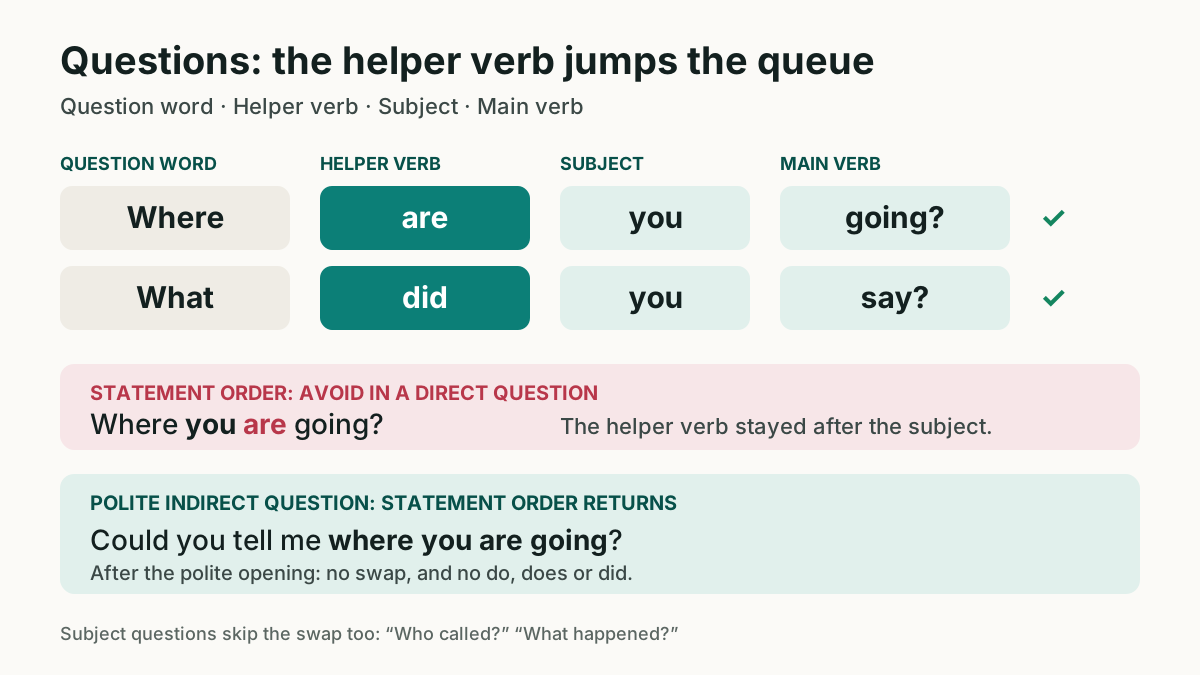
To make a question in English, put a helper verb before the subject: "You are ready" becomes "Are you ready?", and "You live in Pune" becomes "Do you live in Pune?" For a wh-question, the question word goes first and the same swap follows: "Where are you going?" Two cases skip the swap: when the question word is itself the subject ("Who called?"), and in polite indirect questions ("Could you tell me where the station is?").
That is the whole system in three sentences. This guide takes each part slowly, with lines to say aloud, the mix-ups that are easiest to hear, how question tags work, and how to ask follow-up questions that keep a conversation going. It ends with a five-minute drill you can do with your phone.
Why do questions trip up so many speakers?
In Hindi, Gujarati, Marathi, Tamil and most other Indian languages, a question keeps the same word order as a statement. You add a question word, or the word "kya", or a rising tone, and the sentence becomes a question. "Tum kahan ja rahe ho?" has the same order as "Tum ghar ja rahe ho."
English does something extra: it moves a verb. That one move is easy to forget when you are speaking quickly and thinking about what to say, which is why questions such as "Where you are going?" and "What you want?" are so common in Indian English. In a chat with friends in Delhi, nobody will blink. In an interview, a client call or an IELTS test, the standard form sounds more controlled, and it is the form listeners from other countries expect.
How do you make a yes/no question?
A yes/no question starts with a helper verb, then the subject, then the rest. Which helper you use depends on the sentence you started with:
- Be (am, is, are, was, were): move it to the front. "She is at home." → "Is she at home?" "It was expensive." → "Was it expensive?"
- Have (in perfect tenses): move it to the front. "The train has left." → "Has the train left?"
- Modals (can, will, should, could, would, must): move it to the front. "You can hear me." → "Can you hear me?"
- No helper at all: add do, does or did. "You work on Saturdays." → "Do you work on Saturdays?" "He plays cricket." → "Does he play cricket?" "They called." → "Did they call?"
The do/does/did questions hide the most common slip. Once you add does or did, it carries the tense and the "-s", so the main verb goes back to its plain form. The "-s" and the past tense appear once, not twice.
- Weak
- Does he works in Bengaluru?
- Better
- Does he work in Bengaluru?
- Weak
- Did you went to the wedding?
- Better
- Did you go to the wedding?
- Weak
- You are coming tomorrow?
- Better
- Are you coming tomorrow?
That last one deserves a note. "You are coming tomorrow?" with a rising voice is used by native speakers too, usually to check something they already half expect. It is not wrong in conversation. But if every question you ask sounds like that, you never show the listener you can form a real question, so use the standard form by default.
How do you make wh-questions in English?
Wh-questions ask for information: what, where, when, who, why, which, whose and how. The order is the yes/no question with the question word in front. Many teachers remember it as QUASM: Question word, Auxiliary (helper verb), Subject, Main verb.
- Say it
- Where are you staying in Goa?
- Say it
- What did the manager say?
- Say it
- How long have you been learning English?
- Say it
- Which train should I take to Andheri?
- Say it
- Why does the meeting start so early?
If you know the tense well, the question is just that tense with the helper moved. Say the statement, then turn it: "You have been learning English for two years." → "How long have you been learning English?" If tenses themselves are the shaky part, start with the English tenses you actually need for speaking.
- Weak
- What you want to eat?
- Better
- What do you want to eat?
- Weak
- Why she is not coming?
- Better
- Why isn't she coming?
- Weak
- How much it costs?
- Better
- How much does it cost?
When do you not need do, does or did?
When the question word is the subject, there is nothing to swap, so you keep statement order and add no helper. Compare these pairs. In the first of each, you are asking about the person who did the action; in the second, about the person or thing it happened to.
- Subject
- Who called you? (Someone called you. Who?)
- Object
- Who did you call? (You called someone. Who?)
- Subject
- What happened at the office?
- Object
- What did you do at the office?
- Subject
- Which bus goes to the airport?
- Object
- Which bus did you take?
A common over-correction is "What did happen?" or "Who did call you?" Unless you are stressing "did" to contradict someone, drop it: "What happened?" "Who called you?"
How do you ask a question politely in English?
A direct question is perfectly polite with friends and family. With a stranger, a senior colleague or a customer, English speakers often soften it by wrapping it in a polite opening. This is an indirect question, and it has one surprise: after the opening, the word order goes back to a statement.
- Direct
- Where is the visa office?
- Polite
- Could you tell me where the visa office is?
- Direct
- When does the training start?
- Polite
- Do you know when the training starts?
- Direct
- Can you send the file today?
- Polite
- I was wondering if you could send the file today.
- No swap after the opening: "Could you tell me where it is?", not "where is it?"
- No do, does or did after the opening: "Do you know when it starts?", not "when does it start?"
- For a yes/no question, add if or whether: "Can I pay by UPI?" → "Could you tell me if I can pay by UPI?"
Indirect questions are worth practising before any interview or formal call. A sentence like "Could you tell me what the next steps are?" at the end of an interview sounds confident and well-prepared. Our guide to common job interview questions and answers in English has more lines like it.
How do question tags work?
A question tag is the short question at the end of a statement: "You are from Surat, aren't you?" The rule: repeat the helper verb from the statement, flip it (positive to negative, or negative to positive), and add the pronoun. If there is no helper, use do, does or did, just as in a question.
- Say it
- You're from Surat, aren't you?
- Say it
- She works in Hyderabad, doesn't she?
- Say it
- They didn't call, did they?
- Say it
- We can leave at six, can't we?
- Say it
- I'm on the list, aren't I?
In Indian English, "isn't it?" is often used as a tag for every sentence: "You are coming, isn't it?" It is understood across India, much like "na?" in Hindi. In international settings, the matching tag sounds more natural: "You are coming, aren't you?" If you are not sure of the tag, "right?" works in informal speech: "You are coming, right?"
What questions keep a conversation going?
Grammar is half the skill. The other half is asking questions that make the other person want to keep talking. Closed questions (yes/no) are useful for checking facts, but a string of them sounds like a form being filled in. Open questions, starting with what, how or why, invite a story.
- Closed
- Do you like your job?
- Open
- What do you enjoy most about your job?
- Closed
- Did you go to Manali?
- Open
- How was Manali? What did you do there?
- Follow up
- That sounds interesting. How did you get into that?
- Follow up
- What was the hardest part?
A good habit: listen for one detail in the answer and ask about that, not a new topic. It shows you were listening, and it gives you something easy to say next. For dozens of everyday questions to practise answering and asking, see English conversation practice: everyday questions to answer out loud.
Questions only become automatic when you ask them out loud, in a real exchange. Role-play puts you in real situations with an AI partner whose level moves with you, so you can practise asking as well as answering.
Try a role-playA five-minute drill to fix question word order
Do this with the voice recorder on your phone. The aim is to make the helper verb move without thinking about it.
- Write five statements about your day. "I take the metro to work." "My sister is studying in Canada." "We had biryani for lunch."
- Turn each into a yes/no question, out loud. "Do you take the metro to work?" "Is your sister studying in Canada?" "Did you have biryani for lunch?"
- Turn each into a wh-question. "How do you get to work?" "Where is your sister studying?" "What did you have for lunch?"
- Turn each into a polite indirect question. "Could you tell me how you get to work?" "Do you know where your sister is studying?" Check: no swap after the opening.
- Listen back once. Mark any question where the helper verb is missing or in the wrong place, and say that one again three times.
Fifteen questions in five minutes is plenty. Do it for a week with new statements each day, and questions start to come out in the right shape on their own. The same record-and-listen method works for other habits too; see how to practise speaking English alone.
Common questions about English question forms
Is "Where you are going?" wrong?
It is common in Indian English and is understood in India, but it is not standard in a direct question. The standard form moves the helper verb before the subject: "Where are you going?" Use the standard form in interviews, exams and international calls.
Why do we say "Does he work?" and not "Does he works?"
Because "does" already carries the -s for he, she and it. The main verb goes back to its plain form. In the same way, "did" carries the past tense, so it is "Did you go?", not "Did you went?"
When do I not use do in a question?
When the sentence already has a helper verb (be, have or a modal such as can or will), and when the question word is the subject, as in "Who called?" or "What happened?" It is also left out after the opening of a polite indirect question: "Do you know when it starts?"
Is "isn't it?" correct as a question tag?
It is correct when the statement uses "it is": "It is hot today, isn't it?" As an all-purpose tag ("You are coming, isn't it?") it is typical of Indian English. Elsewhere, the tag usually matches the statement: "You are coming, aren't you?"
Can I ask the examiner to repeat a question in the IELTS Speaking test?
Yes. A clear, polite question such as "Could you repeat the question, please?" is fine. Learn one or two of these phrases so you can ask without hesitation.
Your recording is used only to transcribe your answer, then deleted within 15 minutes. We keep your transcript and results, never the audio.
Sources
Keep reading
- The English tenses you actually need for speaking
Six forms carry everyday conversation. Which ones they are, the mix-ups that give learners away, and how to practise them out loud.
- 12 common grammar mistakes in spoken English, and quick fixes
Spoken grammar is not exam grammar. These are the 12 slips listeners actually notice, each with a one-line rule, a better sentence and a quick drill.
- English conversation practice: 49 everyday questions to answer out loud
Seven topics, seven questions each, and one simple answer shape: say your answer, give a reason, add an example. Pick one question a day and say it out loud.