120 daily use English sentences for home, college, work and out
By the SpeakWisely team · Published · 7 min read
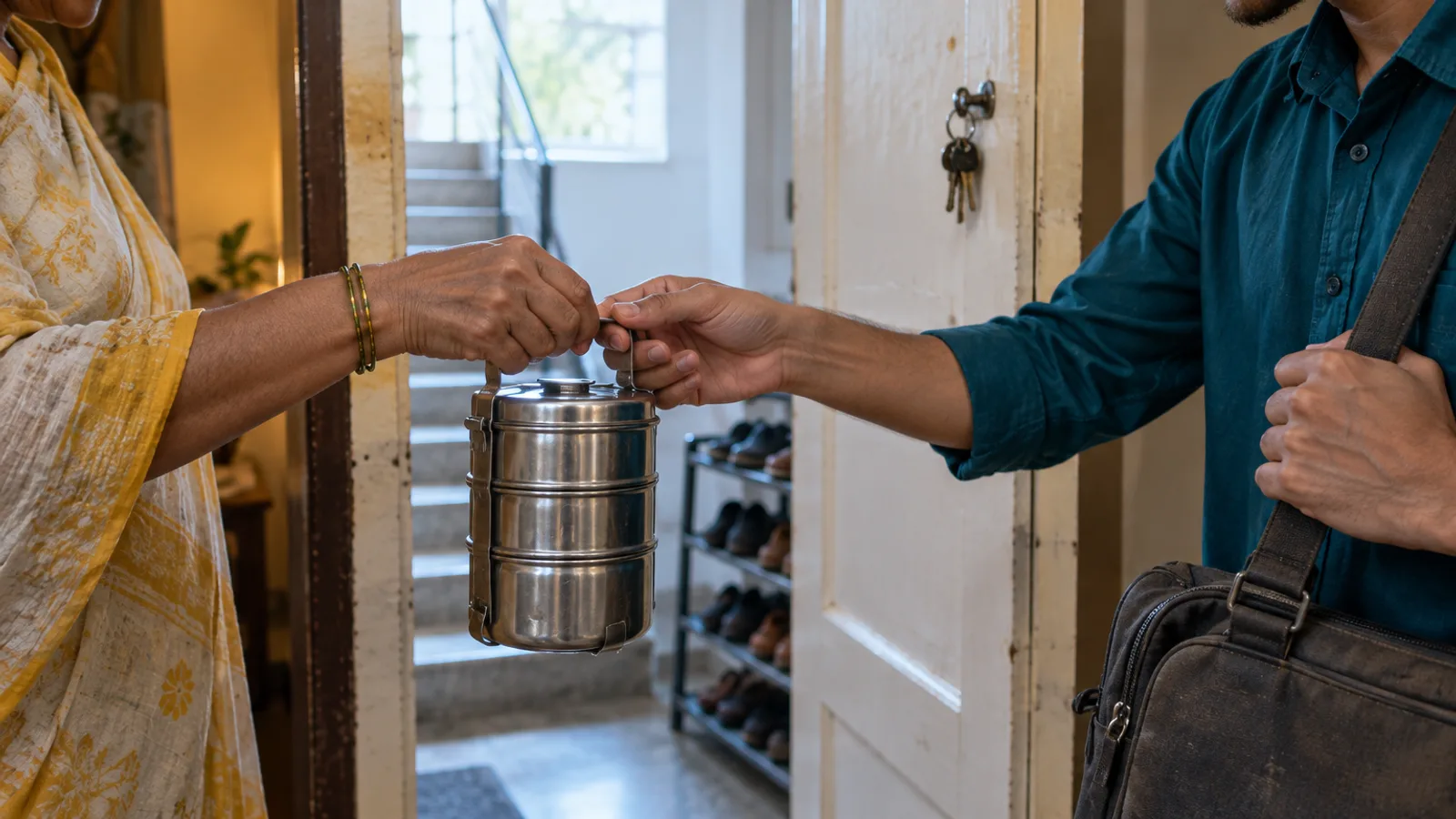
The most useful daily use English sentences are short, ordinary ones that you can say without building them: "I'm running late", "Could you say that again?", "How much is this?", "Let me check and get back to you." Below are 120 of them, grouped by situation and written in the natural English that people use in India. Pick the ten you would really say this week, and say them aloud until they come easily.
Do not try to memorise the whole list. Language researcher Paul Nation notes that, especially early on, "there is value in becoming fluent with a repertoire of useful sentences and phrases". The aim is a small stock that you actually use, which then frees your attention for the rest of the conversation.
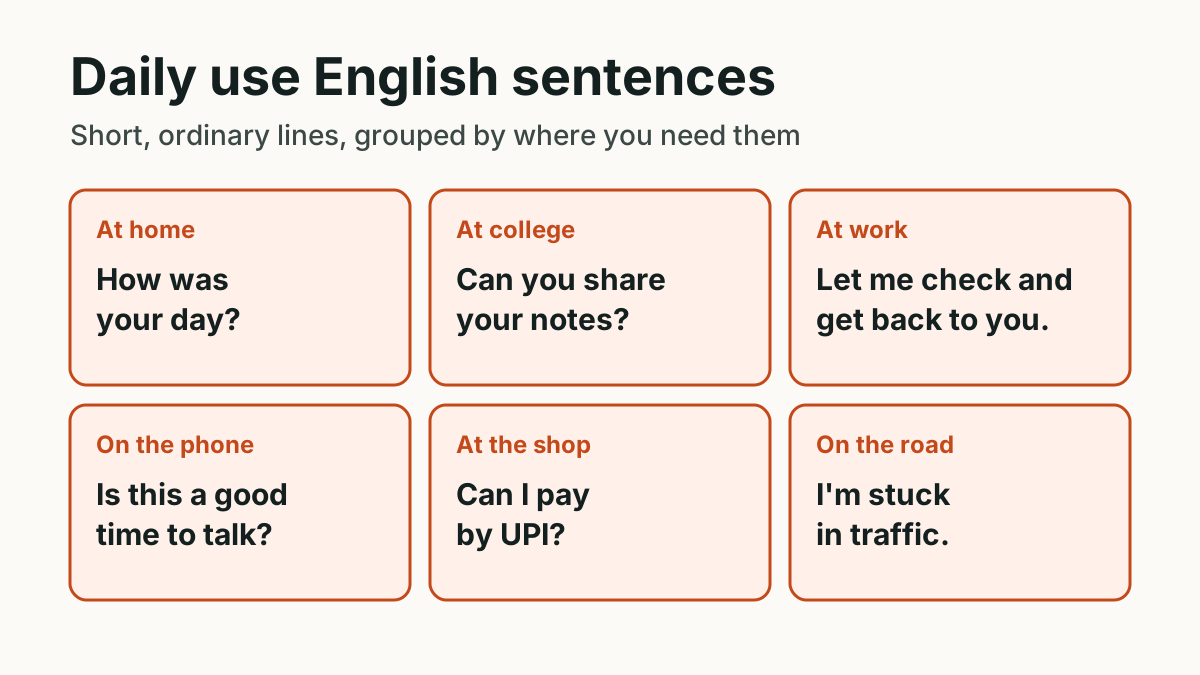
What English sentences can you use at home every day?
Mornings
- Waking up
- It's already seven. Please get up.
- Waking up
- I didn't sleep well last night.
- Getting ready
- Have you seen my charger?
- Getting ready
- Is the water hot yet?
- Getting ready
- Can you iron this shirt for me?
- Breakfast
- Breakfast is ready. Come and eat while it's hot.
- Breakfast
- I'll just have tea today. I'm getting late.
- Leaving
- Don't forget your tiffin.
- Leaving
- I should be back by eight.
- Leaving
- Take an umbrella. It might rain.
Evenings and family
- Evening
- How was your day?
- Evening
- I'm so tired. It was a long day.
- Food
- What should we make for dinner?
- Food
- The dal needs a little more salt.
- Chores
- Can you help me with the dishes?
- Chores
- Please switch off the fan when you leave the room.
- Home
- The Wi-Fi is not working again.
- Home
- Our house help is on leave today.
- Family
- Have you called Mummy? She's been asking about you.
- Family
- We are going to my uncle's place this Sunday.
- Night
- It's late. Turn off the lights and go to sleep.
- Night
- I'll set an alarm for six.
What are daily use English sentences for students?
These cover class, teachers, friends and exams. Saying them to a teacher is a low-risk way to use English in real life.
- To a teacher
- Good morning, ma'am. May I come in?
- To a teacher
- Sorry I'm late, sir. My bus was delayed.
- To a teacher
- Could you please explain that once more?
- To a teacher
- I didn't understand the last part.
- To a teacher
- Could I submit the assignment by Monday?
- To a teacher
- Will this be asked in the exam?
- To a teacher
- May I go to the washroom, please?
- To a friend
- Did you finish the assignment?
- To a friend
- Can you share your notes with me?
- To a friend
- I missed the lecture. What did I miss?
- To a friend
- Which chapters are in the syllabus?
- To a friend
- Shall we study together this evening?
- To a friend
- When is the last date to pay the fees?
- Exams
- I have a test tomorrow, and I haven't started yet.
- Exams
- How did your paper go?
- Exams
- The results come out next week.
- College
- Let's meet in the canteen after this class.
- College
- I need to get my ID card renewed.
What English sentences do you need at the office?
At your desk and in meetings
- Status
- I'm working on it. I'll send it by end of day.
- Status
- It's almost done. I just need to check a few things.
- Status
- I'm running a bit behind on this.
- Asking
- Do you have a minute?
- Asking
- Could you take a look at this for me?
- Asking
- Who should I speak to about this?
- Asking
- Could we move the meeting to three o'clock?
- Meetings
- Can you see my screen?
- Meetings
- Sorry, could I add something here?
- Meetings
- I agree, but I have one concern about the timeline.
- Meetings
- Let me check and get back to you.
- Meetings
- I'll send a short summary after this call.
- Leave
- I won't be in tomorrow. I'm not feeling well.
- Leave
- I need to leave a little early today.
On phone and video calls
- Starting
- Hello, this is Priya from Sharma Traders.
- Starting
- Is this a good time to talk?
- Starting
- Am I speaking to Mr Mehta?
- Problems
- Sorry, your voice is breaking.
- Problems
- You're on mute.
- Problems
- The network is bad here. Can I call you back in five minutes?
- Details
- Could you repeat the number, please?
- Details
- Please share the details on WhatsApp.
- Ending
- I'm in a meeting right now. I'll call you back.
- Ending
- Thanks for calling. Have a good day.
What English sentences help when you are out?
Shops and online orders
- Shop
- How much is this?
- Shop
- Do you have this in a bigger size?
- Shop
- Can you give me a better price?
- Shop
- Can I pay by UPI?
- Shop
- Is there any discount on this?
- Shop
- Could I have a bill, please?
- Shop
- I'm just looking, thank you.
- Vegetables
- Half a kilo of tomatoes, please.
- Delivery
- Please leave the parcel with the security guard.
- Delivery
- Please call me when you reach the gate.
- Delivery
- My order hasn't arrived yet.
- Delivery
- I would like to return this. It's damaged.
Autos, metro and trains
- Auto
- How much to the railway station?
- Auto
- Please go by the meter.
- Auto
- Stop here, please. This side is fine.
- Cab
- I've booked a cab. It'll be here in five minutes.
- Directions
- Excuse me, how do I get to the metro station?
- Directions
- Is it walking distance from here?
- Train
- Which platform does the Rajdhani leave from?
- Train
- Excuse me, I think this is my seat.
- Train
- Could you tell me when we reach Dadar?
- Delay
- I'm stuck in traffic. I'll be there in twenty minutes.
- Delay
- The train is running two hours late.
Restaurants and the doctor
- Restaurant
- A table for four, please.
- Restaurant
- Could we see the menu?
- Restaurant
- Is this dish very spicy?
- Restaurant
- We're ready to order.
- Restaurant
- Could we have some more water, please?
- Restaurant
- Could we have the bill, please?
- Doctor
- I'd like to book an appointment with the doctor.
- Doctor
- I've had a fever since yesterday.
- Doctor
- I have a bad headache and a sore throat.
- Doctor
- How many times a day should I take this tablet?
- Doctor
- Do I need to get any tests done?
- Doctor
- Should I take it before or after food?
What are polite English sentences for everyday conversation?
Requests, thanks and apologies
- Request
- Could you do me a small favour?
- Request
- Would you mind waiting for a moment?
- Thanks
- Thank you so much. That really helped.
- Thanks
- You're welcome. It was no trouble.
- Sorry
- I'm sorry, I didn't mean that.
- Sorry
- Sorry to bother you.
- Sorry
- No problem. It happens.
- Not sure
- I'm not sure, but I can find out.
- Saying no
- Thanks for asking, but I can't make it today.
- Not hearing
- Sorry, I didn't catch that. Could you say it again?
Small talk
- Meeting
- Hi, how have you been? It's been a long time.
- Meeting
- Nice to meet you. I'm Rahul, Neha's colleague.
- Weather
- It's so humid today.
- Weather
- It looks like the rains have started early this year.
- Weekend
- Any plans for the weekend?
- Meeting
- Which part of Gujarat are you from?
- Festival
- Happy Diwali! Please give my regards to your family.
- Cricket
- Did you watch the match last night?
- Interest
- Really? What happened then?
- Leaving
- It was great seeing you. Let's catch up soon.
- Leaving
- Take care. See you on Monday.
How do you remember daily use English sentences?
Reading a list does very little by itself. This takes about five minutes a day:
- Choose five sentences you will need today, not the five that look most impressive.
- Say each one aloud five times, slowly at first and then at normal speed.
- Change one detail. "I'm stuck in traffic" becomes "I'm stuck at work." This makes it yours, and it shows you how the sentence works.
- Use at least one with a real person today. Even a single sentence to a shopkeeper counts.
- Reuse them tomorrow, and add two new ones.
Do not stop at fixed sentences. They get you started, but real conversations soon go off-script, so move on to answering questions with our list of English conversation practice questions. If you are a Hindi speaker, our guide to mistakes Hindi speakers make helps you avoid common slips.
SpeakWisely's Role-play lets you try sentences like these in real situations with an AI partner, out loud, and the Pronunciation lab helps you check how clearly you are understood.
Start practising freeQuestions about daily use English sentences
What are some daily use English sentences?
What are daily use English sentences for students?
How many English sentences should I learn every day?
Will learning sentences make me fluent?
Choose five sentences now and use one today. When you are ready for more, our guide on how to speak English fluently sets out a four-week routine, and how to think in English shows how to stop translating these phrases in your head.
Your recording is used only to transcribe your answer, then deleted within 15 minutes. We keep your transcript and results, never the audio.
Sources
Keep reading
 Spoken English10 min read
How to speak English fluently: 7 steps and an honest 30-day routine
Fluency is using what you already know, smoothly and out loud. Here are seven steps, a four-week routine, and a straight answer on what 30 days can and cannot do.
 Spoken English7 min read
English conversation practice: 49 everyday questions to answer out loud
Seven topics, seven questions each, and one simple answer shape: say your answer, give a reason, add an example. Pick one question a day and say it out loud.
 Spoken English7 min read
How to think in English and stop translating in your head
Thinking in English is not a switch you flip. It grows with use. Here are six small habits that reduce translating, and an honest look at what the research says.
 For Indian learners10 min read
Common English mistakes Hindi speakers make, and how to fix them
Verb at the end, no "a" or "the", one "se" for since and for, one व for v and w. Ten patterns Hindi brings into English, and a drill for each.