How to think in English and stop translating in your head
By the SpeakWisely team · Published · 7 min read

To think in English, use it for small private tasks every day: name what you see, describe what you are doing, plan your day in short English sentences, and learn whole phrases instead of single words. You will not stop translating overnight, and you do not need to stop completely. The aim is to make your first attempt at simple, everyday ideas come in English, so that you only reach for your first language when an idea is hard.
If you build each sentence in Hindi or Gujarati first, you probably know the result: long pauses, and English that follows the wrong word order. This guide explains what is going on, what the research can and cannot tell us, and six habits you can start today.
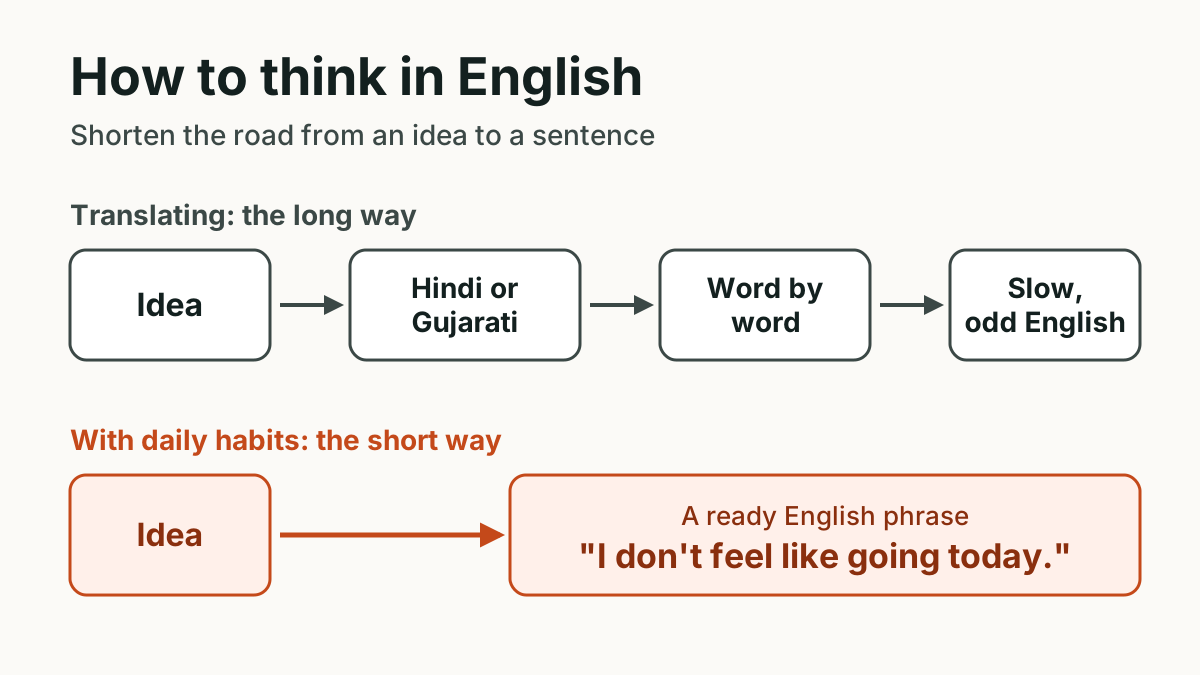
Can you really learn to think in English?
Yes, in part, and it usually happens gradually. Researchers call this silent self-talk "inner speech". A 2018 research review by María de Guerrero in the journal Language Teaching notes that many learners do use a second language for inner speech, while "the L1 is generally the preferred language of thought" even among proficient users. So do not worry if your mother tongue stays with you. It is normal, even at high levels.
What seems to matter most is use. The same review reports a 2015 web survey by the researcher Dewaele of 1,579 people who speak several languages. The strongest predictor of which language they used for inner speech was how often they used that language in everyday interactions; proficiency also played a part. A 2017 study by Kate Hammer of 149 highly educated Polish-English bilinguals, most of them living in the UK, points the same way: those with mostly English-speaking social circles and stronger ties to life in the UK reported more inner speech in English.
Why do you translate in your head, and is it bad?
You translate because your first language is fast and English is still slow. School may have added to it, if you learned English through word lists and grammar rules rather than by using it. Translating is not a failing, and it is a sensible tool at times, such as checking the meaning of a new word or preparing something difficult.
It becomes a problem in live conversation, for two reasons. It takes time, so you pause too long. And word-for-word sentences often come out sounding odd. Compare these:
- Translated
- My mind is not doing to go to office today.
- Natural
- I don't feel like going to the office today.
- Translated
- What is the time going on?
- Natural
- What's the time?
- Translated
- I am having two brothers.
- Natural
- I have two brothers.
- Translated
- He told to me that he will come.
- Natural
- He told me he would come.
The natural versions cannot be reached by swapping words one at a time. You have to know them as complete phrases, which is why the habits below focus on phrases. Our guides to mistakes Hindi speakers make and mistakes Gujarati speakers make have many more examples.
How do you start thinking in English?
Try these six habits in order, adding a new one every few days. They take very little extra time, because you can do most of them during things you already do.
1. Name what you see
On your way to work or college, name things silently in English: traffic signal, footpath, flyover, auto, vegetable cart. When a word is missing, make a note and look it up later. This is the lowest level of thinking in English, and it needs no grammar at all.
2. Describe what you are doing
Move from words to short sentences about the moment. Simple present continuous sentences are perfect. Say them aloud if you are alone, or in your head if you are not.
- At home
- I'm making tea. We're out of milk, so I'll get some later.
- On the way
- The bus is late again. I'll probably reach by ten.
- At work
- I'm checking this file first, and then I'll call him.
3. Plan your day in English
Each morning, go through your plan in three or four English sentences. Each night, sum up what happened. This practises future and past forms, and it uses real content from your life, so the words stay useful.
4. Learn phrases, not words
When you meet a useful expression, keep the whole thing: "I don't feel like it", "It depends on", "I'm running late", "Let me check". Ready phrases can be said without building them, and that is the real meaning of speaking without thinking. Our list of daily use English sentences is a good place to collect them.
5. Look words up in English
Once you are comfortable enough, try an English learner's dictionary before a bilingual one. Reading a short English definition keeps you inside the language, and the example sentences show the word in use. If that is too slow at first, use both.
6. Say it out loud
Silent thinking alone will not make you a faster speaker, because your mouth also needs the practice. Once a day, speak your thoughts aloud for a minute with one rule: no Hindi, no Gujarati, keep going. Our routine for practising English speaking alone builds this in.
Answering out loud with no time to translate is what SpeakWisely is built around. The Daily coach gives you one short speaking task a day, then asks a follow-up question about what you said, so you have to respond in the moment.
Start practising freeHow do you speak English without thinking?
You probably do not want to speak with no thought at all, but you can aim for the words to come without effort, so that your attention stays on your meaning. That comes from repetition. In language teaching research, repeating the same talk in less time is a well-known way of building speed, because the same words and phrases get used again and again. Our guide to speaking English fluently explains this technique and gives you a four-week routine.
What should you do when you cannot find the English word?
This is the moment most people switch to translating or simply stop. Instead, describe the thing using words you do have. It keeps you in English, keeps the conversation moving, and the other person will often give you the word.
- Describe it
- It's a kind of metal box that you cook rice in under pressure.
- Say its use
- It's the thing you use for opening bottles.
- Say it another way
- What I mean is, he helps me whenever I have a problem.
- Ask
- What's the word for the person who checks tickets on a train?
- Hold
- Sorry, the word has slipped my mind. Give me a second.
An occasional Hindi or Gujarati word with Indian friends is fine, and it is how many people really talk. Just avoid making it your only escape if you are trying to build the habit.
Questions about thinking in English
How can I think in English instead of translating?
How long does it take to start thinking in English?
How can I speak English without thinking?
Is it bad to translate from Hindi to English in my head?
Do fluent speakers think in English all the time?
Start with one small step today: describe your next cup of tea in English. If nerves are what really stops your English from coming out, read our guide to the fear of speaking English next.
Your recording is used only to transcribe your answer, then deleted within 15 minutes. We keep your transcript and results, never the audio.
Sources
- de Guerrero, M. C. M. (2018). Going covert: Inner and private speech in language learning. Language Teaching
- Hammer, K. (2017). Bilingual cogito: inner speech in acculturated bilinguals (preprint, UCL Discovery)
- Nation, P. (2007). The four strands. Innovation in Language Learning and Teaching
- de Jong, N. and Perfetti, C. A. (2011). Fluency training in the ESL classroom. Language Learning
Keep reading
 Spoken English10 min read
How to speak English fluently: 7 steps and an honest 30-day routine
Fluency is using what you already know, smoothly and out loud. Here are seven steps, a four-week routine, and a straight answer on what 30 days can and cannot do.
 Spoken English7 min read
120 daily use English sentences for home, college, work and out
A practical list of 120 everyday English sentences, grouped by situation: home, college, the office, phone calls, shops, travel, the doctor and small talk.
 For Indian learners10 min read
Common English mistakes Hindi speakers make, and how to fix them
Verb at the end, no "a" or "the", one "se" for since and for, one व for v and w. Ten patterns Hindi brings into English, and a drill for each.
 Spoken English7 min read
How to practise speaking English alone, with nothing but your phone
No partner needed: a six-step, 15-minute routine for speaking English alone at home, with 30 topics to talk about and a simple way to measure progress.