Is Duolingo good for speaking English? What it does well and where it stops
By the SpeakWisely team · Published · 7 min read

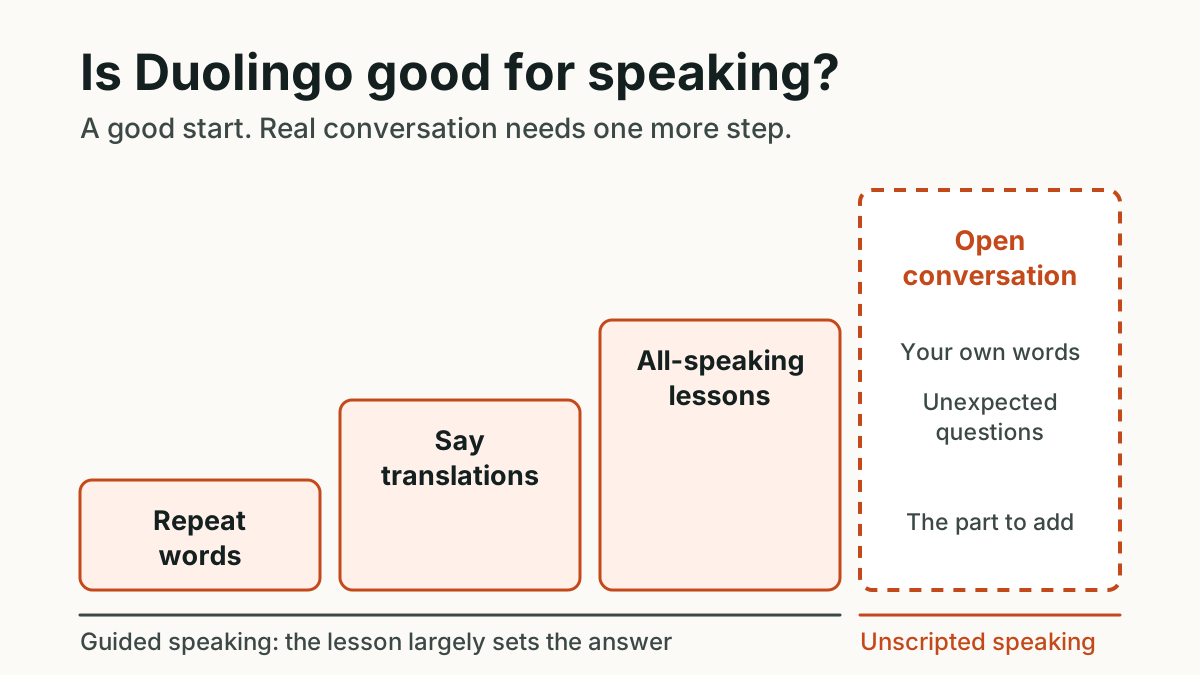
Duolingo is good for getting beginners used to saying English words and short sentences aloud, and for building a daily habit, but its free speaking practice is mostly guided, so it is not enough on its own for real conversations. The answers are largely set by the lesson, whereas a real conversation asks you to come up with your own sentences. Add regular unscripted speaking, through Duolingo's own conversation tools if your plan and course include them, or through another partner.
A note on who is writing: SpeakWisely publishes this post, and we make a speaking practice tool, so read it with that in mind. The facts about Duolingo below come from its own blog, help pages and store listing, checked on 3 November 2026. Its plans and features change often, so confirm them in your own app.
Does Duolingo have speaking exercises?
Yes. In a February 2026 post, Duolingo says that from the first lesson, exercises prompt you to repeat words and translate sentences out loud, and that lessons include short dialogues. It also says that many writing exercises let you tap a microphone and speak your answer instead of typing, and that flashcards ask you to recall a translation and say it aloud.
The Practice tab also has speaking-only lessons, which that post says are free for all learners. An earlier December 2025 post described all-speaking lessons in the Practice Hub as a Super feature, so if you do not see them, check for an app update or look at your own plan.
Duolingo's India App Store listing says every course is free, and paid plans are offered as in-app purchases. Its English course for Hindi speakers is listed on its site. It also said in December 2025 that it offers a special course for intermediate and advanced learners of English, which does not rely on translation, so learners from any language background can use it.
What does Duolingo speaking practice actually build?
It helps to separate the skills involved in speaking. Guided exercises are useful for some of them and weaker on others.
- Getting your mouth moving. For someone who rarely speaks English aloud, frequent small repetitions lower the barrier. This is a real benefit.
- A daily habit. Duolingo describes its lessons as quick, bite-sized and game-like, with leaderboards and rewards for daily practice. A speaking habit is hard to build alone, so this can be its most useful part.
- Common words and patterns. Beginners can build a base of everyday vocabulary and short sentence patterns.
- Choosing your own words: less so. In a guided exercise, the lesson has largely decided what you should say. In a conversation, you must find the idea, the words and the grammar on the spot.
- Speaking at length: less so. A job interview, or even a chat about your weekend, asks for several connected sentences. Short exercises give little practice in this.
- Reacting to someone: less so. Understanding an unexpected question and answering it is the skill many learners find hardest. It needs a partner who can surprise you.
Duolingo's post does not explain how spoken answers are graded or how pronunciation is judged, and it does not list limitations of these exercises. So do not treat a passed exercise as proof that other people will understand you easily.
Does Duolingo have real conversation practice?
Yes, in Video Call and Roleplay. Video Call lets you "call" the character Lily for a free-flowing conversation. Duolingo says she adjusts to your level, and that you can ask her to repeat herself or slow down. In Roleplay, you can speak your responses aloud. In its February 2026 post, Duolingo says both of these need Duolingo Max, its top plan.
Three things are worth checking before you pay:
- Is it offered on your course? Duolingo's help page, as we read it in November 2026, lists English among the Video Call courses, and names English for Spanish, Portuguese, Japanese, German and French speakers. It did not list English for Hindi speakers. Look in your app, or ask Duolingo, before buying a plan for this feature.
- Which plan is it on now? Duolingo's letter to shareholders on the fourth quarter of 2025 said it planned to move Video Call into the Super tier. We did not find a confirmed date, so check the plan page in your app.
- How much correction do you want? Duolingo wrote in 2024 that Lily will not correct your grammar during the call and that you will not be penalised for mistakes. A January 2026 post about a beginner version with the character Falstaff says it gives real-time feedback in your own language, and was on iOS at the time. Low pressure is good for confidence, but it may leave slips unaddressed.
What does the evidence say about Duolingo's speaking practice?
The most direct evidence we found is Duolingo's own. In a March 2026 post, its researchers report that intermediate Japanese-speaking learners of English who used Video Call at least twice a day improved more on a standardised speaking test after a month than those doing regular lessons only. They also report positive results for beginners in French and Spanish, and for early-intermediate English-speaking learners of Spanish.
That is useful but limited. The company ran the studies, the post does not report sample sizes, and the English study involved Japanese speakers, not Indian learners. It concerned Video Call rather than ordinary guided exercises, and it does not promise that you would see the same result. We did not find independent evidence specific to Indian learners, so treat strong claims in any direction with caution, including ours.
Who should use Duolingo to practise speaking English?
- Good fit: beginners who need a gentle start and a reason to open an app each day, and learners who enjoy game-like lessons.
- Partial fit: intermediate learners using it to keep vocabulary fresh, alongside other speaking practice.
- Weaker fit: people with an interview or speaking test soon, or those who read English well but freeze in conversation. Their gap is usually unscripted speaking, not more vocabulary.
How can you add real speaking to Duolingo?
Keep your lesson and add five minutes of unscripted speaking straight after it. Take a word or pattern from the lesson and use it in a sentence about your own life. Then answer a question without preparing, and record yourself.
- Lesson pattern
- I usually eat breakfast at home.
- Make it yours
- I usually skip breakfast because my bus leaves at seven.
- Keep going
- On Sundays it is different. My mother makes poha and we eat together.
- Answer freely
- What did you do last weekend, and why did you enjoy it?
- Answer freely
- What is one thing you would change about your daily routine?
Our guide to practising English speaking alone gives you a full routine, and our English conversation practice questions mean you will not run out of things to answer. If fear is what stops you, read how to deal with the fear of speaking English.
For unscripted practice with a free AI partner, try ChatGPT voice or Gemini Live. Our comparison of AI apps for English speaking practice covers other options, and SpeakWisely is one of them.
After your next Duolingo lesson, try one open question in SpeakWisely. You answer out loud, and the feedback quotes the words it heard, with your pauses and fillers measured.
Start practising freeCommon questions about Duolingo and speaking English
Is Duolingo good for speaking English?
Does Duolingo have speaking exercises?
Can I become fluent in English with only Duolingo?
Is Duolingo Video Call free?
Does Duolingo correct my spoken English?
If your aim is conversation rather than a streak, the next step is our guide on how to speak English fluently.
Your recording is used only to transcribe your answer, then deleted within 15 minutes. We keep your transcript and results, never the audio.
Sources
- How Duolingo teaches speaking skills (Duolingo, 9 February 2026)
- Ways to practice in Duolingo (Duolingo, 16 December 2025)
- Video Call (Duolingo, 24 September 2024)
- Video Call with Falstaff (Duolingo, 14 January 2026)
- Video Call research report (Duolingo, 30 March 2026)
- 2025 Duolingo Language Report (Duolingo, 1 December 2025)
- What is Duolingo Max? (Duolingo Help Center)
- Courses for Hindi speakers (Duolingo)
- Duolingo shareholder letter, Q4 and full year 2025
- Duolingo on the App Store, India
Keep reading
 Spoken English7 min read
Best AI apps for English speaking practice: a fair comparison of six
There is no single best AI English speaking app. We compare six from their own pages, say who each suits, and show where the others beat ours. SpeakWisely publishes this post.
 Spoken English7 min read
How to practise speaking English alone, with nothing but your phone
No partner needed: a six-step, 15-minute routine for speaking English alone at home, with 30 topics to talk about and a simple way to measure progress.
 Spoken English7 min read
Fear of speaking English: why it happens and how to speak without it
Freezing when you have to speak English is common and has been studied for decades. Here is why it happens, and a ladder of small steps for speaking with less fear.
 Spoken English10 min read
How to speak English fluently: 7 steps and an honest 30-day routine
Fluency is using what you already know, smoothly and out loud. Here are seven steps, a four-week routine, and a straight answer on what 30 days can and cannot do.