How to get band 7 in IELTS Speaking, and what band 8 asks for on top
By the SpeakWisely team · Published · 7 min read

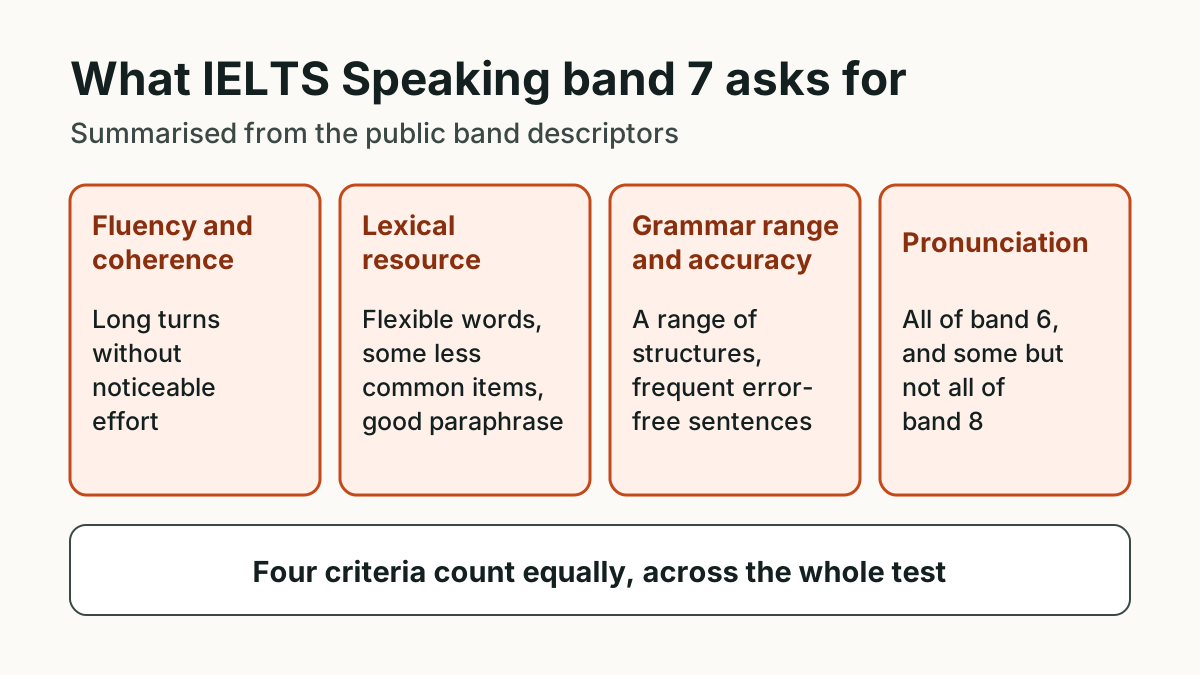
To get band 7 in IELTS Speaking, your speaking has to meet the band 7 level on four equally weighted criteria. In practice, you need to give long answers without noticeable effort, use a range of grammar with frequent error-free sentences, show some less common vocabulary and paraphrase when you need to, and stay clear enough that your listener rarely has to work. Nobody can promise you a band, but the marking criteria are public, so you can see what to work on.
For all four criteria explained at bands 6, 7 and 8 with examples, read the IELTS Speaking band descriptors in plain English. This guide is about what to do with them.
What are the IELTS Speaking band 7 criteria?
These are the key phrases from the band 7 row of the public descriptors, published by IELTS:
- Fluency and coherence: "Able to keep going and readily produce long turns without noticeable effort." Some hesitation or self-correction may occur, but "these will not affect coherence".
- Lexical resource: "Resource flexibly used to discuss a variety of topics", with "some ability to use less common and idiomatic items" and "effective use of paraphrase".
- Grammatical range and accuracy: "A range of structures flexibly used. Error-free sentences are frequent." A few basic errors persist.
- Pronunciation: "Displays all the positive features of band 6, and some, but not all, of the positive features of band 8."
Two notes at the end of the document change how you should read that list. You "must fully fit the positive features of the descriptor at a particular level", and you are rated on "average performance across all parts of the test". So one good Part 2 will not carry a weak Part 3. According to ielts.org, your Speaking score is the average of the four criteria, so a strength in one can balance a weakness in another, but all four count.
What separates band 6 from band 7?
Read the two rows side by side and a few phrases do most of the work. The change is less about harder language and more about control.
- Coherence. Band 6: "Coherence may be lost at times as a result of hesitation, repetition and/or self-correction." Band 7: hesitation happens, but it does not affect coherence.
- Linking. Band 6 uses discourse markers "though not always appropriately". Band 7 uses them flexibly.
- Grammar. Band 6 uses a variety of structures "with limited flexibility", and errors frequently occur in complex structures. At band 7, "error-free sentences are frequent".
- Vocabulary. Band 6 has enough words "to discuss topics at length". Band 7 adds less common items and "an awareness of style and collocation".
What should you practise to reach band 7?
The descriptors say what examiners listen for, not how to train, so this is our own advice based on that wording, not an official method. Start with whichever problem you hear most often in your own recordings.
- Make long turns normal. Record yourself for two minutes on a topic you did not prepare, then listen for the point where your answer stops going anywhere. Our 32 practice cue cards give you plenty of material.
- Keep your thread when you get stuck. Band 7 allows hesitation mid-sentence, so what you need is to come back to your point. When a word will not come, say what you mean another way and carry on.
- Find your two or three repeat errors. Band 7 allows "a few basic errors", which is not the same as the same errors in every sentence. Work on what you repeat first. Our list of common grammar mistakes in speaking is a good place to check.
- Learn word partnerships, not rare words. "Awareness of style and collocation" means knowing which words go together: "a heavy workload", "make a decision".
- Practise complex sentences you can actually finish. Because, although, which, if I had: use a few you control. Band 7 asks for simple and complex sentences used "effectively despite some errors".
- Work on stress and rhythm rather than accent. Band 6 mentions rhythm affected by "a rapid speech rate", so slowing down slightly can help. See our guide to English word stress.
- When a word will not come
- It's a kind of... well, a tool you use to measure how level a shelf is.
- Fixing yourself calmly
- I went there last year, or rather the year before, when I was still at college.
- Coming back to your point
- Anyway, what I was trying to say is that it saves time.
What does an IELTS Speaking band 7 sample answer sound like?
Here is an illustration written by the SpeakWisely team to show the features above. It is not an official IELTS sample, no examiner has marked it, and we are not claiming it would score a particular band. Bands are given for a whole test, and pronunciation cannot be judged from text.
- Examiner
- Why do some young people find it hard to save money?
- Illustration
- I think there are a couple of reasons. The obvious one is that spending has become so easy. You can pay with your phone in a few seconds, so it doesn't really feel like money is leaving your account. I've noticed this myself, actually. A few years ago I'd think twice before buying something, whereas now I sometimes order food without even checking the price. The other thing, and this is probably more important, is that a lot of young people are on quite low salaries when they start out, and rent takes up a big chunk of that. So it's not always about being careless. If you're earning very little in an expensive city, saving can feel a bit, what's the word, pointless, because the amount is so small. That said, I do think even a small habit helps, as long as you start early.
What it is meant to show: a long turn that stays on the question; markers such as "actually" and "that said"; a contrast with "whereas" and a condition with "if"; collocations such as "think twice"; and a short search for a word that does not lose the thread. The vocabulary is mostly ordinary.
How do you get band 8 in IELTS Speaking?
Band 8 asks for the same things with fewer gaps. Most hesitation should be about what to say next, rather than how to say it. In the official wording:
- Fluency: "Fluent with only very occasional repetition or self-correction." Hesitation "may occasionally be used to find words or grammar, but most will be content related".
- Vocabulary: a "wide resource, readily and flexibly used to discuss all topics and convey precise meaning", with "skilful use of less common and idiomatic items".
- Grammar: "The majority of sentences are error free." Errors are occasional and "non-systematic", though "a few basic errors may persist".
- Pronunciation: "Can be easily understood throughout. Accent has minimal effect on intelligibility."
The practical shift is from "correct" to "exact": saying precisely what you mean on any topic. So practise Part 3 questions on subjects you know little about, because that is where gaps show. Then look for systematic errors, since band 8 tolerates occasional slips but not patterns.
How can you check whether you are close to band 7?
Only an IELTS examiner can give you an IELTS band, but you can test yourself first. Record a full run through all three parts and check it against the phrases above: did you lose your thread, were your errors the same each time, did you have to replay anything to understand yourself?
If you would like a second opinion, IELTS speaking practice with Clara ends each mock with an estimated band on the four criteria, with your grammar and vocabulary issues quoted from what you said. It is an AI estimate inspired by the IELTS criteria, not an official result, and it can be wrong. How SpeakWisely estimates your band explains the method and its limits. To see how a Speaking score affects your overall result, try the IELTS band calculator.
Clara asks all three parts out loud in about fifteen minutes, then shows an estimated band on each criterion and what to fix.
Start practising freeQuestions about band 7 in IELTS Speaking
How can I get band 7 in IELTS Speaking?
Will my Indian accent stop me getting band 7?
Can I make mistakes and still get band 7?
How long does it take to go from band 6 to band 7?
Pick the one phrase above that sounds least like you, and work on that this week. For material to practise with, go to our IELTS Speaking topics for 2026, all written by us for practice.
AI-estimated assessment inspired by IELTS speaking criteria. Not an official IELTS or IDP result.
Your recording is used only to transcribe your answer, then deleted within 15 minutes. We keep your transcript and results, never the audio.
Sources
Keep reading
 IELTS speaking9 min read
IELTS Speaking band descriptors in plain English: what band 6, 7 and 8 actually sound like
Fluency, vocabulary, grammar and pronunciation at bands 6, 7 and 8, in everyday words, with example answers that make the difference easy to hear.
 IELTS speaking10 min read
IELTS Speaking topics 2026: 32 practice cue cards, Part 1 questions and model answers
Thirty-two cue cards by theme, six Part 1 question sets and three model answers, all written by us for practice. None is a leaked or guaranteed exam question.
 IELTS speaking8 min read
How SpeakWisely estimates your IELTS Speaking band (and its limits)
Your speech is measured, the AI finds quoted evidence, and a fixed rubric with no AI in it sets the band. Here is every step, and what an estimate cannot tell you.
 IELTS speaking11 min read
IELTS Speaking Part 3: question types, an answer structure and sample answers
The six kinds of Part 3 question, a four-step structure that turns a short reply into a developed answer, and sample answers to say aloud.