English pronunciation for Indian speakers: stress, rhythm and being understood
By the SpeakWisely team · Published · 7 min read
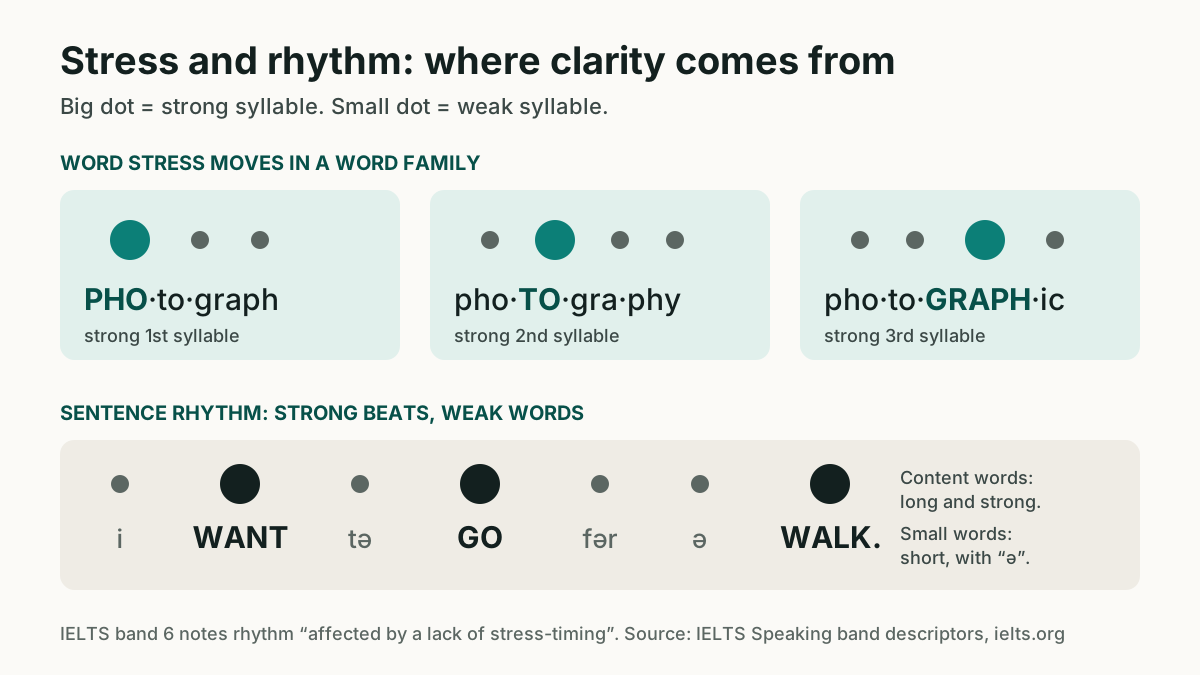
Good English pronunciation is about being understood easily, not about sounding British or American. Most Indian speakers are already clear on individual sounds most of the time. What more often makes a listener work harder is word stress (which syllable is strong), rhythm (strong and weak words in a sentence) and a handful of sound contrasts that change one word into another, such as "vest" and "west". This guide explains each, with words and sentences to practise aloud, and what the IELTS Speaking test actually rewards.
Do you need to lose your Indian accent?
No. An accent is simply where you are from, and every speaker of English has one. The goal is intelligibility: a listener from anywhere understands you the first time, without effort. The public IELTS band descriptors make the same distinction. At the top band, "accent has no effect on intelligibility"; at band 8, it "has minimal effect". Nowhere do they ask for a particular accent. IDP puts it plainly: examiners are certified "to assess your spoken English and not your accent".
So "neutral accent" training that tries to remove every trace of an Indian accent is aiming at the wrong target. A much smaller set of habits does most of the work. They are below, roughly in the order they affect clarity.
How does IELTS mark pronunciation?
Pronunciation is one of the four criteria in IELTS Speaking, so it is a quarter of your speaking score. The public descriptors are worth reading in their own words, because they say what examiners listen for:
- Band 6: "Uses a range of phonological features, but control is variable. Chunking is generally appropriate, but rhythm may be affected by a lack of stress-timing and/or a rapid speech rate." Individual sounds may be mispronounced, but this "causes only occasional lack of clarity".
- Band 7: all the positive features of band 6 and some, but not all, of band 8.
- Band 8: "Can sustain appropriate rhythm. Flexible use of stress and intonation across long utterances, despite occasional lapses. Can be easily understood throughout."
Notice what moves you up: rhythm, stress-timing, stress and intonation, and chunking (pausing between meaningful groups of words). Individual sounds matter less than many learners think. That is why this guide starts with stress and rhythm. For the other three criteria, see the IELTS Speaking band descriptors in plain English.
Word stress: which syllable is strong?
In an English word of two or more syllables, one syllable is stronger: a little longer, louder and higher. Listeners use that pattern to recognise the word, so a word with the stress in an unexpected place can be harder to catch even when every sound is right.
Indian languages tend to treat syllables more evenly, and published descriptions of Indian English note that stress often falls on different syllables than in British or American English. You do not need to change every word. Start with the families where the stress moves, because these are the ones that cause real confusion:
- Stress moves
- PHOtograph · phoTOgraphy · photoGRAPHic
- Stress moves
- eCONomy · ecoNOMic · eCONomist
- Stress moves
- DEMocrat · deMOCracy · democRATic
- Noun or verb
- a REcord · to reCORD
- Noun or verb
- a PREsent · to preSENT
- Noun or verb
- an OBject · to obJECT
The noun-verb pairs are a good example of why stress matters: the same letters are two different words, and the stress tells the listener which one you mean. IDP's pronunciation guide uses "record" for exactly this reason.
Rhythm: strong words and weak words
English is described as stress-timed: in a sentence, the important words (nouns, main verbs, adjectives, negatives) get a strong beat, and the small words between them (to, for, a, the, of, and, can) are squeezed short. Most Indian languages are syllable-timed, giving each syllable similar weight. Carried into English, that even rhythm is exactly what the band 6 descriptor calls "a lack of stress-timing". Every word is clear, but the sentence does not have the shape a listener expects.
- Even rhythm
- I · WANT · TO · GO · FOR · A · WALK.
- Stress-timed
- i WANT tə GO fər ə WALK.
- Even rhythm
- I · CAN · COME · AT · SIX.
- Stress-timed
- i kən COME ət SIX.
The weak words are not dropped; they are said quickly, usually with the short, relaxed vowel "ə" (as in the first sound of "about"). Two words keep their full form when they carry meaning: "Yes, I can." and "It's not for you, it's from you."
Chunking: pause in the right places
The band 6 descriptor also mentions chunking. Spoken English comes in groups of words that belong together, with tiny pauses between groups, not between every word, and not one long stream. Speaking very fast removes the chunks, which is why the descriptor pairs "rapid speech rate" with rhythm. Slowing down slightly often makes you sound more fluent, not less.
- One stream
- Inmycitythemetrohasmadeahugedifferencetotraffic.
- Chunked
- In my city / the metro has made / a huge difference / to traffic.
Five sound contrasts that change the word
Some sounds matter more than others, because mixing them up turns one word into a different word. These are the contrasts SpeakWisely's Pronunciation lab starts with for Hindi, Gujarati and most other South Asian first languages:
- v or w: vest / west, vine / wine, vet / wet. Many Indian languages have one sound between the two, so both English sounds come out the same. A 2019 study of educated Indian English speakers found the contrast is often weak or merged. For v, touch your top teeth to your lower lip; for w, round your lips with no teeth.
- th or t: thin / tin, three / tree, thought / taught. Most Indian languages have no "th" sound, so a strong "t" replaces it. Put the tip of your tongue lightly between your teeth and blow.
- th or d: they / day, then / den, those / doze. The same tongue position, with your voice on.
- z or j: "zero" and "rosy" said with a "j" sound. For z, make an s and add your voice, with your tongue behind your teeth, not touching the roof of your mouth.
- s or sh: sip / ship, sea / she, save / shave. Speakers of some languages, such as Assamese, use one sound for both.
For why these happen in each language, with more examples, see English mistakes Hindi speakers make and English mistakes Gujarati speakers make.
Two smaller habits worth knowing about
- Unaspirated p, t, k. In British and American English, "pin", "top" and "key" start with a small puff of air. In Indian English, these are usually unaspirated, which can make "pin" sound closer to "bin" to some listeners. Hold a tissue in front of your mouth: it should move on "pin" and not on "bin".
- An extra vowel before a cluster. Words that start with s plus a consonant, like "school", "station" and "speak", sometimes gain a vowel in front ("ischool"). Start the word directly on the s, holding it for a moment.
The Pronunciation lab plays minimal pairs like vest and west and judges your answer by which word was heard, so it checks how clearly you are understood, never your accent.
Try the Pronunciation labA 10-minute pronunciation routine
- Two minutes of minimal pairs. Pick one contrast, say each pair slowly, then quickly, then in a short sentence: "The vet got wet."
- Three minutes of word stress. Take five long words from your work or studies, check their stress in a dictionary, and say each one three times, exaggerating the strong syllable.
- Three minutes of shadowing. Play a short clip of clear spoken English, a sentence at a time, and say it along with the speaker. Copy the rhythm, the weak words and the pauses, not the accent.
- Two minutes of free speech, recorded. Talk about your day for a minute, then listen back once for chunking: are there pauses between groups of words, or between every word?
Little and often works better than one long session, because pronunciation is partly a physical habit. Short daily practice also fits the rest of your speaking: our guide on how to stop saying "um" uses the same record-and-listen method for fillers.
Questions about English pronunciation
Does an Indian accent lower my IELTS Speaking band?
Not in itself. The band descriptors assess how easily you are understood, and IDP says examiners assess your spoken English, not your accent. What can lower the pronunciation score is a lack of clarity, uneven rhythm or stress, not where you are from.
What is a "neutral accent"?
It is usually used to mean an accent with few strong regional features, especially in call-centre training. There is no single neutral English accent. A more useful goal is to be easily understood by listeners from many places.
Should I learn British or American pronunciation?
Either is fine, and so is a clear Indian English. IELTS accepts all of them. Choose models you can listen to often, and be consistent within a word.
How long does it take to improve pronunciation?
There is no fixed timeline: it depends on how often you practise and what you are fixing. A single sound contrast is a narrow target, while rhythm covers whole sentences, so expect rhythm to take longer. Record yourself every week or two so you can hear the change rather than guess at it.
Your recording is used only to transcribe your answer, then deleted within 15 minutes. We keep your transcript and results, never the audio.
Sources
- IELTS Speaking band descriptors, public version (ielts.org)
- Do accents affect IELTS Speaking scores? (IDP)
- Word stress, sentence stress and intonation in IELTS Speaking (IDP)
- Fuchs, R. (2019). The elusive /v/-/w/ contrast in educated Indian English. ICPhS 2019
- Indian English: phonology (Wikipedia)
- Stress and vowel reduction in English (Wikipedia)
Keep reading
- Common English mistakes Hindi speakers make, and how to fix them
Verb at the end, no "a" or "the", one "se" for since and for, one व for v and w. Ten patterns Hindi brings into English, and a drill for each.
- Common English mistakes Gujarati speakers make, and how to fix them
Verb at the end, one "thi" for since and for, one વ for v and w, no z of its own. Ten patterns Gujarati brings into English, and a drill for each.
- IELTS Speaking band descriptors in plain English: what band 6, 7 and 8 actually sound like
Fluency, vocabulary, grammar and pronunciation at bands 6, 7 and 8, in everyday words, with example answers that make the difference easy to hear.