How SpeakWisely estimates your IELTS Speaking band (and its limits)
By the SpeakWisely team · Published · 8 min read
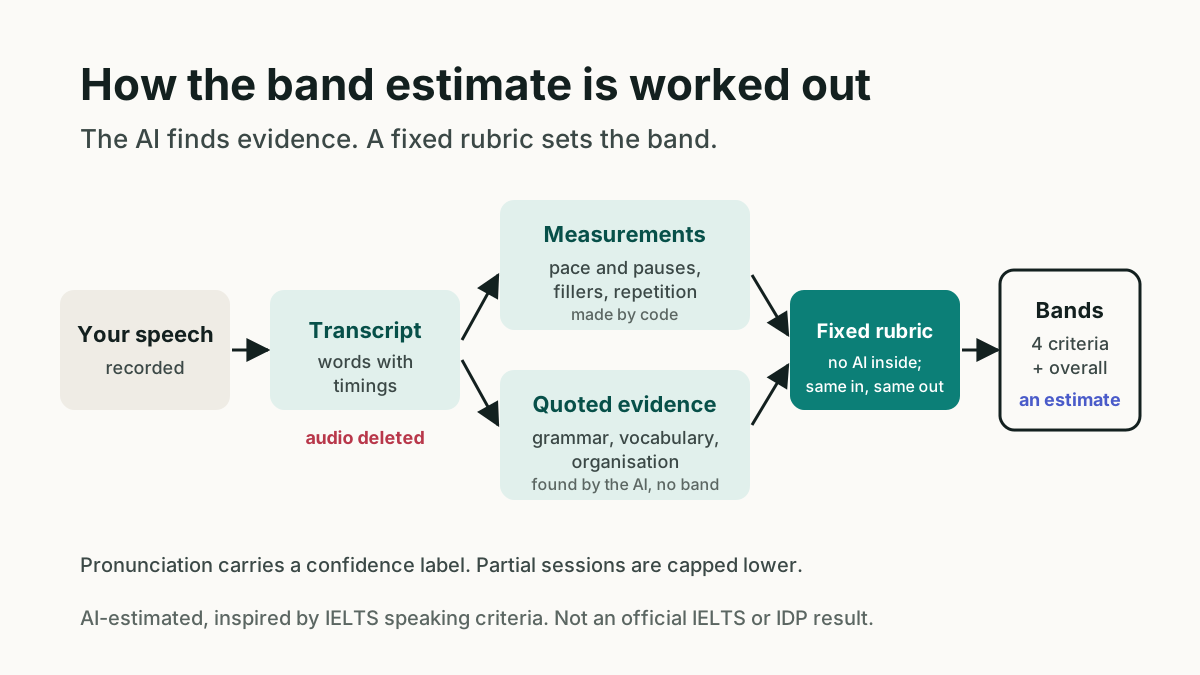
SpeakWisely estimates your IELTS Speaking band in four steps. Your answer is transcribed into words with timings. Your fluency is measured from those timings: pace, pauses, filler words and repetition. An AI model reads the transcript and finds grammar, vocabulary and organisation issues, each quoted from what you said, but it is never asked for a band. Finally a fixed rubric, written as ordinary code with no AI inside it, turns all of that evidence into four criterion bands and an overall band.
This post explains each step, the safety rails around them, and the honest limits of the result. It is written for anyone who wants to know whether to trust the number, and how far.
What happens to your recording?
When you finish an answer, the recording is sent to a speech recogniser, which turns it into a transcript: the words you said and when each one started and ended. Everything after this point works from the transcript and its timings, not from the audio.
Then the audio goes. Your recording is processed and then deleted. It is never stored; only your transcript and results are kept. While it waits to be transcribed, the recording sits in temporary memory with an automatic expiry, so it disappears even if something goes wrong. There is no audio field in the database and no way to download it. The replay button on your results page plays a copy held in your own browser tab, which is why it disappears when you reload the page.
What is measured directly from your speech?
The first kind of evidence is measured by code, not judged by AI. These are counts and ratios worked out from the transcript and its timings:
- Pace: words per minute. Slow speech pulls the fluency estimate down much more than fast speech does; the rubric treats slowness, not speed, as the fluency problem.
- Pauses: how often you go silent for more than two seconds, and what share of the recording is silence.
- Filler words: "um", "uh", "er", "you know", "I mean" and similar, counted per 100 words.
- Repetition: words said twice in a row while you searched for the next one.
- Vocabulary range: how much you vary your words, and how many go beyond everyday vocabulary.
- Sentence complexity: how many sentences join ideas with words such as "because", "although" or "which".
- Linking words: how many different ones you used, such as "however", "for example" or "on the other hand", and whether you leaned on one of them for most of your linking.
- Recognition confidence: how reliably the recogniser could make out your words.
These numbers matter because they are the habits behind a fluency estimate, and they are the hardest to notice in yourself. If filler words are your biggest number, our guide on how to stop saying "um" is the place to start.
What does the AI model do, and what does it not do?
The second kind of evidence needs language understanding, so an AI model reads your transcript. It is asked to find:
- Grammar mistakes, each with the exact words you said, a correction and a one-line reason, marked major if it changes or hides your meaning and minor if it does not.
- Vocabulary issues, such as words used wrongly or unnaturally, and more precise alternatives for phrases you actually used.
- Organisation, meaning how well your ideas followed one another, and whether you answered the question that was asked.
- You said
- Nowadays peoples are very busy.
- Correction
- Nowadays people are very busy.
- Reason
- "People" is already plural, so it never takes an -s.
Two safety rails apply. First, every quote is checked against your transcript. An issue whose quote cannot be found in what you said is dropped before it can reach your report or move a score. Second, the model is not trusted with arithmetic: the share of your sentences that were error-free is calculated by code from the quoted mistakes, not taken from the model.
The model does give a few narrow ratings out of 100, such as how well your answer was organised or how precise your word choice was. What it never gives is a band. It finds and rates evidence; it does not decide your score.
How does a fixed rubric turn evidence into a band?
The rubric is a set of fixed tables, one for each measurement, that say which band a value points to. For example, very few long pauses per minute points towards a high fluency band, and several a minute points much lower. Each criterion combines its measurements with fixed weights and rounds to the nearest half band.
Some band descriptors are requirements, not averages, so the rubric also applies descriptor checks after averaging. For example, a band 8 for grammar needs a majority of error-free sentences, so if fewer than half of yours were error-free, grammar is capped at 7.5 however good the rest was. These checks can only lower a band, never raise one, and the report says which requirement was not met.
- No AI inside. The rubric is plain code, so the same measurements and evidence always produce the same bands.
- Versioned. Every result stores the rubric version it was scored with, so a later change to the rubric never silently rewrites your old scores.
- Shown, not hidden. Each band in the report lists what was measured, the band that measurement points to and how much it counts.
Your overall band is the average of the four criteria, rounded so that an average ending in .25 goes up to the next half band and one ending in .75 goes up to the next whole band. If you want to know what each band sounds like in practice, read the IELTS Speaking band descriptors in plain English.
The clearest way to understand the report is to see it built from your own answer. Sit one part or a full mock with Clara and open the evidence behind each band.
Try a free IELTS mock with ClaraWhy does pronunciation carry a confidence label?
Pronunciation is the hardest criterion to judge from a recording. SpeakWisely does not claim to hear individual sounds the way a trained listener does. Instead it uses how reliably the recogniser could make out your words, how many stretches were hard to resolve and how steady your pace was. Accent is never treated as an error; only how clearly your words came through counts.
Because this evidence is weaker than the rest, the pronunciation band always comes with a confidence label: high, medium or low. When the audio evidence is limited, the estimate is held closer to your other three bands instead of being stated as if it were certain, and the report says so.
Why is a single part capped lower than a full mock?
A real examiner scores you across all three parts, because each part tests something the others cannot. Part 1 asks simple questions about familiar topics, so it cannot show whether you can handle abstract discussion. A session that covers only some parts therefore has a ceiling:
- Part 1 only: capped at 6.5.
- Part 2 or Part 3 only, or a single answer from either: capped at 7.0.
- Two of the three parts: capped at 7.5.
- A full mock with all three parts: no cap.
A partial session also gets a lower confidence label. If a cap changed your band, the report shows the band before the cap and names the part that was missing. To see where you really stand, sit a full IELTS Speaking mock; to understand what each part asks of you, see the IELTS Speaking test format.
What are the limits of the estimate?
- It is not an examiner. It works from a transcript and word timings. An examiner listens to you live, follows up in the moment and judges things a transcript does not capture.
- It depends on the transcript. If the recogniser mishears a word, a "mistake" can appear that you never made. Your report shows the transcript as it was recognised, so check it when something looks wrong.
- Short answers give less evidence. A brief answer gives fewer sentences to judge, so its bands come with lower confidence.
- The rubric is ours. Its tables were written by SpeakWisely from the wording of the public band descriptors. They are not supplied by IELTS, IDP or the British Council.
- Some judgements are judgements. Ratings for organisation or word choice come from an AI model reading your answer. The quotes are checked; the opinions are still opinions.
Used well, the estimate is a consistent ruler: it tells you which criterion is holding you back, shows the exact sentences behind it, and lets you see whether a retry moved it. Used badly, it is a number to worry about. Read the evidence, fix one thing, and try again.
Questions about the band estimate
Is the SpeakWisely band an official IELTS score?
No. It is an AI-estimated assessment inspired by the IELTS Speaking criteria, not an official IELTS or IDP result. Use it to see where you stand and what to work on.
Does the AI decide my band?
No. The AI model finds quoted grammar, vocabulary and organisation evidence and gives a few narrow ratings. A fixed rubric with no AI inside turns that evidence and your measured fluency into bands.
Will my Indian accent lower my pronunciation band?
No. Accent is never treated as an error. Pronunciation feedback looks only at how clearly your words came through.
Why did one part get a lower band than my full mock?
A session that covers only part of the test is capped, because it gives less evidence: 6.5 for Part 1 alone, 7.0 for Part 2 or Part 3 alone, and 7.5 for two parts. A full mock has no cap.
Are my recordings stored?
No. Your recording is processed and then deleted. Only your transcript and results are kept.
AI-estimated assessment inspired by IELTS speaking criteria. Not an official IELTS or IDP result.
Your recording is processed and then deleted. It is never stored — only your transcript and results are kept.
Sources
Keep reading
- IELTS Speaking band descriptors in plain English: what band 6, 7 and 8 actually sound like
Fluency, vocabulary, grammar and pronunciation at bands 6, 7 and 8, in everyday words, with example answers that make the difference easy to hear.
- IELTS Speaking test format: Parts 1, 2 and 3 explained
Eleven to fourteen minutes, three parts, one examiner. What happens in each part, how long you speak, and what to practise for each.
- How to learn to speak English with AI: what AI feedback can and can't tell you
AI is a patient practice partner that can measure your pauses and quote your mistakes. It cannot give you an official score or replace real conversations. Here is how to use it well.