How to answer "Tell me about yourself" in an English interview
By the SpeakWisely team · Published · 7 min read
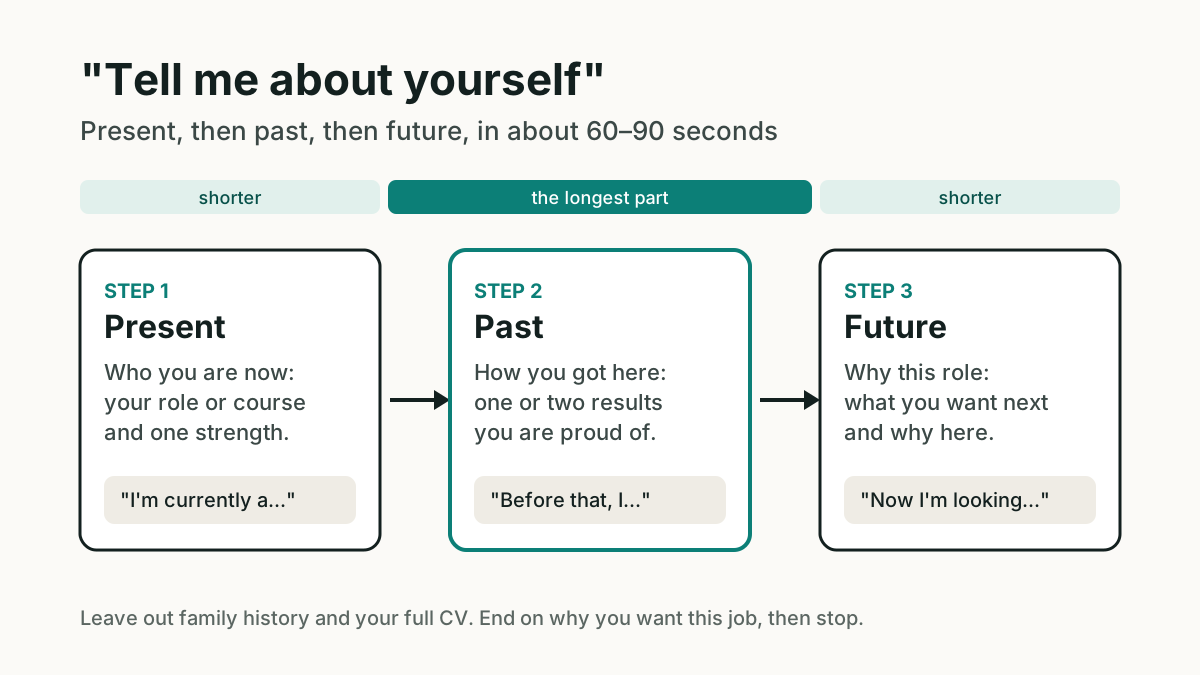
Answer "Tell me about yourself" in three steps: present (who you are now), past (one or two things you have done that matter for this job), and future (why you want this role). Keep it to about 60 to 90 seconds, talk about work rather than your family history, and rehearse it out loud until it sounds like talking, not reciting.
Below you will find the structure in detail, three sample answers for different situations, phrases to use and avoid, and a way to rehearse that works even if you get nervous speaking English.
What does the interviewer want to hear?
This question is a warm-up, but it does real work. In about a minute, the interviewer learns what you do, whether your experience fits the role, and whether you can explain yourself clearly in English. Your answer also sets up the next questions: whatever you mention, they are likely to ask about.
So it is not an invitation to tell your life story, and it is not a request to read your CV aloud line by line. They already have your CV. What they want is the short, spoken version that connects your background to this job.
The present–past–future structure
University careers services often recommend this simple order. It works because it starts with what is most relevant and ends with the reason you are in the room.
- Present: who you are now. Your current role, company or course, and one strength or focus area. Two sentences.
- Past: how you got here. One or two experiences that matter for this job, each with a concrete result. This is the longest part.
- Future: why this role. What you want to do next and why this company or team fits. Then stop.
- Present
- I'm currently a … at …, where I mainly work on …
- Past
- Before that, I … One thing I am proud of is …, which led to …
- Future
- Now I'm looking for a role where I can …, which is why this position interests me.
The order is a guide, not a rule. If your most relevant experience is in the past, for example if you are returning to a field you worked in before, you can start there. What matters is that the answer moves in one direction and ends with the future.
How long should your answer be?
Aim for about 60 to 90 seconds. Shorter than that and you give the interviewer little to work with; much longer and you start to lose them. At a calm pace of around 130 words a minute, that is roughly 130 to 200 words. The sample answers below are around 110 words each, which takes about a minute once you add natural pauses.
Time yourself once or twice. A minute can go faster than you expect, and two minutes can feel very long when you are the only one talking.
Sample answers for three situations
Use these to see the structure in action, not to memorise. Swap in your own facts and say it in your own words.
A fresher: final-year engineering student
- Sample answer
- I'm Priya, and I'm in the final year of a B.Tech in computer science at a college in Coimbatore. Most of my project work has been on the back end, mainly Java and SQL. Last summer I did a two-month internship at a logistics start-up in Chennai, where I built a small tool to track delayed shipments. The operations team still uses it every day, which was a great feeling. In college I also lead our coding club, so I'm used to explaining technical things to juniors. Now I'm looking for a trainee role where I can work on real products and learn from an experienced team, and that's why this programme appeals to me.
With no full-time job yet, the "past" is projects, internships and responsibilities. One concrete result, a tool people still use, is worth more than a list of five technologies.
An experienced professional
- Sample answer
- I'm Rahul. I'm a senior sales executive with a pharmaceutical company in Indore, and I've been in sales for six years. I currently manage about forty doctors and twelve chemists across two districts. Over the last two years I've grown my territory's sales steadily, mainly by focusing on a few high-potential clinics instead of spreading myself thin. Before this, I spent two years in FMCG sales, which taught me how to work with distributors. I've also been training two new joiners on our team. Now I'm ready to lead a team myself, and this area manager role is a natural next step, especially since your company is expanding in central India.
An experienced answer chooses. Six years contain many stories; this one picks the two that point at a manager role: results and training others.
A career switcher
- Sample answer
- I'm Sneha. For the last four years I've been a science teacher at a CBSE school in Pune. A big part of my job has been designing lessons, and two years ago I started creating short videos and quizzes for my classes when we moved to blended learning. That became the part of the job I enjoyed most. To build on it, I completed an online course in instructional design last year, and I've since built three sample e-learning modules, which are in my portfolio. Now I'd like to do this full time, and your learning and development team appeals to me because you create training for very different audiences.
A switcher needs to answer the unspoken question "why the change?" before it is asked. The answer shows a thread from the old job to the new one, and proof of the move: a course and a portfolio.
Reading a good answer is not the same as saying one. In SpeakWisely's practice lab, tell it what is coming up, such as an interview tomorrow, and you get a rehearsal role-play, likely questions and useful phrases. The job interview role-play opens by asking you to tell the interviewer about yourself.
Rehearse your answer out loudWhich phrases should you use and avoid?
Phrases that work
- "I'm currently working as… at…"
- "I've spent the last … years working on…"
- "One thing I'm proud of is…, which led to…"
- "That experience taught me how to…"
- "Now I'm looking for a role where I can…"
- "That's what drew me to this position."
Phrases to drop
Some common openings are grammar slips, and others sound unnatural in standard English. They are easy to fix:
- Weak
- Myself Rahul.
- Better
- I'm Rahul. / My name is Rahul.
- Weak
- I am having six years of experience in sales.
- Better
- I have six years of experience in sales.
- Weak
- I have done my graduation from Pune University in 2019.
- Better
- I graduated from Pune University in 2019.
The last two are tense slips: "have" for possession is not used with -ing, and a finished year such as 2019 needs the past simple. Our guide to the English tenses you need for speaking covers both.
- Family details nobody asked for. "My father is a businessman and my mother is a homemaker" uses up time that should go on your work.
- A list of adjectives. "I am hard-working, sincere and honest" proves nothing. One example of hard work does.
- "As you can see in my resume…" They can. Tell them what the CV does not say.
- Filler openings. Starting with "So, basically…" or "Um, okay, so…" wastes your strongest moment. If fillers are a habit, the 7-day routine to stop saying "um" helps.
How should you rehearse it out loud?
- Write bullet points, not a script. Three or four keywords for each part. A full script tempts you to memorise, and memorised answers sound flat.
- Say it out loud five times and record it. Saying it in your head is not practice; your mouth needs the rehearsal as much as your memory.
- Time each take. Trim until you land between 60 and 90 seconds.
- Listen back for three things only: fillers, tense slips and whether the ending clearly says why you want this job.
- Change the wording each time. Keep the structure and the facts, vary the sentences. That way it still sounds fresh on the day.
- Practise the follow-ups. "Tell me more about that project." "Why are you leaving?" "Why the change of career?" Whatever you mentioned, be ready to expand on it.
In SpeakWisely you can set Job interviews as your goal when you start, so daily practice focuses on answering clearly, giving examples and sounding confident. The job interview role-play has a friendly but probing interviewer who follows up on vague answers, and you can choose a British, American, Australian or Indian accent for your partner. Read more about English speaking practice and the tools in the practice lab, or see how to learn English with AI for a wider plan.
Common questions about "Tell me about yourself"
Should I talk about my family and hometown?
Only briefly, if at all, and only if it connects to the job, for example a family business that got you interested in the field. In most interviews, your work, studies and goals are a better use of the time.
Can I memorise my answer?
Memorise the structure and the key facts, not the sentences. A word-for-word answer tends to sound recited, and if you forget one line it is hard to recover. Rehearse with different wording each time.
I am a fresher with no experience. What do I say for the "past" part?
Use projects, internships, college responsibilities, competitions or a part-time job. Pick one with a concrete result and explain what you did, not just what the team did.
Is it a problem to have an Indian accent in an English interview?
No. Interviewers need to understand you, and that is about clarity, not accent. Speak at a calm pace, finish the ends of your words and pause between ideas.
Your recording is processed and then deleted. It is never stored — only your transcript and results are kept.
Sources
Keep reading
- The English tenses you actually need for speaking
Six forms carry everyday conversation. Which ones they are, the mix-ups that give learners away, and how to practise them out loud.
- How to stop saying "um" and "like": a fluency practice routine
Fillers are the sound of planning out loud. Swap them for short silent pauses, keep a few thinking phrases ready, and track your fillers per minute for a week.
- How to learn to speak English with AI: what AI feedback can and can't tell you
AI is a patient practice partner that can measure your pauses and quote your mistakes. It cannot give you an official score or replace real conversations. Here is how to use it well.