IELTS Speaking Part 3: question types, an answer structure and sample answers
By the SpeakWisely team · Published · 11 min read
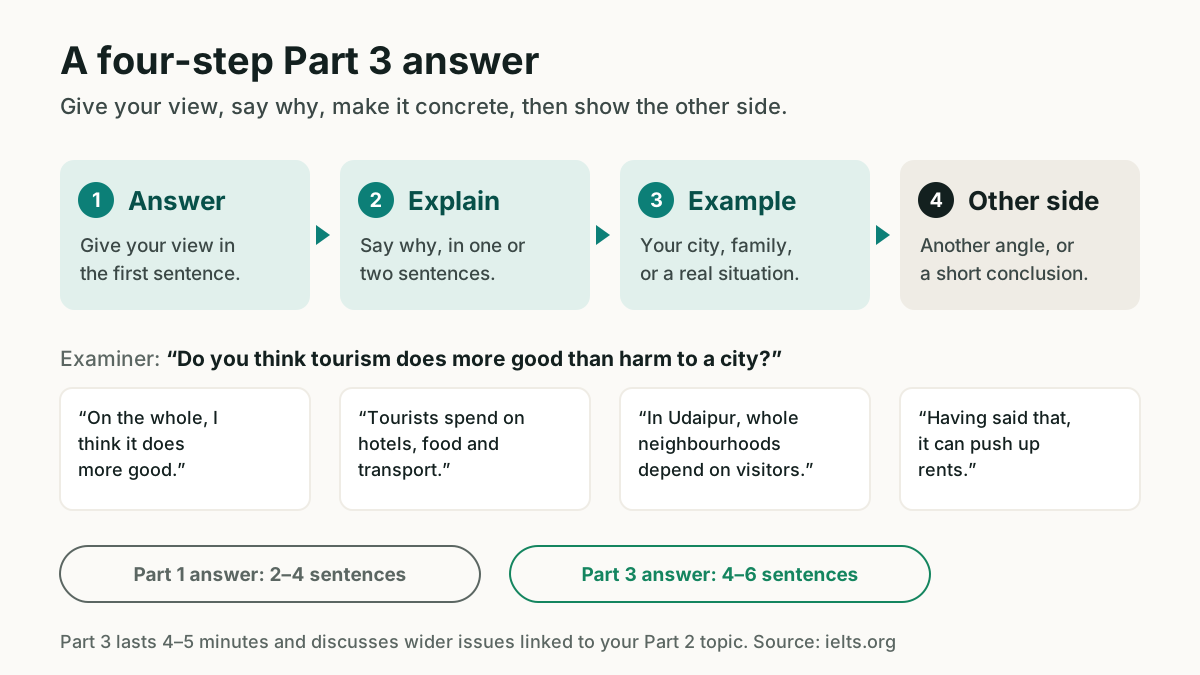
IELTS Speaking Part 3 is a 4 to 5 minute discussion with the examiner about wider issues linked to your Part 2 topic. The questions are more abstract than in Part 1: why people do things, how things have changed, what might happen in future. A good answer is four to six sentences long: answer directly, explain why, give an example, then add the other side or a short conclusion. This guide covers the question types, that four-step structure, phrases that buy you thinking time, and sample answers on three common topics.
As with any sample answers, these are not "the" questions from the current test. They are typical of what the official format describes, written for an Indian test taker. Use them to practise the shape of an answer, then talk about your own ideas.
What happens in IELTS Speaking Part 3?
Part 3 comes straight after your two-minute Part 2 talk. According to ielts.org, you and the examiner discuss issues related to the Part 2 topic "in a more general and abstract way". It tests your ability to explain your opinions and to analyse, discuss and speculate about issues. IDP describes it as feeling "more like a discussion than an interview".
So if your Part 2 card asked you to describe a place you would like to visit again, Part 3 moves away from that one place and towards ideas: why people travel, whether tourism is good for a city, how holidays have changed. The examiner is no longer asking about you; they are asking what you think about people and society. For how this part fits with the rest of the test, see the IELTS Speaking test format.
How long should a Part 3 answer be?
Longer than in Part 1. In Part 1, two to four sentences is right. In Part 3, a short answer leaves the examiner nothing to assess, so aim for four to six sentences, which is roughly thirty seconds to a minute. That is our guidance, not an official rule: the examiner keeps time and may interrupt with a follow-up question, which is normal and not a sign you did badly.
A common problem for learners who move straight from Part 1 practice is carrying the short-answer habit into Part 3. "Yes, I think tourism is good because it gives jobs." is correct English, but it is one idea with no development, and the band descriptors reward the ability to produce long turns and link ideas.
A four-step structure for Part 3 answers
- Answer. Give your view in the first sentence: "I think…", "On the whole, yes…", "It depends, but mostly…".
- Explain. Say why, in one or two sentences: "The main reason is that…", "This is because…".
- Example. Make it concrete: something from your city, your family, the news, or a general situation. "For example, in Jaipur…", "Take my cousin, who…".
- Other side or conclusion. Show you can see more than one angle, or round off: "Having said that…", "On the other hand…", "So overall…".
- Examiner
- Do you think tourism does more good than harm to a city?
- Answer
- On the whole, I think it does more good.
- Explain
- The main reason is money: tourists spend on hotels, food and transport, so a lot of local people earn a living from them.
- Example
- In Udaipur, for instance, whole neighbourhoods near the lake depend on visitors, from guesthouse owners to boatmen.
- Other side
- Having said that, it can push up rents and make the old city very crowded, so I think the government needs to manage it carefully rather than just attract as many tourists as possible.
You do not have to use all four steps every time, and you should not say the step names aloud. Some answers need two examples and no other side; a simple question may need only an answer, a reason and an example. The structure is a safety net for the moment your mind goes blank, not a script.
What kinds of questions come up in Part 3?
Most Part 3 questions fall into six types. Recognising the type in the first second tells you what shape your answer should take, and which language helps.
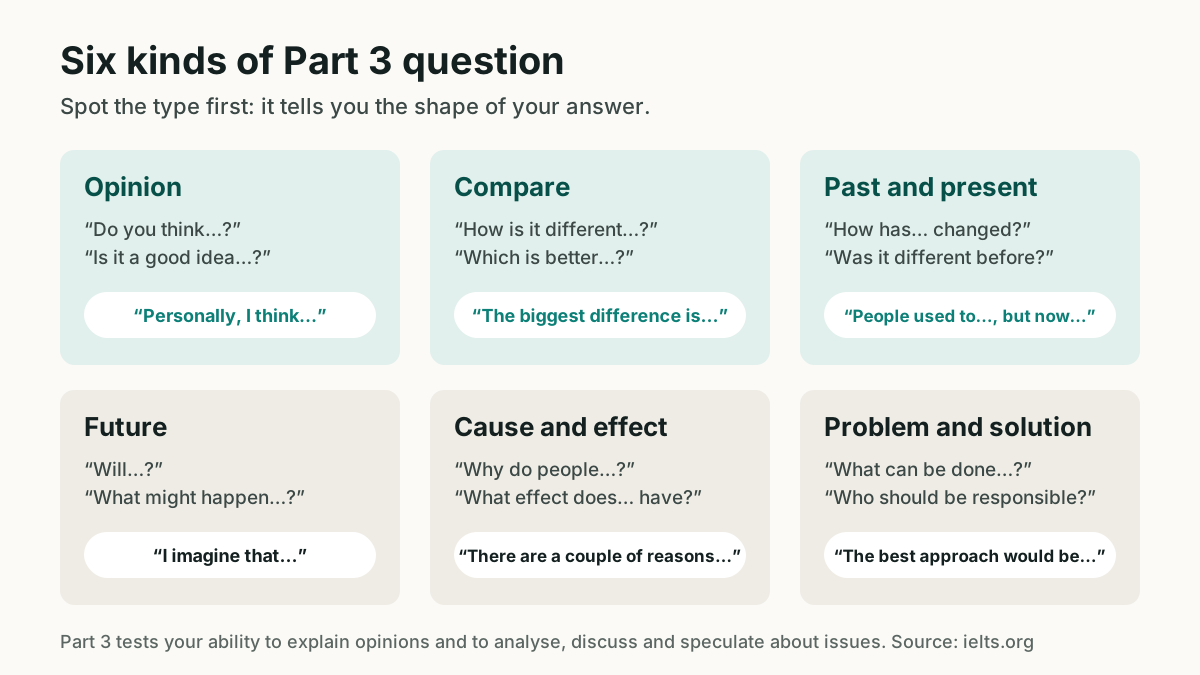
1. Opinion: "Do you think…?", "Is it a good idea…?"
Give a clear view, then the reason. Useful phrases: "I'd say…", "Personally, I think…", "I'm not completely convinced that…". Avoid a bare "yes" or "no".
2. Compare: "How is it different from…?", "Which is better…?"
Name the difference, then explain it: "The biggest difference is that…", "…whereas…", "…is much more… than…". Comparisons of cities and villages, young and old people, or online and in-person activities are common.
3. Past and present: "How has… changed?"
This is where tense range shows. Contrast then and now: "Twenty years ago, people used to…, but these days…", "…has become far more common since…". Our guide to English tenses for speaking covers the forms you need.
4. Future and speculation: "Will…?", "What might happen…?"
You are not expected to know the future, only to speculate. Use language of probability: "I imagine…", "It's likely that…", "…might well…", "I doubt that… will…".
5. Cause and effect: "Why do people…?", "What effect does… have?"
Give two causes or effects rather than one: "There are a couple of reasons. Firstly… Another reason is…", "One effect is… It also means that…".
6. Problem and solution: "What can be done about…?", "Who should be responsible…?"
Suggest a solution and say who should act: "I think the best approach would be to…", "It should really be up to… because…", "Schools could…, and parents could…".
Recognising question types is easier out loud than on paper. Clara asks four Part 3 questions that grow out of your Part 2 topic, and in Help me as I go mode she tells you after each answer whether you developed it enough.
Practise Part 3 with ClaraPart 3 sample answers on three common topics
Each topic below follows on from a typical Part 2 card. Read the answers aloud, notice the structure, then answer the same questions with your own ideas.
Technology (after "describe a piece of technology you use every day")
- Examiner
- How has technology changed the way people communicate?
- Answer
- Enormously. When my parents were young, a phone call to another city was expensive, so people wrote letters or waited for festivals to meet. Now my mother is in three family WhatsApp groups and talks to her sisters every day. The downside, I think, is that conversations have become shorter and more frequent rather than deep, so we are in touch more but sometimes know each other less.
- Examiner
- Do you think children spend too much time on screens?
- Answer
- In many cases, yes. A lot of children use phones to fill every spare minute, and that probably affects their sleep and their attention in class. That said, screens aren't the problem in themselves: a child watching a science video is doing something quite different from one scrolling short clips. So I'd say parents should focus on what children watch, not only on how long.
Education (after "describe a teacher who helped you")
- Examiner
- What makes a good teacher?
- Answer
- I'd say patience matters most. Students learn at very different speeds, and a teacher who makes a slow student feel stupid can put them off a subject for life. My maths teacher in Class 9 was a good example: she would explain the same idea three different ways until everyone got it. Subject knowledge is important too, of course, but it is not much use if you can't pass it on.
- Examiner
- Will online learning replace classrooms in future?
- Answer
- I doubt it will replace them completely. Online courses are great for adults who work, and they've made good teaching available in small towns. But school is about more than information: children learn to work in groups, argue, make friends. I imagine we'll end up with a mix, with some subjects taught online and the classroom kept for the things that need people together.
Cities and housing (after "describe a place where you would like to live")
- Examiner
- Why do so many young people move to big cities?
- Answer
- There are a couple of reasons. The obvious one is jobs: most IT and finance companies are in cities like Bengaluru and Pune, so graduates follow the work. Another reason is lifestyle; young people want more independence and more things to do than a small town offers. The cost is that they often pay very high rents and live far from their families.
- Examiner
- What can governments do to make cities better places to live?
- Answer
- I think the best approach would be to invest in public transport. If people could get to work quickly by metro, they wouldn't all need to live in the most expensive areas, and there would be less traffic and pollution. Mumbai's newer metro lines are a step in that direction. Housing matters too, but transport probably makes the biggest difference to everyday life.
What should you say when you need time to think?
Part 3 questions are harder, and a short pause to think is natural. A silent two-second pause is fine; a long "ummm" is what draws attention. ielts.org suggests phrases such as "let's see… that's a difficult question" and "I've never really thought about that, but…". A few more that sound natural:
- "That's an interesting question. I suppose…"
- "It's hard to say for sure, but I'd guess…"
- "Let me think about that for a second…"
- "I don't know much about it, to be honest, but my impression is that…"
Use each one once, not before every answer, or it becomes a filler of its own. For the wider habit, see how to stop saying "um" and "like".
What if you have no opinion on the topic?
It happens: you may never have thought about, say, the future of museums. The examiner is assessing your English, not your knowledge, so there is no wrong opinion. Three moves help:
- Bring it closer to home. "I don't visit museums much myself, but in my city the government museum is usually full of school groups, so…"
- Speculate openly. "I've never really thought about it, but I imagine…" is honest and shows the language of speculation.
- Talk about different people. "For older people… whereas younger people…" gives you two sides to discuss without needing facts.
Common Part 3 mistakes
- Part 1-length answers. One sentence per question. Develop each answer with a reason and an example.
- Answering about yourself only. "I don't use social media much" answers a Part 1 question. Part 3 wants "people", "young people", "society": widen it.
- Memorised answers. IDP advises against memorising answers and recommends learning how to think and structure your replies instead. A prepared speech rarely fits the exact question, and it shows.
- Formal written linkers. "Furthermore" and "in conclusion" sound like an essay. Prefer "and another thing is", "on top of that", "so overall".
- Stopping at the first idea. If you finish in ten seconds, add an example or the other side before the examiner moves on.
- Treating follow-ups as a bad sign. The examiner may interrupt to ask "Why?" or "Is that always true?". That is how a discussion works.
How does Part 3 affect your band?
Part 3 is marked on the same four criteria as the rest of the test: fluency and coherence, lexical resource, grammatical range and accuracy, and pronunciation. The public band descriptors say you are rated on your average performance across all parts, so Part 3 is not scored on its own. It is, however, where higher-band features are easiest to show: long turns, flexible linking, speculation and a range of tenses. The IELTS Speaking band descriptors in plain English explains what each band asks for.
How should you practise Part 3?
- Practise after a Part 2 talk. Part 3 follows on from your cue card, so practise them together. Our Part 2 cue card guide has topics to start from.
- Ask yourself "why?" twice. For any opinion you give, ask why, then ask why again. The second answer is usually your example.
- Record and time yourself. Under twenty seconds is usually too short for Part 3; over a minute and a half, you may be repeating yourself.
- Change your opinion on purpose. Answer the same question once agreeing and once disagreeing. It trains the "other side" step and stops you memorising.
With SpeakWisely you can practise Part 3 with Clara, on its own or as the last part of a full mock. She asks four discussion questions that grow out of your Part 2 topic, out loud, and you answer out loud. The report then gives an estimated band on the four criteria, with notes on your own sentences.
Questions about IELTS Speaking Part 3
How long is IELTS Speaking Part 3?
Part 3 lasts 4 to 5 minutes, according to the official test format. The number of questions varies with the length of your answers, because the examiner keeps time rather than working through a fixed count.
Is Part 3 related to Part 2?
Yes. Part 3 discusses issues connected to your Part 2 topic, but in a more general and abstract way. If Part 2 was about a teacher, Part 3 may be about education in general.
Can I disagree with the examiner or give an unpopular opinion?
Yes. There are no right or wrong opinions in IELTS Speaking. What is assessed is how clearly you explain and support your view, not the view itself.
What if I do not understand a Part 3 question?
Ask the examiner to repeat or rephrase it, for example "Sorry, do you mean…?". It is normal, and much better than answering a question you were not asked.
Should I give examples from my own life in Part 3?
You can, as one example inside a wider answer. Start with the general point about people or society, then use your own experience to illustrate it.
AI-estimated assessment inspired by IELTS speaking criteria. Not an official IELTS or IDP result.
Your recording is used only to transcribe your answer, then deleted within 15 minutes. We keep your transcript and results, never the audio.
Sources
Keep reading
- IELTS Speaking Part 2 cue cards: how to plan in one minute and speak for two
A note layout that fits in the one-minute preparation, a full worked cue card with a two-minute model answer, and what to do when you run dry.
- IELTS Speaking band descriptors in plain English: what band 6, 7 and 8 actually sound like
Fluency, vocabulary, grammar and pronunciation at bands 6, 7 and 8, in everyday words, with example answers that make the difference easy to hear.
- IELTS Speaking Part 1: common questions with natural sample answers
Typical Part 1 questions on familiar topics, natural two-to-four-sentence answers, and the simple formula that keeps every answer the right length.