IELTS vs PTE vs TOEFL: what actually differs, and how to choose in 2026
By the SpeakWisely team · Published · 7 min read

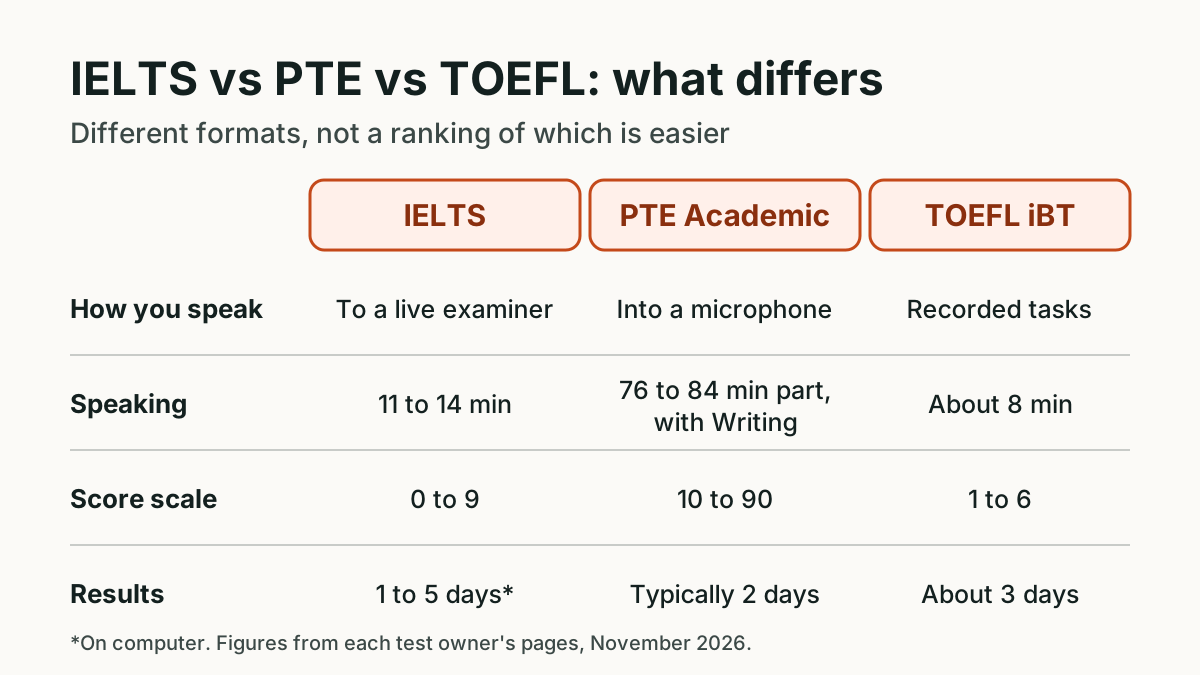
The biggest practical difference between IELTS, PTE and TOEFL is how you speak and what your target accepts. In IELTS you talk face to face with an examiner. In PTE Academic you record into a microphone and an AI system does the marking, with some human review. In the updated TOEFL iBT, Speaking lasts about 8 minutes and also uses recorded responses. Start with the test your visa or university accepts. If more than one fits, choose the format you can perform best in.
A note on where we stand: SpeakWisely publishes this comparison, and we build IELTS speaking practice, with nothing specific to PTE or TOEFL, so we have an interest in IELTS. To keep this fair, test details come from each test owner's pages and visa details from government pages. We have left out fees, which change and vary by country.
Is PTE easier than IELTS?
We did not find neutral evidence that any of the three is easier, so we will not claim it. Personal stories prove little, since someone who does better on a second test, of any kind, has also had more practice. What we can say is that the tasks differ. If talking to a person relaxes you, IELTS may feel more natural. If an examiner makes you nervous and you are comfortable with a microphone and strict timing, PTE or TOEFL may suit you. That is about fit, not about which test is softer.
How is the Speaking section different in each test?
- IELTS: a recorded, face-to-face interview with a certificated examiner, lasting 11 to 14 minutes. Three parts: questions about familiar topics, a task card with about two minutes of talk, and a discussion of broader issues. Even on computer, Speaking is held with a trained examiner. In the IELTS Online version, it takes place on a video call.
- PTE Academic: you record every response into a microphone, and there is no person to speak to. Speaking and Writing share one part of 76 to 84 minutes. The scored speaking tasks include Read Aloud, Repeat Sentence, Describe Image, Retell Lecture, Answer Short Question, Summarize Group Discussion and Respond to a Situation. Recordings cannot be redone, and in Answer Short Question, the recording stops if you pause for 3 seconds.
- TOEFL iBT (since January 2026): 11 items in about 8 minutes, with two task types: Listen and Repeat, and Take an Interview. It used to be 4 tasks in about 16 minutes.
To feel the difference, try these. They are our own imitations of each task style, not official questions.
- IELTS style
- Do you prefer travelling by train or by bus? Answer in two to four sentences, as if a person were sitting opposite you.
- PTE style
- Read this aloud once, clearly, with no restart: The library will close early on Friday because the heating system is being repaired.
- TOEFL style
- Have a friend read this once, then repeat it exactly: Please return your books to the front desk before you leave.
How are the tests scored, and how fast are the results?
- IELTS: bands from 0 to 9. Your overall band is the average of the four sections rounded to the nearest half band. Examiners score Speaking on four equally weighted criteria. Results on computer arrive 1 to 5 days after the test.
- PTE Academic: scores from 10 to 90. Pearson says an AI system marks the test, and "some responses are also reviewed by a human expert before the automated score is finalised". Most people get results within two business days, and some cases take up to five. Scores are valid for two years.
- TOEFL iBT: since 21 January 2026, four section scores and an overall score on a 1 to 6 scale in half steps. For a two-year transition, you also get a comparable score on the old 0 to 120 scale. ETS, which runs TOEFL, posts scores in about 3 days, or about 4 to 8 days for the TOEFL iBT Australia version. Scores are valid for two years.
On TOEFL Speaking marking, the ETS 2026 blueprint lists the items as AI scored, while other ETS pages describe a mix of AI and trained human raters. We did not find a clear split. IELTS, for its part, recommends treating results as current for two years.
What changed in TOEFL and IELTS in 2026?
TOEFL iBT was updated on 21 January 2026. Besides the new scale and shorter Speaking section, Reading and Listening became two-stage adaptive tests, so later questions depend on your earlier answers. ETS's blueprint estimates 1 hour 23 minutes to 1 hour 29 minutes of test time, and its test page says to allow about two hours. Guides written before 2026 describe the previous test, so check the date on anything you read. You can take TOEFL iBT at a test centre, or at home with a live human proctor in the Home Edition.
IELTS is ending paper delivery. ielts.org says that from mid-2026 it will no longer offer a paper-based test and that all tests will be on computer, with exact dates varying by market. In selected markets, a Writing on Paper option lets you handwrite that section. Speaking remains a live session with an examiner.
Which test is accepted for Canada, the UK and Australia?
This often decides it. Requirements change, so confirm on the official page before you pay.
- Canada, Express Entry: IRCC lists IELTS General Training, PTE Core, CELPIP-General, TEF Canada and TCF Canada. TOEFL is not on that list. Note that it is PTE Core here, not PTE Academic.
- UK, where a Secure English Language Test is needed: GOV.UK lists IELTS for UKVI and IELTS Life Skills, PTE Academic UKVI and PTE Home, along with LANGUAGECERT, Skills for English and Trinity tests. TOEFL is not on that list.
- Australia: the Home Affairs pages we could read through search results list IELTS Academic and General Training, PTE Academic and TOEFL iBT, among others. TOEFL only counts if you register through the "Taking TOEFL for Australia" route, and Home Edition and other fully online tests are not accepted. We could not open these pages directly, so please check them yourself.
- Universities: each one sets its own list and scores, so check your course page. Some may still quote TOEFL on the 0 to 120 scale.
For what IELTS scores those routes ask for, see our guide to IELTS score requirements for Canada, the UK and Australia.
How should you choose between IELTS, PTE and TOEFL?
- Check what your target accepts. List every visa, university or employer you may apply to, including later steps such as a work permit after study.
- Check what is available near you. Look for dates and centres in your city, and whether you need a specific version such as IELTS for UKVI or PTE Core.
- Compare the formats honestly. Try an official sample of each if one is available to you, and time yourself. Notice what is harder for you: speaking after a tone, or keeping a conversation going.
- Look at timing. If a deadline is close, compare result times and test dates, and leave room for a retake.
- Prepare for the test you choose. General spoken English helps with all three, but it does not replace practice with the real task types from the test owner.
Where each has an edge, based on the details above: IELTS gives you a real conversation with a person. PTE Academic has no live examiner, and Pearson says most results arrive within two business days. TOEFL has a short Speaking section and a home option, though that option has limits for visas.
If you choose IELTS, Clara runs a spoken mock of Parts 1, 2 and 3 in about fifteen minutes, with an estimated band on the four criteria. It is an AI estimate, not an official result. We do not offer PTE or TOEFL task practice.
Start practising freeQuestions about IELTS, PTE and TOEFL
IELTS vs PTE: which is easier?
Is PTE accepted for Canada PR?
Is TOEFL accepted for UK or Canada visas?
What changed in TOEFL in 2026?
Can I compare my IELTS, PTE and TOEFL scores directly?
Once you have chosen IELTS, our guide to the IELTS Speaking test format explains what happens in the room, and how to get band 7 in IELTS Speaking explains what examiners listen for.
AI-estimated assessment inspired by IELTS speaking criteria. Not an official IELTS or IDP result.
Your recording is used only to transcribe your answer, then deleted within 15 minutes. We keep your transcript and results, never the audio.
Sources
- IELTS Academic Speaking test format (ielts.org)
- Ways to take IELTS (ielts.org)
- IELTS scoring in detail (ielts.org)
- Updates to IELTS test delivery (ielts.org)
- PTE Academic overview (Pearson)
- PTE Academic scoring (Pearson)
- PTE Academic Speaking and Writing format (Pearson)
- TOEFL iBT test content (ETS India)
- TOEFL iBT content and structure, previous format and update note (ETS India)
- TOEFL iBT 2026 update: test blueprint and specifications (ETS)
- 2026-2027 TOEFL iBT Information Bulletin, testing in India (ETS)
- Express Entry: Language test results (IRCC, Canada.ca)
- Prove your English language abilities with a SELT (GOV.UK)
- Competent English (Department of Home Affairs)
Keep reading
 IELTS speaking7 min read
IELTS score requirements for Canada, the UK and Australia: what the official pages say
What IRCC, UK Visas and Immigration and Australian government pages say about IELTS scores, which version of the test each route wants, and why your lowest band often decides it.
 IELTS speaking6 min read
IELTS Speaking test format: Parts 1, 2 and 3 explained
Eleven to fourteen minutes, three parts, one examiner. What happens in each part, how long you speak, and what to practise for each.
 IELTS speaking8 min read
IDP vs British Council IELTS Speaking: what's the same and what's different
The Speaking test, its marking and the certificate are identical whoever delivers IELTS. What changes is who runs the centre, and in India that has been IDP since 2021.
 IELTS speaking7 min read
How to get band 7 in IELTS Speaking, and what band 8 asks for on top
The official band 7 wording, the few phrases that separate it from band 6, what to practise for each criterion, and what band 8 asks for on top.