IELTS Speaking Part 2 cue cards: how to plan in one minute and speak for two
By the SpeakWisely team · Published · 9 min read
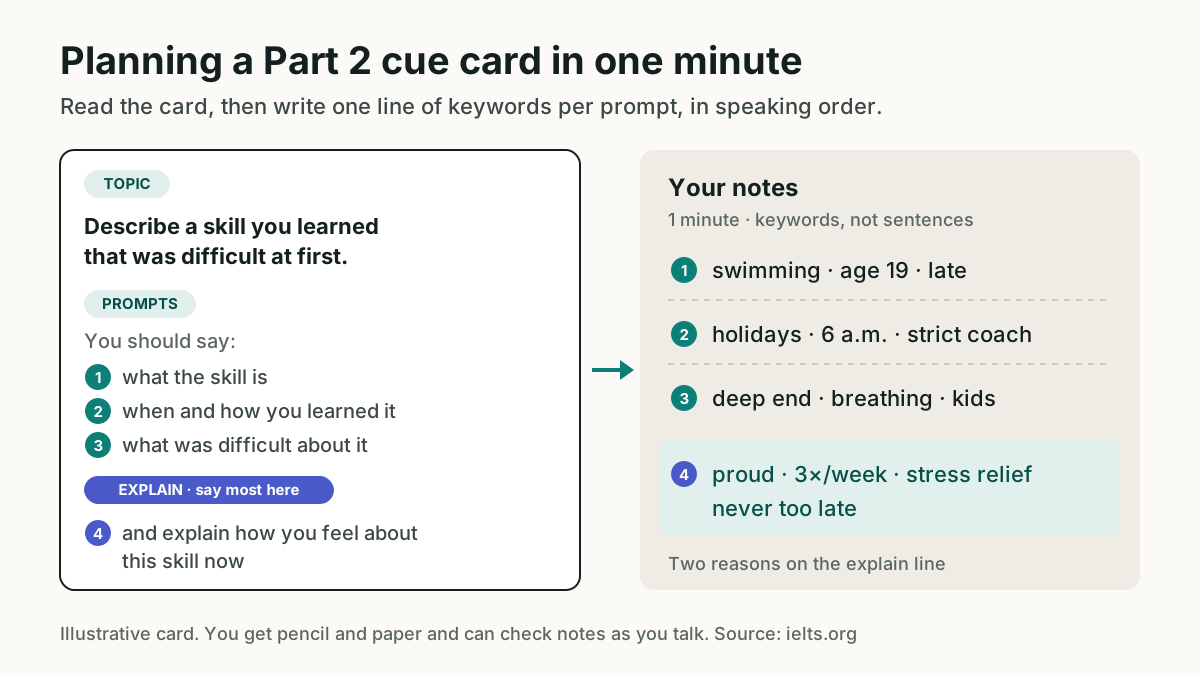
In IELTS Speaking Part 2 you get a task card, often called a cue card, with a topic and a few points to cover. You have one minute to prepare with pencil and paper, then you speak for up to two minutes until the examiner stops you. The best use of that minute is to choose the first real example that comes to mind, write two or three keywords for each point on the card in the order you will speak, and save most of your talking for the final "explain" point.
Below: what is on a card, a note layout that fits in sixty seconds, a full worked example with notes and a model answer of about two minutes, and what to say when you run out halfway.
What is on an IELTS Part 2 cue card?
Each card has three parts. A topic line starts with an instruction such as "Describe a…". Under "You should say" come a few prompts, usually what, who, when, where or how. The last line asks you to explain one aspect of the topic, often why something mattered or how you feel about it now.
- Read the card and plan (1 minute). The examiner gives you a pencil and paper for notes.
- Speak (up to 2 minutes). Keep going until the examiner stops you.
- Answer one or two follow-up questions. The examiner may ask something short on the same topic before Part 3 begins.
Part 2 lasts 3 to 4 minutes in all, and it tests whether you can speak at length on a topic and draw on your own experience. That is why a real memory works better than an invented one: you already know the details. For how Part 2 fits between the other two parts, see the IELTS Speaking test format.
How should you use the one minute to prepare?
Sixty seconds is enough for about four short lines of notes, as long as you do not spend the first twenty choosing an example. Work in this order:
- Read the whole card first (about 10 seconds). If a word on the card is unclear, point to it and ask the examiner what it means straight away, at the start of your minute rather than the end.
- Take the first real example you can describe in English (about 5 seconds). Do not hunt for the most impressive one. A simple example you remember well gives you more to say.
- Write one line per prompt (about 35 seconds). Two or three keywords each, in English, in the order you will speak. Add one concrete detail per line: a name, a number, a place, a feeling.
- Spend the last seconds on the explain line. Write two reasons, not one. This line will carry the second half of your talk.
Write in English, so that you do not have to translate when you glance down, and write phrases, never full sentences. You can check your notes while you speak. Think of them as a safety net: most of the time you will not need them, but they catch you when your mind goes blank.
The four-line note layout
Number your lines to match the prompts on the card. Each line is a small plan for 20 to 30 seconds of speech: the keyword reminds you what to talk about, and the detail gives you something specific to say about it. The explain line gets two reasons, because it should fill the most time.
A worked example: cue card, notes and model answer
- Task card
- Describe a skill you learned that was difficult at first. You should say: what the skill is, when and how you learned it, what was difficult about it, and explain how you feel about this skill now.
Here are notes someone could write in one minute. Keywords only, in the order of the card:
- What: swimming · age 19 · late starter
- When and how: summer holidays · 6 a.m. batch · strict coach
- Difficult: fear of deep end · breathing · kids laughing
- Explain now: proud, swim 3 times a week · stress relief · never too late
And here is a model answer built from those notes. At a natural pace it takes roughly two minutes. It is an illustration of the method, not an official sample, so do not memorise it: build your own answer from your own notes.
- What the skill is
- I'd like to talk about swimming, which I learned surprisingly late, at nineteen. Most of my friends had learned as kids, but nobody in my family swam, so it simply never came up. By the time I was in college, I was honestly a bit embarrassed about it.
- When and how
- I finally signed up during the summer holidays after my first year. There was a municipal pool near our house that ran a six a.m. batch for beginners, and the coach there was very strict. He made us stand in the shallow end and practise breathing for what felt like a week before we were even allowed to kick.
- What was difficult
- The hardest part wasn't the technique, it was fear. Whenever I got near the deep end, I'd panic and grab the side. Breathing was the other problem, because I kept lifting my whole head out of the water instead of turning it. And, to be honest, it didn't help that half the batch were ten-year-olds who were much better than me and found my struggles very funny.
- How I feel now
- Now I'm actually quite proud of it. I swim about three times a week, and it's become the main way I deal with stress: after forty minutes in the pool, whatever was bothering me feels a lot smaller. More than anything, it taught me that being a beginner as an adult is uncomfortable, but it's not a reason to stop. These days, when I'm nervous about learning something new, I remind myself that I once couldn't put my face in the water.
Look at how the notes turn into speech. Each keyword becomes a sentence or two, each detail (six a.m., ten-year-olds, three times a week) makes the story concrete, and the explain line, with its two reasons, fills almost a third of the talk. Notice the phrases that carry you from one prompt to the next, too: "I finally signed up", "The hardest part was", "Now I'm actually quite proud".
Reading a model answer is not the same as speaking for two minutes. Clara hands you a task card, gives you a minute with space for notes and times your talk like the test. The report then checks how well you covered the card.
Try a Part 2 cue card with ClaraWhat should you do if you run out of things to say?
Most people dry up at some point in Part 2. The examiner will stop you when the time is up, so if you stop early, the rest of the two minutes is simply time you did not use to show your English. Keep a few moves ready:
- Go back to your notes. Pick the line you said least about and add another detail.
- Add a moment. Describe one specific scene: where you were, who said what. "I still remember the coach telling me…" leads naturally into a short story.
- Compare then and now. "At first I…, but now I…" works for almost any card about a person, place, object or experience.
- Give a second reason. If you have explained why, explain why else: "There's another reason, too…"
- Look ahead. Say what might happen next: "I'd like to…" or "If I get the chance, I'll…"
- Bridge
- Another thing I remember about it is…
- Bridge
- Looking back, I think the real reason was…
- Bridge
- What surprised me most was…
- Bridge
- If I'm honest, the main reason I'd recommend it is…
Avoid filling the silence with "um" or repeating your last sentence in different words. A short pause while you look at your notes is fine; a run of "um" is not. Our guide on how to stop saying um has drills for steadier speech.
What are the most common Part 2 mistakes?
- Writing sentences in the preparation minute. You run out of time after the first prompt and have no notes for the rest.
- Spending the minute looking for a perfect example. Take the first one you can describe in English. If it does not fit the card exactly, say so near the start of your talk, so the examiner is not confused.
- Making up a story. You do not have to use a real example, but invented ones run out of detail fast. Real memories come with details for free.
- Reciting a memorised answer. A prepared speech rarely fits the exact card, and rehearsed delivery sounds unnatural. Prepare ideas and phrases, not scripts.
- Racing through the prompts like a checklist. One sentence per prompt gets you to about forty seconds. Say more about fewer things.
- Reading your notes aloud. Glance down, look up, speak. Your notes are a map, not a script.
- Correcting every slip. If you make a small mistake, keep going. Constantly restarting sentences hurts your fluency more than the slip hurt your grammar.
How can you practise Part 2 at home?
Practise with a real timer: one minute for notes, then two minutes of speaking, out loud and recorded. Play the recording back and check three things. Did you reach two minutes? Did you say something about every prompt? How much of the talk went on the explain line? A card a day for two weeks is a good way to make two minutes feel normal.
On SpeakWisely you can practise just Part 2 with Clara in a few minutes. She gives you a task card, a minute to prepare with space for notes, and up to two minutes to speak. The report gives an estimated band on the four criteria, quotes your grammar and vocabulary mistakes from your own transcript, checks how well you covered the card and includes a band-8 model answer you can read and listen to. You can then answer again and compare the two attempts. To see what fluency and range mean to an examiner, read the IELTS Speaking band descriptors in plain English.
Questions about Part 2 cue cards
Can I look at my notes while I speak?
Yes. You can check your notes during your talk. Glance at them to find your next point, then look up and keep speaking.
Is it a problem if I stop before two minutes?
It is not against the rules, but it gives the examiner less to assess and shows less ability to keep going, which is part of fluency. Aim to still be talking when the examiner stops you.
Do I have to cover every point on the card?
The points are there to help you plan, and following them in order keeps your talk organised. Touching on each one and spending longest on the explain line is the safest approach.
Can I ask what a word on the card means?
Yes. Ask at the beginning of your preparation minute, not at the end, so you still have time to plan.
Does my example have to be true?
No, but a real example is easier. People who invent a story tend to run out of things to say, because they have no real details to draw on.
AI-estimated assessment inspired by IELTS speaking criteria. Not an official IELTS or IDP result.
Your recording is processed and then deleted. It is never stored — only your transcript and results are kept.
Sources
Keep reading
- IELTS Speaking test format: Parts 1, 2 and 3 explained
Eleven to fourteen minutes, three parts, one examiner. What happens in each part, how long you speak, and what to practise for each.
- IELTS Speaking band descriptors in plain English: what band 6, 7 and 8 actually sound like
Fluency, vocabulary, grammar and pronunciation at bands 6, 7 and 8, in everyday words, with example answers that make the difference easy to hear.
- How to stop saying "um" and "like": a fluency practice routine
Fillers are the sound of planning out loud. Swap them for short silent pauses, keep a few thinking phrases ready, and track your fillers per minute for a week.