English word stress: the rules that help you say long words clearly
By the SpeakWisely team · Published · 8 min read
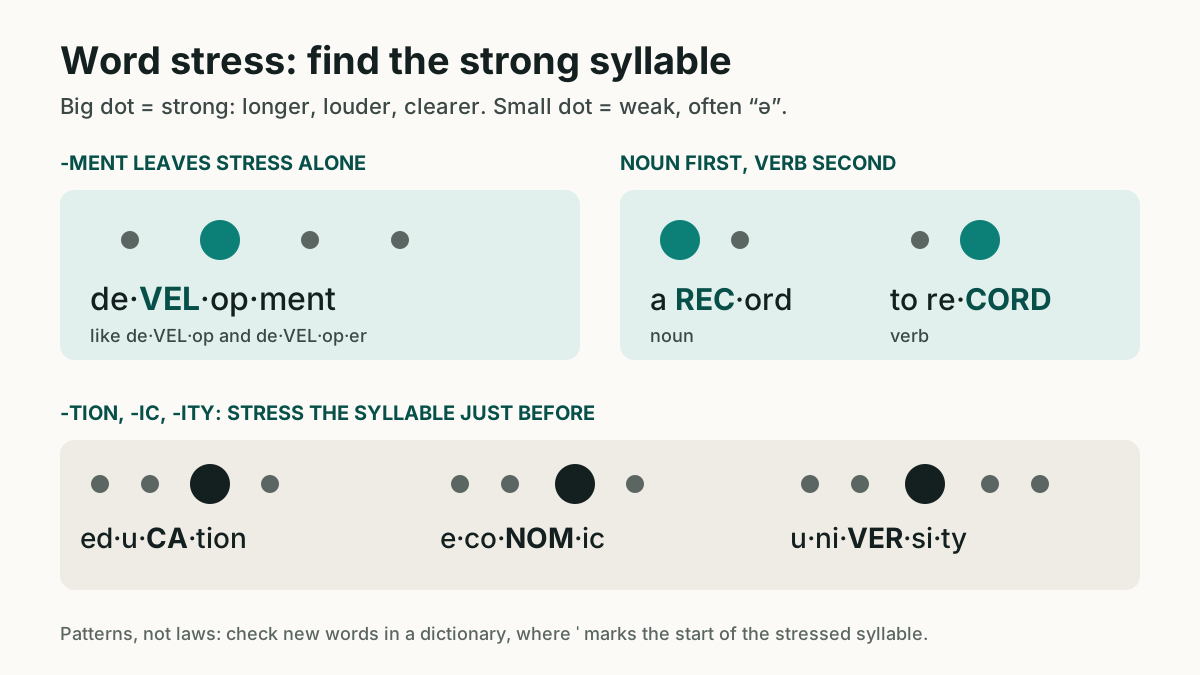
Word stress is the syllable in a word that you say more strongly than the others: a little longer, louder and higher, with a full, clear vowel. The other syllables are lighter, and many of them shrink to a short, relaxed "uh" sound. Listeners use that strong-weak pattern to recognise words, so getting the stress in the right place often makes you easier to understand than changing any single sound.
There is no rule that covers every English word, but a handful of patterns cover a great many of them, especially the long words you use at work and in study. This guide explains what stress sounds like, the patterns worth learning, how to check any word in a dictionary in seconds, and a short routine with sentences to say aloud.
What is word stress in English?
Say the word "banana" slowly. Most speakers say something like buh-NAA-nuh: the middle syllable is long and clear, and the first and last are quick and weak. That is word stress. The strong syllable is marked by four things at once:
- Length: the stressed vowel is held a little longer.
- Loudness: it is slightly louder.
- Pitch: the voice often jumps up or down on it.
- A full vowel: the unstressed syllables around it often reduce to the weak vowel schwa, written ə, the "uh" at the start of "about" and the end of "sofa".
The fourth point is the one most learners miss. Stress is not only about making one syllable strong; it is also about letting the others go weak. "Photograph" is PHO-tə-graph, not PHO-TO-GRAPH with every vowel at full strength.
- Say it
- ba-NA-na (bə-NAA-nə)
- Say it
- a-BOUT (ə-BOUT)
- Say it
- com-PU-ter (kəm-PYOO-tə)
- Say it
- to-DAY (tə-DAY)
Why does word stress matter more than accent?
Everyone has an accent, and an Indian accent is not an error. What a listener needs is to recognise your words the first time. Research on how people process speech suggests listeners use the stress pattern as an early clue to which word is coming, so a word with the strong syllable in an unexpected place can send them looking for a different word, even when every sound in it is perfect.
Hindi, Gujarati, Tamil and most other Indian languages give syllables more even weight, which is why stress in Indian English often lands differently from British or American English. That is normal, and within India it causes little trouble. It matters most with international listeners, on long words, and on the pairs below where stress alone tells two words apart.
- At dinner
- I would like a des-SERT. (something sweet)
- In Rajasthan
- The Thar is a DES-ert. (sand and heat)
- At work
- Please re-CORD the meeting. (verb)
- At work
- Keep a REC-ord of the meeting. (noun)
For the bigger picture of being understood, including sentence rhythm and the sound contrasts such as v and w, read English pronunciation for Indian speakers. This guide goes deeper on stress inside the word.
What are the main English word stress rules?
Think of these as strong patterns rather than laws. Each one has exceptions, and the dictionary is the final answer, but together they will get most of your everyday vocabulary right.
1. Two-syllable words: nouns go first, verbs go second
Most two-syllable nouns and adjectives are stressed on the first syllable: OF-fice, TA-ble, HAP-py, CRICK-et. Most two-syllable verbs are stressed on the second: re-LAX, de-CIDE, be-GIN, a-GREE. That is why some words change stress when they change job:
- Noun / verb
- an IN-crease · to in-CREASE
- Noun / verb
- a PER-mit · to per-MIT
- Noun / verb
- a SUS-pect · to sus-PECT
- Noun / verb
- PRO-gress · to pro-GRESS
- Noun / verb
- an IM-port · to im-PORT
Some very common words break the noun pattern, and they are worth learning by heart because you will say them often: ho-TEL, po-LICE, mis-TAKE, e-VENT, ca-REER. A few common verbs break the verb pattern: OF-fer, LIS-ten, HAP-pen, AN-swer, VIS-it.
2. Endings that pull the stress just before them
Some endings fix the stress on the syllable right before them. This is the most useful rule for long words, because it works on words you have never seen:
- -tion and -sion: ed-u-CA-tion, in-for-MA-tion, de-CI-sion, ex-am-i-NA-tion.
- -ic: e-co-NOM-ic, sci-en-TIF-ic, e-LEC-tric, ac-a-DEM-ic. (A few exceptions: AR-a-bic, POL-i-tics, CATH-o-lic.)
- -ity: u-ni-VER-si-ty, a-BIL-i-ty, e-lec-TRIC-i-ty, per-son-AL-i-ty.
- -ial and -ian: es-SEN-tial, fi-NAN-cial, mu-SI-cian, pol-i-TI-cian.
This rule explains why stress jumps around inside word families. Add an ending and the strong syllable moves with it:
- Family
- POL-i-tics · po-LIT-i-cal · pol-i-TI-cian
- Family
- a-CAD-e-my · ac-a-DEM-ic
- Family
- e-LEC-tric · e-lec-TRIC-i-ty · e-lec-TRI-cian
- Family
- AN-a-lyse · a-NAL-y-sis
3. Endings that leave the stress alone
Other endings are added without moving anything: -ment, -ness, -er, -ful, -less, -ing, -ly. If you know the root, you know the word: de-VEL-op → de-VEL-op-ment, de-VEL-op-er. HAP-py → HAP-pi-ness. em-PLOY → em-PLOY-ment. suc-CESS → suc-CESS-ful.
4. Endings that take the stress themselves
A few endings, mostly borrowed from French, are stressed: -ee, -eer, -ese, -ique. trai-NEE, ref-u-GEE, in-ter-view-EE; en-gi-NEER, vol-un-TEER; Jap-a-NESE, Chi-NESE; tech-NIQUE, u-NIQUE. "Engineer" is a word many Indian professionals say every day, so it is a good one to check.
5. Compound nouns: stress the first part
When two words join to make one thing, the first part usually takes the stress: AIR-port, LAP-top, BOOK-shop, BLACK-board, BUS stop. This can change meaning too: a GREEN-house is a glass building for plants, while a green HOUSE is any house painted green.
How do you check word stress in a dictionary?
Every learner's dictionary shows stress in its pronunciation guide. In the Cambridge and Oxford online dictionaries, a small raised mark ˈ comes just before the stressed syllable, and a low mark ˌ before a weaker, secondary stress. "Development" is shown as /dɪˈvel.əp.mənt/: the mark sits before "vel", so that syllable is strong. Both dictionaries also have audio buttons for British and American pronunciation.
Sometimes the two disagree, and both are right. "Advertisement" is ad-VER-tis-ment in British English and ad-ver-TISE-ment in American English. Pick one and use it consistently. A clear Indian English is just as valid a choice, as long as listeners understand you.
How do you practise word stress?
Stress is a physical habit, so you need to say words, not just read about them. Ten minutes a day is enough:
- Pick ten long words from your own life. Words from your job, course or industry: in IT, "technology", "development", "analysis"; in nursing, "medication", "emergency"; in finance, "economic", "financial". These are the words people hear you say most.
- Check the stress and hum the pattern. For "development", hum da-DA-da-da before you say it. Humming takes the sounds away so you can hear only the beat.
- Tap the table on the strong syllable. One tap, on one syllable. If you want to tap twice, you are giving two syllables equal weight.
- Let the weak syllables go. Say the word again and make the unstressed vowels short and relaxed, close to "uh".
- Put each word in a sentence and record it. Listen back once. Does the strong syllable stand out?
Then say these sentences aloud. Each one puts a stress pair or a word family side by side, so you have to move the stress mid-sentence:
- Say it
- The company will in-CREASE the price. The IN-crease is ten percent.
- Say it
- My pho-TOG-ra-pher took a beautiful PHO-to-graph.
- Say it
- She studies POL-i-tics, wants to be a pol-i-TI-cian, and reads every po-LIT-i-cal story.
- Say it
- The en-gi-NEER explained the e-co-NOM-ic benefits at the u-ni-VER-si-ty.
- Say it
- Please re-CORD your answers. We keep a REC-ord of every session.
Shadowing helps too: play a sentence of clear spoken English, pause, and say it along with the speaker, copying the beat rather than the accent. Our guide to practising English speaking alone explains how to set this up with just your phone.
Say it better rewrites your own sentences one CEFR level up and lets you shadow the model voice, so you can copy its rhythm and stress on words you actually use. For sound contrasts such as vest and west, the Pronunciation lab judges you by which word was heard, never by your accent.
Practise out loudStress and sounds work together. Once your long words have the right beat, the next step is the pairs of sounds that change one word into another; see English minimal pairs to practise out loud. If you are preparing for IELTS, pronunciation is one of the four speaking criteria, and the band descriptors mention stress by name; the IELTS Speaking band descriptors in plain English explains what each band sounds like.
Common questions about English word stress
Is there a rule for word stress that always works?
No single rule covers every English word. A few patterns cover a great many: two-syllable nouns usually stress the first syllable and verbs the second, endings like -tion, -ic and -ity put stress on the syllable just before them, and compound nouns stress the first part. For anything else, check a dictionary.
Can wrong word stress change the meaning of a word?
Yes, in some pairs. "A REC-ord" is a noun and "to re-CORD" is a verb; "DES-ert" is a dry place and "des-SERT" is something sweet. More often, wrong stress does not change the meaning but makes the word harder for a listener to recognise.
Is Indian English word stress wrong?
No. It is part of an Indian accent, and accents are not errors. Stress becomes worth working on when it makes a word hard for your listeners to recognise, which happens most with long words and with international listeners.
What does the mark ˈ mean in a dictionary?
It marks the start of the stressed syllable. In /dɪˈvel.əp.mənt/, the mark comes before "vel", so "development" is stressed on its second syllable. A low mark ˌ shows a weaker secondary stress.
How can I remember the stress of new words?
Learn the stress at the same moment you learn the meaning, say the word aloud three times while tapping the strong syllable, and use it in a sentence the same day. Writing new words with the strong syllable in capitals, such as de-VEL-op, also helps.
Your recording is used only to transcribe your answer, then deleted within 15 minutes. We keep your transcript and results, never the audio.
Sources
Keep reading
- English pronunciation for Indian speakers: stress, rhythm and being understood
Why you do not need to lose your Indian accent, and the stress, rhythm and sound habits that really decide whether a listener understands you.
- Minimal pairs in English: 60 word pairs to practise out loud
Ship or sheep, vest or west, pan or pen: one sound changes the word. Ten sets of minimal pairs for Indian speakers, and how to drill them so you are understood the first time.
- How to speak wisely: 7 habits of clear, confident speakers
Speaking wisely is not about big words. It is choosing one clear point, saying it simply, pausing on purpose and listening before you answer.