How to stop saying "um" and "like": a fluency practice routine
By the SpeakWisely team · Published · 7 min read
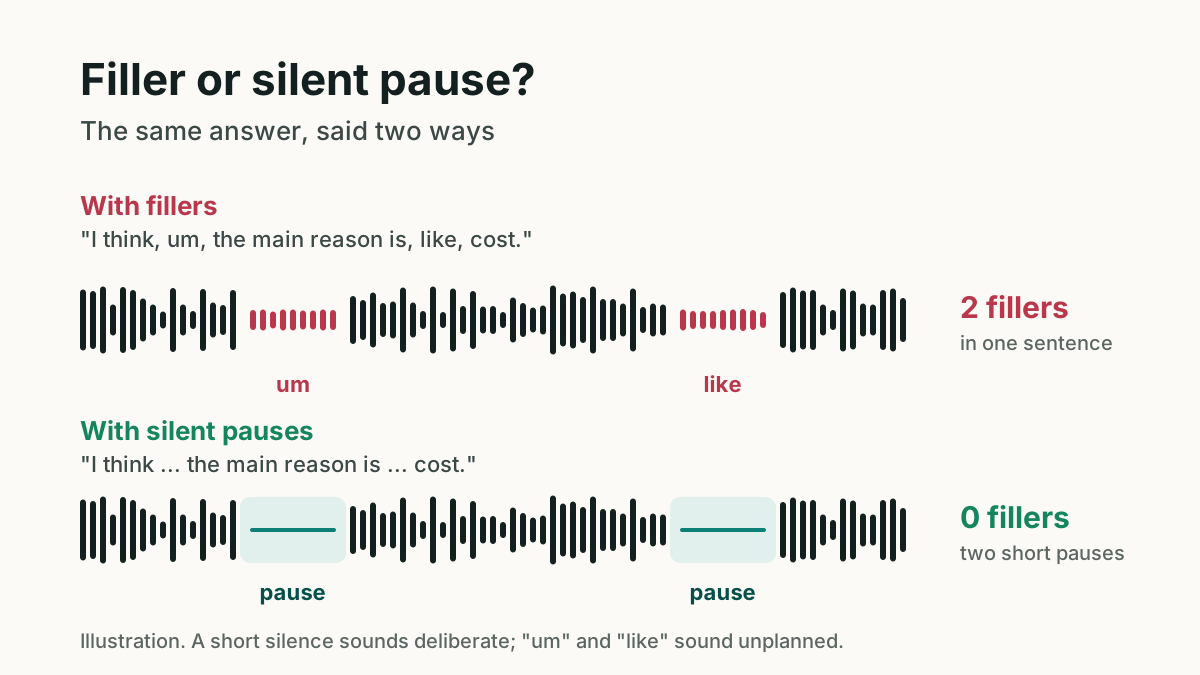
To stop saying "um" and "like", replace the filler with a short silent pause, keep two or three thinking phrases ready for hard questions, and practise in short recorded bursts where you count your fillers per minute. Fillers are not a vocabulary problem or a confidence problem. They are the sound your mouth makes while your brain is still planning the next words, so the fix is to change what you do in that planning moment.
This guide explains why fillers happen, how a silent pause differs from a filler, what to say instead, and a 7-day routine of one-minute drills you can do with just your phone.
Why do we say "um" and "like"?
Speaking is planning in real time. While you say one sentence, you are already choosing the next idea, the next word and the grammar to hold it together. When the plan is not ready, there is a gap, and most speakers fill it with a sound so the listener knows they have not finished.
The psychologists Herbert Clark and Jean Fox Tree argued that "uh" and "um" work as signals of exactly this: speakers use them to announce a delay, with "uh" pointing to a short one and "um" to a longer one. In other words, a filler is the sound of thinking out loud. Native speakers use them too; the aim is fewer, not none.
Speaking in a second language adds an extra planning step. You may be finding the English word, checking a verb form, or quietly translating from Hindi, Gujarati or Tamil before you speak. Each extra step is another gap, and another place for an "um" to slip in.
Fillers are not only "um". Listen for these in your own speech:
- Hesitation sounds: um, uh, er, hmm.
- "Like" as a gap-filler: "It was, like, really far." (Not "I like my job", where it is a real verb.)
- Habit words: basically, actually, literally, honestly, obviously, when they start sentence after sentence.
- Phrases: you know, I mean, kind of, sort of.
- Starters: so, well or right at the start of every single answer.
What is the difference between a filler and a silent pause?
Both buy you thinking time. The difference is how they sound to the listener. A short silence, especially between two ideas, sounds deliberate: the listener waits and assumes you are choosing your words. A filler sounds unplanned, and when it comes every few words it pulls attention away from what you are saying.
- Weak
- So, um, basically I, like, work in a bank in Pune, and, um, I handle, you know, home loans.
- Better
- I work in a bank in Pune. (pause) I handle home loans, mostly for first-time buyers.
A pause is not a free pass, though. A silence of a second at the end of an idea sounds calm. A silence of three or four seconds in the middle of a sentence sounds like you are stuck. The goal is short pauses in sensible places, not long ones anywhere.
What can you say instead of "um"?
For a question you need a moment to think about, a holding phrase sounds far more natural than a string of "um"s. Keep a few ready and use one at the start of a hard answer:
- Say it
- Let me think about that for a second.
- Say it
- That's a good question.
- Say it
- There are a couple of reasons for that.
- Say it
- How can I put this?
- Say it
- The main thing for me is…
- Say it
- What I mean is…
Use them sparingly. A holding phrase repeated in every answer becomes a filler of its own. One at the start of a difficult question, then short silent pauses after that, is the pattern to aim for.
Fillers also drop when you know where your answer is going. Before you speak, decide on two points, not five. Simple signposts such as "first", "the other reason is" and "so overall" give you a map, which means less planning in the middle of a sentence.
A 7-day routine to cut your fillers
You need ten minutes a day and the voice recorder on your phone. Every drill is one minute long. Short drills work because you can listen back to the whole thing and hear every filler.
- Day 1: Take a baseline. Record one minute on an easy topic, such as your morning routine or the city you live in. Do not try to fix anything. Listen back and count every filler.
- Day 2: Find your favourites. Listen to Day 1 again and write down which fillers you use and where. You will probably find one or two favourites, perhaps at the start of sentences or just before a difficult word. Pick the one to work on.
- Day 3: The pause drill. Speak for one minute on the same topic. Each time you feel the filler coming, close your mouth and pause instead. It will feel slow. Do three takes.
- Day 4: Holding phrases. Switch to opinion questions, such as "Should Mumbai have more pedestrian-only streets?" Open with one holding phrase, then pause instead of filling for the rest of the minute.
- Day 5: Plan in chunks. Before each recording, take ten seconds to choose two points. Speak using "first", "the other thing is" and "so overall". Count your fillers again.
- Day 6: Add pressure. Write ten questions on slips of paper, or ask a friend to fire them at you, and answer each one without preparation. Real conversations are unplanned, so your practice should be too.
- Day 7: Re-test. Repeat the Day 1 topic and count again. Compare the two numbers, and listen to the two recordings one after the other.
After the first week, keep one or two drills a day as a warm-up and move on to harder topics. Fillers come back under pressure, so practise with questions you have not seen before.
Counting fillers by ear takes time. SpeakWisely has a 60-second "Speak without fillers" drill that counts them for you and tells you whether you hit the target: under 2 fillers per 100 words.
Try the no-fillers drillHow do you measure progress?
Use one simple number: fillers per minute. Count the fillers in a recording and divide by the minutes you spoke. Nine fillers in a 90-second answer is six per minute. Write the number down after every drill, with the date and the topic, so you can see the trend over a week rather than judging one bad day.
Two other numbers keep you honest, because it is possible to cut fillers in a way that makes your speaking worse:
- Long pauses. Count silences of more than about two seconds. If your fillers go down but your long pauses go up, you have swapped one problem for another.
- Pace. Count the words in a one-minute recording. If it drops sharply, you are pausing too often. A calm, even pace is what you want.
SpeakWisely measures these from the timing of your words rather than by guessing: your pace in words per minute, how long and where you pause, filler words such as "um" and "like", and repetition. "Like" only counts when it is used as a filler, so "I like my job" is never marked down. The English speaking practice lab has a 60-second drill for each habit: Speak without fillers (under 2 fillers per 100 words), Keep going without stopping (no pause longer than 2 seconds) and Hold a steady pace (at least 120 words per minute). In the daily task, if you go quiet for a few seconds mid-answer, a sentence starter appears to help you keep going.
If you are preparing for IELTS, fluency and coherence is one of the four criteria the examiner rates. Our guide to the IELTS Speaking band descriptors in plain English explains what each band sounds like in practice, and you can hear how you do in a full mock with IELTS speaking practice with Clara. Fillers often get worse in long answers, so planning a Part 2 cue card in one minute is worth practising too.
Common questions about filler words
Is it wrong to say "um" at all?
No. Everyone uses fillers sometimes, including native speakers. A few in a long answer are normal. The problem is when they come every few words and the listener starts hearing them instead of your ideas.
Is a long silence worse than saying "um"?
A short pause of a second or so is better than a filler. A very long silence in the middle of a sentence is not, because it sounds like you are stuck. If you need more time, use a holding phrase such as "Let me think about that for a second", then continue.
How long does it take to stop saying "um"?
There is no fixed timeline, and it depends on how often you practise. A week of daily one-minute drills gives you enough recordings to see whether your fillers-per-minute number is moving. Keeping the habit under pressure, in real conversations, takes longer.
Should I speak faster so there is no time for fillers?
No. Speeding up does not remove the planning gap, and it makes you harder to follow. Speak at a calm pace and let short pauses do the work.
Fillers are only one part of sounding fluent. If you want to see how an AI coach can help with the rest, read how to learn English with AI.
Your recording is processed and then deleted. It is never stored — only your transcript and results are kept.
Sources
Keep reading
- IELTS Speaking band descriptors in plain English: what band 6, 7 and 8 actually sound like
Fluency, vocabulary, grammar and pronunciation at bands 6, 7 and 8, in everyday words, with example answers that make the difference easy to hear.
- How to learn to speak English with AI: what AI feedback can and can't tell you
AI is a patient practice partner that can measure your pauses and quote your mistakes. It cannot give you an official score or replace real conversations. Here is how to use it well.
- IELTS Speaking Part 2 cue cards: how to plan in one minute and speak for two
A note layout that fits in the one-minute preparation, a full worked cue card with a two-minute model answer, and what to do when you run dry.