How to speak wisely: 7 habits of clear, confident speakers
By the SpeakWisely team · Published · 8 min read
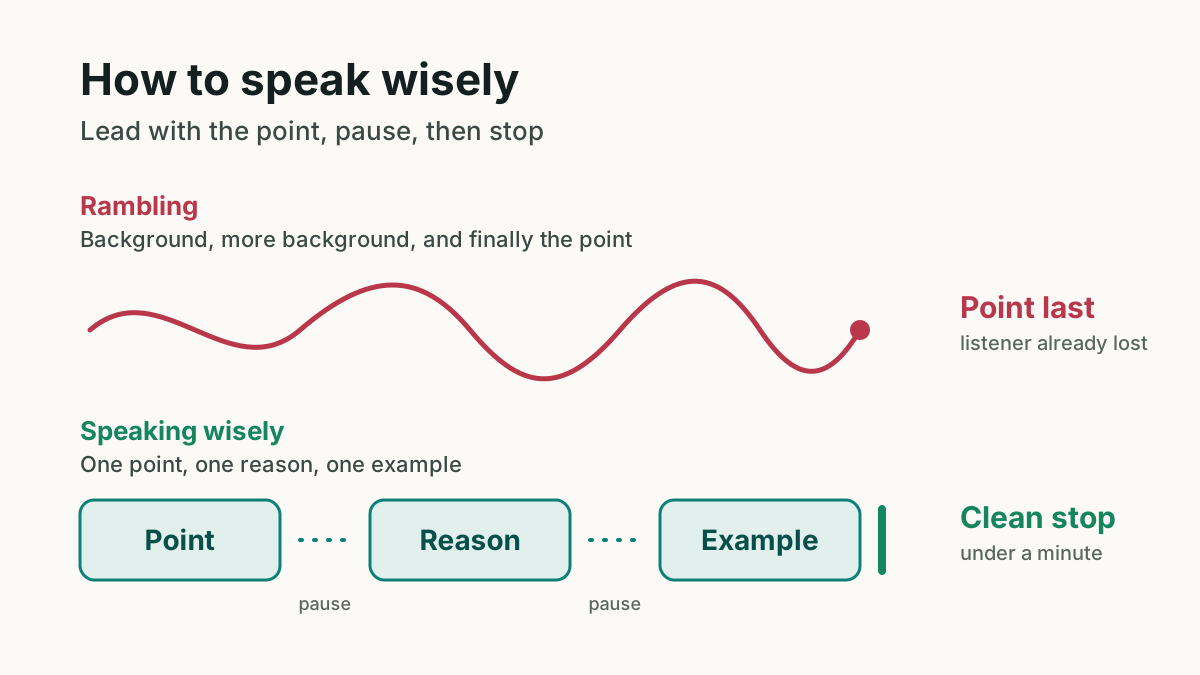
To speak wisely is to say what you mean in as few clear words as the moment needs, after a second of thought, in a tone that fits the person in front of you. In practice it comes down to a handful of habits: think before you speak, lead with your point, give one reason and one example, pause instead of filling silence, and listen properly before you reply.
None of this needs perfect grammar or a large vocabulary. Plenty of people with fluent English ramble, and plenty of careful learners are a pleasure to listen to. This guide explains what speaking wisely looks like in everyday English, seven habits with lines you can say aloud, and a ten-minute daily routine to build them.
What does "speak wisely" mean?
In everyday use, "speak wisely" means to choose your words with care: to think about what you want to say, who you are saying it to and what effect it will have, before the words leave your mouth. It is the opposite of speaking on autopilot, where you start a sentence and hope it finds its own way to an end.
For someone speaking English as a second language, it has a very practical meaning too. You cannot always control how fast the right word arrives, but you can control the shape of what you say. A short answer with a clear point beats a long one with impressive vocabulary, in a job interview in Bengaluru, a client call from Ahmedabad or a chat with a neighbour.
How do you think before you speak without sounding slow?
"Think before you speak" sounds like advice to go quiet for ten seconds. It is not. The thinking that helps takes one or two seconds, and it answers only one question: what is my point? Not the whole answer, just where it is going. Once you know the destination, the sentences on the way come more easily, and you are far less likely to fill the gaps with "um" and "basically".
If you need a little longer, say so out loud. A short holding phrase sounds calm and confident, not slow:
- Say it
- Let me think about that for a second.
- Say it
- That's a fair question. I'd say...
- Say it
- The short answer is yes, but there is one condition.
What are the habits of people who speak wisely?
These seven habits show up again and again in speakers who are easy to follow. Each one comes with a weak and a better version of the same idea. Say both out loud; you will hear the difference more clearly than you can read it.
1. Lead with your point
Many of us were taught to build up to the answer: background first, conclusion last. In conversation, the listener is waiting for the point and may stop listening before it arrives. Say it first, then explain.
- Weak
- So in my last company we had many projects, and the timelines were changing, and my manager was also new, so finally I learned to plan better.
- Better
- I learned to plan under pressure. In my last company, deadlines changed almost every week, so I started planning in two-day blocks.
2. Use point, reason, example
The simplest structure for almost any answer is point, reason, example: what you think, why, and one real case that shows it. It works for an interview question, an opinion at dinner or an IELTS Part 3 discussion. Three short parts are enough; you can stop after the example.
- Point
- I think working from home suits some jobs, but not all of them.
- Reason
- Work that needs deep focus gets easier, but anything that depends on quick decisions gets slower.
- Example
- My cousin writes code from her flat in Pune and gets more done, but her husband manages a warehouse and has to be there.
3. Choose the plain word
Wise speakers rarely reach for the longest word they know. "Use" beats "utilise", "help" beats "facilitate", "start" beats "commence". A plain word lands faster, is easier to pronounce under pressure and leaves you less exposed if you are not sure of the exact meaning. Save precise vocabulary for where it actually adds something, such as "deadline", "budget" or "shortlist".
4. Pause on purpose
A short silence between two ideas sounds deliberate. It gives the listener a moment to catch up and gives you a moment to plan. What does not work is a filler in every gap, or a long silence in the middle of a sentence. If fillers are your habit, our guide on how to stop saying "um" and "like" has a seven-day routine to replace them with pauses.
5. Listen to the actual question
Half of speaking wisely is listening. Many weak answers are good answers to a different question. Before you reply, notice the key word: is the question asking "why", "how", "what would you do" or "do you agree"? If you are not sure, check. Asking is not a weakness; answering the wrong question is.
- Say it
- Just to check, do you mean in my current role or in general?
- Say it
- Sorry, could you say that again? I didn't catch the last part.
6. Match your tone to the moment
The same message can sound rude or respectful depending on a few words. In English, softeners such as "I think", "maybe", "could we" and "I am not sure that" do a lot of work, especially when you disagree. Direct translations from Hindi or Gujarati can sound sharper in English than you intend, so a small softener is often the wise choice.
- Weak
- No, this plan is wrong. We have to change it.
- Better
- I'm not sure this plan works yet. Could we look at the timeline again?
7. Know when to stop
The last habit is the hardest: finish. Once you have made your point and given an example, stop, or close with one short line. Adding "and also, one more thing" three times weakens everything that came before. A clean ending sounds confident even when your grammar was not perfect.
- Say it
- So overall, that's why I'd choose the train.
- Say it
- That's the main reason, really.
How can you practise speaking wisely every day?
Habits change through repetition out loud, not through reading. This routine takes about ten minutes and needs only your phone or a quiet room. Do it for a week and listen to the first and last recordings side by side.
- Pick one question. Use something ordinary: "What did you do last weekend?", "Is your city a good place to grow up?" Our list of English conversation practice questions has dozens to choose from.
- Think for five seconds. Decide only your point. Say it in one sentence in your head.
- Answer in under a minute, using point, reason, example. Record it.
- Listen back for three things: did the point come first, did you pause instead of filling, and did you stop cleanly?
- Answer again, fixing just one of the three. A second take that is slightly better is the whole point.
If you practise alone, our guide to practising English speaking alone with just your phone has more ways to keep it interesting.
SpeakWisely gives you one short speaking task a day, asks a follow-up question about what you actually said, and shows you what to fix: filler words, long pauses, grammar slips, vague vocabulary or ideas that are hard to follow.
Try today’s speaking taskWhere does speaking wisely matter most?
Anywhere you get one chance to make an impression. In a job interview, the first answer usually sets the tone, so it is worth preparing how to answer "Tell me about yourself" until it comes out in one calm minute. In the IELTS Speaking test, examiners rate fluency and coherence, which rewards answers that are easy to follow; the same point, reason, example structure works well in Part 3. And at work, a short, clear update on a call often counts for more than a long, perfect one.
Common questions about speaking wisely
What is the meaning of "speak wisely"?
It means choosing your words with care: thinking briefly about your point and your listener, saying it clearly and simply, and stopping when you have made it. It is about judgement and clarity, not about using difficult words.
How can I speak clearly and confidently in English?
Lead with your point, use plain words, pause between ideas instead of saying "um", and finish with a short closing line. Confidence grows from practice out loud: short daily recordings you listen back to help more than reading about grammar.
Does thinking before I speak make me sound slow?
Not if the pause is short. One or two seconds to decide your point sounds calm and deliberate. If you need longer, use a holding phrase such as "Let me think about that for a second" and then answer.
Do I need a big vocabulary to speak wisely?
No. Clear structure and plain, accurate words matter more. A small set of words you use correctly is better than rare words you are not sure about.
Is SpeakWisely the same as Speak Wisely?
Yes. SpeakWisely is often written as two words, Speak Wisely. It is an AI English speaking coach that works in your browser, named after the idea in this guide.
Speaking wisely is a habit, not a talent. Start with one question today, answer it in under a minute, and see how it feels to stop when you have said what you meant. For a broader plan, read how to learn English with AI.
Your recording is used only to transcribe your answer, then deleted within 15 minutes. We keep your transcript and results, never the audio.
Sources
Keep reading
- How to stop saying "um" and "like": a fluency practice routine
Fillers are the sound of planning out loud. Swap them for short silent pauses, keep a few thinking phrases ready, and track your fillers per minute for a week.
- English conversation practice: 49 everyday questions to answer out loud
Seven topics, seven questions each, and one simple answer shape: say your answer, give a reason, add an example. Pick one question a day and say it out loud.
- How to answer "Tell me about yourself" in an English interview
Present, past, future, in about a minute. A structure for the first interview question, three sample answers, and the phrases that weaken an answer.