Minimal pairs in English: 60 word pairs to practise out loud
By the SpeakWisely team · Published · 10 min read
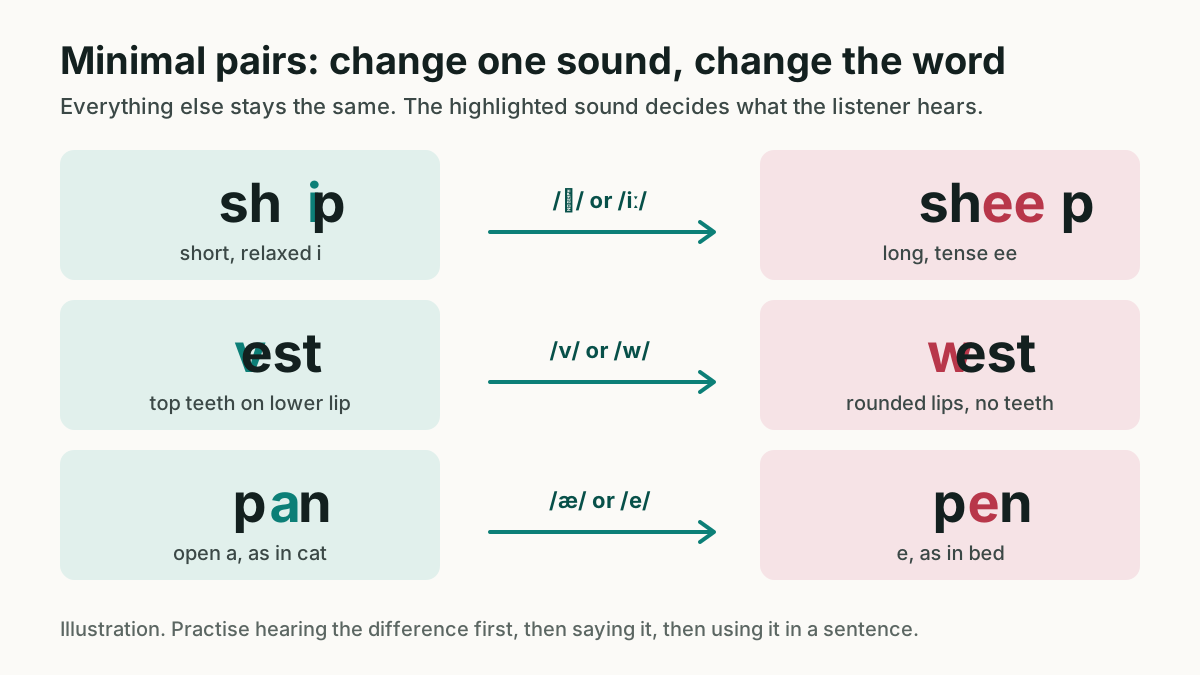
A minimal pair is two words that differ by only one sound, such as "ship" and "sheep" or "vest" and "west". Practising them works because it trains your ear to hear a difference before you train your mouth to make it, and the words themselves tell you whether you got it right: if a listener hears "sheep" when you meant "ship", the sound needs work. Ten minutes a day on the right pairs does more for clarity than hours of general "accent" practice.
This guide explains why minimal pairs work, gives you 60 pairs in ten sets chosen for speakers of Hindi, Gujarati, Marathi, Bengali, Tamil and other Indian languages, with a sentence pair for each, and ends with a 10-minute routine you can do with your phone.
What is a minimal pair?
Take a word, change exactly one sound, and if you get a different real word, the two form a minimal pair. "Pan" and "pen" differ only in the vowel. "Fan" and "pan" differ only in the first consonant. "Cold" and "coal" differ only in the final "d". Note that it is the sound that counts, not the spelling: "sea" and "she" are a minimal pair even though their spellings look quite different.
Linguists use minimal pairs to prove that two sounds are separate in a language. If swapping the sounds changes the meaning, English treats them as two different sounds, and a listener will rely on that difference. That is exactly why they matter for you: they point to the handful of sound differences that decide which word someone hears.
Why does minimal pair practice work?
Your first language shapes what your ear notices. If Hindi or Gujarati has one sound where English has two, your brain has spent years filing both English sounds into the same box. You cannot reliably say a difference you cannot hear, so the first job is listening, not speaking.
Research on perception training backs this up. In a well-known 1991 study, Logan, Lively and Pisoni trained Japanese listeners to tell English "r" and "l" apart by having them identify words from minimal pairs, spoken by several different voices. Their listening improved, and later studies by the same group found that pronunciation of the same sounds improved too, even though it was never trained directly. Hearing the difference comes first; saying it follows.
Minimal pairs also give you a clear pass or fail. "Did that sound right?" is hard to judge. "Did they hear ship or sheep?" is not. That makes them one of the few pronunciation exercises you can check on your own.
Which minimal pairs should Indian speakers practise?
Not every pair is worth your time. These ten sets cover the contrasts that most often blur for speakers of Indian languages. Read the note, say each pair slowly, then quickly, then try the sentence pair. You do not need all ten: record yourself on the first word of each set, and start with the sets where your two words sound the same.
1. v or w: vest and west
Hindi, Gujarati, Marathi and many other Indian languages have one sound, व, that sits between English "v" and "w", so both English sounds come out the same. For v, rest your top teeth lightly on your lower lip and let the sound buzz. For w, round your lips as if to blow out a candle, with no teeth touching.
- Pairs
- vest / west · vine / wine · vet / wet
- Pairs
- verse / worse · veil / wail · vow / wow
- Sentence
- Don't touch the vine. / Don't touch the wine.
2. Short i or long ee: ship and sheep
Hindi already has a short इ and a long ई, which helps. The difference in English is not only length: the vowel in ship is short and relaxed, with the mouth slightly open, while the vowel in sheep is long and tense, with the lips spread in a slight smile. The usual slip is saying both with the tense "ee", especially in fast speech.
- Pairs
- ship / sheep · sit / seat · fill / feel
- Pairs
- live / leave · hit / heat · bit / beat
- Sentence
- I saw a ship. / I saw a sheep.
- Sentence
- I want to live here. / I want to leave here.
That second sentence pair shows why this matters. Mix them up in a conversation about moving cities and you have said the opposite of what you meant.
3. Short oo or long oo: full and fool
Here the matching pair in Hindi is उ and ऊ. The trap is English spelling: "oo" is short in book, look, good, foot and cook, but long in food, pool and school. Many speakers say "book" with the long vowel of "food" because the spelling suggests it.
- Pairs
- full / fool · pull / pool · look / Luke
- Pairs
- should / shooed · could / cooed · wood / wooed
- Sentence
- Look over there. / Luke, over there.
4. a or e: pan and pen
The vowel in cat and bad is very open: drop your jaw further than feels natural. In much Indian English it moves towards the "e" of bed, so "bad" and "bed" can sound alike. (The vowel in "cut" is close to the short Hindi अ, and is usually not a problem.)
- Pairs
- pan / pen · bad / bed · man / men
- Pairs
- sad / said · had / head · sat / set
- Sentence
- Can you pass me the pan? / Can you pass me the pen?
5. s or sh: sea and she
Speakers of Bengali, Assamese and some regional varieties of other languages may use one sound for both, or swap them. For s, keep your tongue behind your top teeth and smile slightly. For sh, pull your tongue back a little and push your lips forward.
- Pairs
- sea / she · sip / ship · sort / short
- Pairs
- save / shave · sell / shell · mess / mesh
- Sentence
- Did you save today? / Did you shave today?
6. z or j: Zack and Jack
Most Indian languages have no native "z", so "zero" often becomes "jero". For z, make a long "s" and add your voice: your tongue stays behind your teeth and never touches the roof of your mouth. For j, the tongue touches, then releases.
- Pairs
- zest / jest · raise / rage · seize / siege
- Pairs
- Zack / Jack · buzz / budge · pays / page
- Sentence
- His name is Zack. / His name is Jack.
7. th or t: thin and tin
Many Indian speakers say "th" as थ, an aspirated t with the tongue on the teeth. Most listeners understand it, and because the English "t" is usually said further back in Indian English, the two words often stay different. It is still worth practising for listeners from outside India: put the tip of your tongue lightly between your teeth and blow, with no stop in the air.
- Pairs
- thin / tin · three / tree · thank / tank
- Pairs
- thought / taught · thorn / torn · both / boat
- Sentence
- Is the sheet thin? / Is the sheet tin?
8. th or d: they and day
The same tongue position as set 7, with your voice switched on. This "th" appears in some of the most common words in English (the, this, that, they, there), so even a small improvement is heard often.
- Pairs
- they / day · then / den · those / doze
- Pairs
- though / dough · there / dare · breathe / breed
- Sentence
- They broke. / Day broke.
9. p or f: pan and fan
In traditional Hindi, फ is an aspirated "p", and some speakers of Bengali, Odia, Marathi and other languages carry that into English, so "fan" sounds like a breathy "pan". For f, there is no stop at all: top teeth on the lower lip, and let the air flow out continuously.
- Pairs
- pan / fan · pool / fool · pine / fine
- Pairs
- pair / fair · copy / coffee · leap / leaf
- Sentence
- Turn on the fan. / Turn on the pan.
10. Final consonants: cold and coal
This one is not about a single sound but about the end of the word. When a word ends in two consonants, the last one is easy to drop in fast speech, and the word changes. Finish every word: say the final "d" or "t" clearly, even if lightly.
- Pairs
- cold / coal · hold / hole · field / feel
- Pairs
- build / bill · past / pass · mist / miss
- Sentence
- I'll build it. / I'll bill it.
SpeakWisely's Pronunciation lab plays minimal pairs like vest and west and judges your answer by which word was heard, so it checks how clearly you are understood, never your accent.
Try the Pronunciation labHow do you practise minimal pairs?
Work through four stages, in order. Skipping straight to the last one is the most common reason minimal pair practice feels like it does not work.
- Listen. Play both words in a learner's dictionary (Cambridge and Oxford both have audio). Close your eyes and listen to them several times, until you can hear the difference clearly.
- Test your ear. Ask a friend, or use a text-to-speech app, to say one word of the pair at random. Write down which one you heard. Aim for eight out of ten before you move on.
- Say and record. Say each pair slowly, exaggerating the difference, and record it. Listen back without looking at the list: can you tell which word is which? If you cannot, neither can a listener.
- Use it in sentences. Say the sentence pairs, then make your own with words from your daily life. A sound you can make in a list but not in a sentence is not fixed yet.
A 10-minute minimal pairs routine
Pick one set for the whole week. One sound practised every day beats ten sounds practised once.
- Minutes 1–2: listen. Play the six pairs from your set and test your ear.
- Minutes 3–5: say and record. Each pair three times: slowly, normally, then quickly. Listen back once.
- Minutes 6–8: sentences. Say the sentence pair, then three sentences of your own that use words from the set.
- Minutes 9–10: free speech. Talk for one minute about your day and record it. Listen for the sound in real words, not just the ones on the list.
The same record-and-listen habit works for the rest of your speaking. If you practise alone, our guide to practising English speaking alone with your phone has more drills, and the English speaking practice page shows everything SpeakWisely can check for you.
Are sounds the most important part of pronunciation?
No, and it is worth knowing that before you spend weeks on "th". Individual sounds are one part of being understood. Word stress (which syllable is strong) and rhythm (strong and weak words in a sentence) often matter more, because listeners use them to find the words in the first place. Our guide to English pronunciation for Indian speakers covers both, and English word stress goes deeper on where the strong syllable falls.
A good balance: minimal pairs for the two or three sounds that really blur for you, and stress and rhythm for everything else.
Common questions about minimal pairs
What is an example of a minimal pair?
"Ship" and "sheep" are the classic example: the only difference is the vowel, short and relaxed in "ship", long and tense in "sheep". Others are "vest" and "west", "pan" and "pen", and "fan" and "pan".
How many minimal pairs should I practise a day?
One set of five or six pairs is enough. Repetition matters more than range, so stay with one contrast for a week before moving to the next.
Will practising minimal pairs change my accent?
Only in the small places where two words were coming out the same. Your accent stays yours. The aim is that a listener hears the word you meant, the first time.
Which minimal pairs are hardest for Indian speakers?
It depends on your first language, but v and w (vest, west), the a in "cat" against the e in "bed", and z against j (zero, jero) are among the most common. Record yourself on the first word of each set above to find yours.
Do minimal pairs help with IELTS Speaking?
They can. Pronunciation is one of the four IELTS Speaking criteria, and the band descriptors reward being easily understood, not a particular accent. Clear sounds are part of that, alongside stress and rhythm.
Your recording is used only to transcribe your answer, then deleted within 15 minutes. We keep your transcript and results, never the audio.
Sources
Keep reading
- English pronunciation for Indian speakers: stress, rhythm and being understood
Why you do not need to lose your Indian accent, and the stress, rhythm and sound habits that really decide whether a listener understands you.
- English word stress: the rules that help you say long words clearly
Listeners recognise words by their strong syllable. Learn what stress sounds like, the patterns that cover thousands of words, and how to check any word in seconds.
- Common English mistakes Hindi speakers make, and how to fix them
Verb at the end, no "a" or "the", one "se" for since and for, one व for v and w. Ten patterns Hindi brings into English, and a drill for each.