Common English mistakes Gujarati speakers make, and how to fix them
By the SpeakWisely team · Published · 10 min read
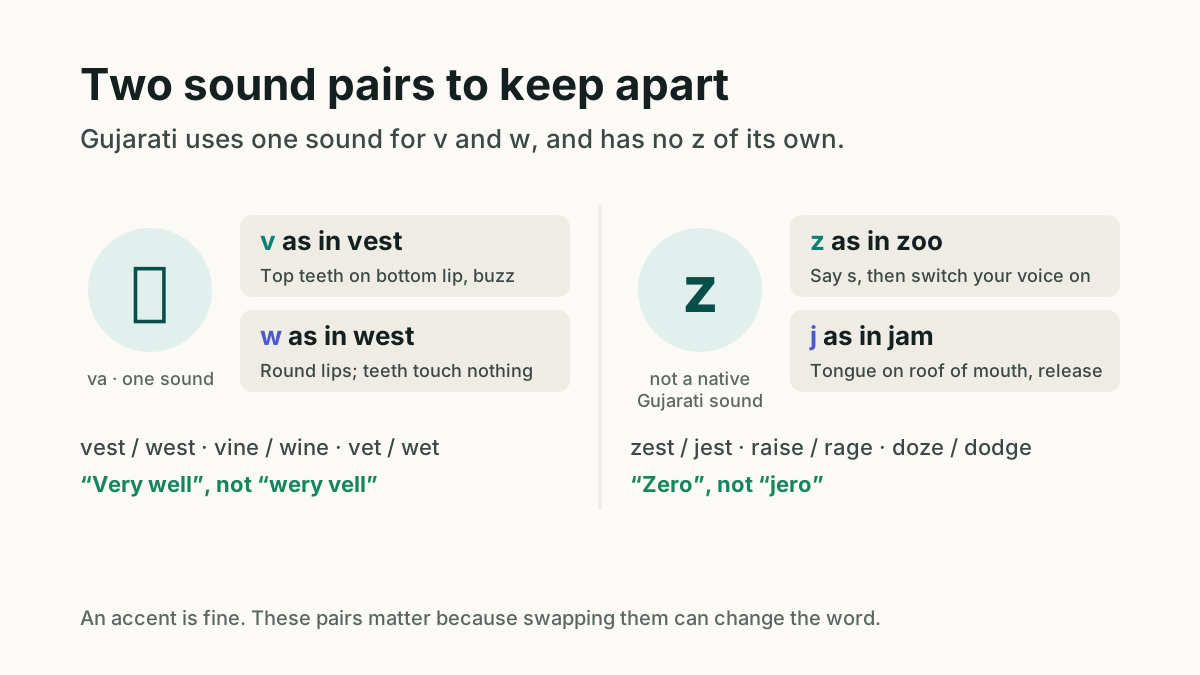
Most English mistakes Gujarati speakers make follow directly from how Gujarati works. The verb comes at the end, there are no words for "a" and "the", one postposition, "thi", covers "since", "for" and "from", one sound, વ, does the job of both v and w, and z is not a Gujarati sound at all. Know the cause and the fix is usually small.
Here are ten patterns, each with how Gujarati says it, the common English version, the natural English and a drill to say aloud. These are tendencies, not facts about every Gujarati speaker, and none of them is about your accent: having a Gujarati accent is not a mistake. The goal is only to remove the slips that make a listener stop and guess. If you searched "english bolta kevi rite shikhvu", start here: spot the habits Gujarati brings with it, then speak English a little every day.
Why does the verb move to the end?
Gujarati is a subject–object–verb language, so the verb closes the sentence. English is subject–verb–object, so the verb comes straight after the subject. In short sentences most people get this right, but in a long sentence, said while you are still thinking, the verb tends to wait until the end.
- In Gujarati
- Hun bhaat khaun chhun. (હું ભાત ખાઉં છું.) Word for word: I rice eat.
- Common
- My brother in Surat in a bank works.
- Natural English
- My brother works in a bank in Surat.
- Say it aloud
- My mother runs a shop. My cousin studies in Vadodara. I drink tea after lunch.
When do you need "a" and "the"?
Gujarati has no articles. "Ek" (એક, one) can stand in for "a", but usually a noun has nothing in front of it. So English articles are easy to leave out, and, when you are concentrating on them, easy to add where English has none.
- In Gujarati
- Hun engineer chhun. (હું એન્જિનિયર છું.)
- Common
- She is doctor. This is very good idea.
- Natural English
- She's a doctor. This is a very good idea.
- Common
- The cricket is my favourite sport.
- Natural English
- Cricket is my favourite sport.
- Say it aloud
- I have a sister. The sister I told you about lives in Pune. Cricket is a lot of fun.
A quick rule for speech: a/an for the first mention of one thing, the when the listener knows which one, and nothing for things in general, sports, and most names of people, cities and countries.
Since or for? "I work here since two years"
In Gujarati, "thi" (થી) does three jobs: "2024thi" is since 2024, "be varshthi" is for two years, and "Rajkotthi" is from Rajkot. Gujarati also uses its ordinary present tense for something that started in the past and is still true. Put word for word into English, that gives "since two years" with a present tense, which a listener understands but which does not sound natural.
- In Gujarati
- Hun be varshthi ahin kaam karun chhun. (હું બે વર્ષથી અહીં કામ કરું છું.)
- Common
- I work here since two years. I am working here since two years.
- Natural English
- I've been working here for two years. I've been working here since 2024.
- Say it aloud
- I've lived in Ahmedabad for twelve years. I've known him since college. I've been waiting for an hour.
For + a length of time (two years, an hour, ages). Since + a starting point (2024, Diwali, Monday, I was ten). And because the situation started in the past and continues now, English needs the present perfect: "I have lived", "I've been working". Our guide to the tenses you need for speaking has more examples.
"I am coming from Rajkot": simple or continuous?
Gujarati has one everyday present form where English has two. "Hun jaun chhun" (હું જાઉં છું) means both "I go" and "I'm going", and "chhun" (છું) feels like "am". So "am + -ing" can become the default English present, even for facts, habits and states, where English uses the simple form. Verbs for states, such as know, understand, want, like and have (meaning own), are almost never continuous in English.
- In Gujarati
- Hun Rajkotthi aavun chhun. (હું રાજકોટથી આવું છું.)
- Common
- I am coming from Rajkot. I am knowing him very well.
- Natural English
- I'm from Rajkot. I know him very well.
- Say it aloud
- I'm from Rajkot. I know. I understand. Right now I'm sitting at my desk.
A quick test: habits, facts and states take the simple form; things happening right now take the continuous. "I'm coming from Rajkot" is fine English, but it means you are on your way from Rajkot at this moment.
Knowing the rule is one thing; using it while you speak is another. SpeakWisely asks for your first language when you start, listens to what you actually say, and when one of these slips shows up in your own speech, explains it by its cause.
Practise speaking with feedbackWhy does "Where you are going?" sound wrong?
A Gujarati question keeps the order of a statement. "Tame kyaan jaao chho?" (તમે ક્યાં જાઓ છો?) is the statement "Tame jaao chho" with "kyaan" (where) added, and a yes/no question can start with "shun" (શું) or simply rise at the end. English moves the helping verb, such as is, are, do, did or can, in front of the subject.
- In Gujarati
- Tame kyaan jaao chho? (તમે ક્યાં જાઓ છો?)
- Common
- Where you are going? What you want to eat?
- Natural English
- Where are you going? What do you want to eat?
- Say it aloud
- Where are you going? What do you want? When did you arrive? Can you help me?
Tag questions follow the same pattern. Gujarati adds "ne?" (ને?) to the end of a sentence: "Tame kaale aavsho ne?" (તમે કાલે આવશો ને?). In English that tends to come out as "You will come tomorrow, no?" or "…, isn't it?" English builds the tag from the helping verb: "You'll come tomorrow, won't you?" If that feels like a lot to manage mid-sentence, "right?" works after any statement.
Angry on, married with: which preposition?
Gujarati uses postpositions, which follow the noun and often join onto it: "gharmaan" (ઘરમાં, in the house), "table par" (ટેબલ પર, on the table). Many match English, but in some fixed phrases Gujarati uses a different one, and it carries over into English.
- In Gujarati
- Te mara par gusse thayo. (તે મારા પર ગુસ્સે થયો.)
- Common
- He got angry on me.
- Natural English
- He got angry with me.
- In Gujarati
- Tene Priya sathe lagna karya. (તેણે પ્રિયા સાથે લગ્ન કર્યાં.)
- Common
- He married with Priya.
- Natural English
- He married Priya. He is married to Priya.
- Say it aloud
- Don't be angry with me. She's married to my cousin. He's good at maths. It depends on you.
These are fixed phrases, so learn the ones you use as whole chunks: angry with someone, married to someone, good at something, depend on, discuss a plan (no "about"), reach home (no "to").
"He go", "she don't", and mixing up he and she
Gujarati verb endings change in a different pattern from English: "hun karun chhun", "tame karo chho", "te kare chhe". English adds a single -s in the present simple, only after he, she, it and singular nouns. Because that small sound carries so little meaning, it is the first thing to go in fast speech, and sometimes it lands on the wrong verb ("they goes").
Gujarati "te" (તે) means he, she or it. Gender shows only in some verb forms, such as "te gayo" (તે ગયો, he went) and "te gai" (તે ગઈ, she went), and the present "te kare chhe" is the same for both. That is why "he" and "she" can swap in English even when you know exactly who you mean.
- Common
- My father work in a bank. She don't eat onion.
- Natural English
- My father works in a bank. She doesn't eat onions.
- Common
- My sister lives in Canada. He is a nurse.
- Natural English
- My sister lives in Canada. She is a nurse.
- Say it aloud
- He works. She lives. It costs. My sister? She's a nurse. She doesn't. He doesn't.
Vest or west? The v and w sounds
In Gujarati, v and w are two ways of saying the same sound, વ, and swapping them never changes a word. In English they are different sounds that make different words: "vest" and "west", "vine" and "wine", "vet" and "wet". That is why "very well" can come out as "wery vell" without you hearing any difference.
For v, rest your top teeth lightly on your bottom lip and push air through so it buzzes. For w, round your lips into a small circle with your teeth touching nothing, then open them.
- Can sound like
- "Wery vell" for "very well"; "vine" for "wine".
- Clear English
- Very well, thank you. We went to Vadodara on Wednesday.
- Say it aloud
- vest, west · vine, wine · vet, wet · very well · we visited
Zero or "jero"? The z sound
Z is not a native Gujarati sound. Words that came into Gujarati from Persian with a z usually took a j instead: Hindi "zameen" (land) is "jamin" (જમીન) in Gujarati. So English z can come out as j: "zero" as "jero", "zoo" as "joo", "raise" as "rage". Most listeners will follow you from context, but "zest" and "jest" or "doze" and "dodge" are different words.
- Can sound like
- "Jero" for "zero"; "rage" for "raise".
- Clear English
- Please raise your hand if you scored zero.
- Say it aloud
- zest, jest · raise, rage · doze, dodge · zero, zoo, easy, busy
To make z, say a long s, then switch your voice on without moving your tongue, so it buzzes.
Thin or tin? The th sounds
Gujarati has no "th" sound as in "think" or "this". The closest Gujarati sounds, ત, થ and દ, touch the tongue against the back of the teeth instead of between them, so "three" can sound like "tree", "thought" like "taught" and "they" like "day". For both th sounds, put the tip of your tongue lightly between your teeth: blow air for "think" and "three", and add your voice for "this" and "mother".
- Can sound like
- "I taught so" for "I thought so".
- Clear English
- I thought about it for three days.
- Say it aloud
- thin, tin · three, tree · thought, taught · they, day · this, those
How do you make the fixes stick?
- Choose two patterns. Pick the two you hear most in your own speech and work on only those for a week.
- Drill out loud, every day. Reading a fix changes what you know; saying it changes what comes out of your mouth.
- Record a minute about your day. Listen for your two patterns, and for fillers too: our guide on how to stop saying "um" helps with those.
- Treat self-correction as progress. Catching "I am knowing… I know him" mid-sentence means the new habit is on its way.
SpeakWisely's English speaking practice works this way. You choose your first language when you start, Gujarati among them, and the coach mentions a Gujarati pattern only when your own words show it. The pronunciation lab starts Gujarati speakers with v and w, then z and j, and checks which word was heard, never your accent. Slips that keep coming back across sessions appear in your mistakes fingerprint with their likely cause, and your own corrected sentences become review cards. If practising with AI is new to you, read how to learn English with AI.
Hindi shares most of these grammar patterns with Gujarati; see English mistakes Hindi speakers make for a comparison.
Common questions
Do Gujarati and Hindi speakers make the same English mistakes?
Many of the grammar patterns are shared, because both languages put the verb last, use postpositions and have no articles. The sounds differ a little: z, which Gujarati does not have, and s and sh, which some Gujarati dialects do not keep apart, are worth extra attention.
Do I need to lose my Gujarati accent?
No. Everyone speaks English with an accent, and having one is not a mistake. Fix v and w, z and th only because swapping them can change the word a listener hears.
Will these mistakes affect my IELTS Speaking band?
Grammar slips such as missing articles count under grammatical range and accuracy. Sounds count under pronunciation, which is judged on how easy you are to understand, not on your accent. Our guide to the IELTS Speaking band descriptors explains each criterion.
How long does it take to fix a habit like this?
There is no fixed time; it depends on how often you speak. A few minutes of saying the right version every day does more than an hour once a week.
Your recording is processed and then deleted. It is never stored — only your transcript and results are kept.
Sources
Keep reading
- Common English mistakes Hindi speakers make, and how to fix them
Verb at the end, no "a" or "the", one "se" for since and for, one व for v and w. Ten patterns Hindi brings into English, and a drill for each.
- The English tenses you actually need for speaking
Six forms carry everyday conversation. Which ones they are, the mix-ups that give learners away, and how to practise them out loud.
- How to learn to speak English with AI: what AI feedback can and can't tell you
AI is a patient practice partner that can measure your pauses and quote your mistakes. It cannot give you an official score or replace real conversations. Here is how to use it well.