The English tenses you actually need for speaking
By the SpeakWisely team · Published · 7 min read
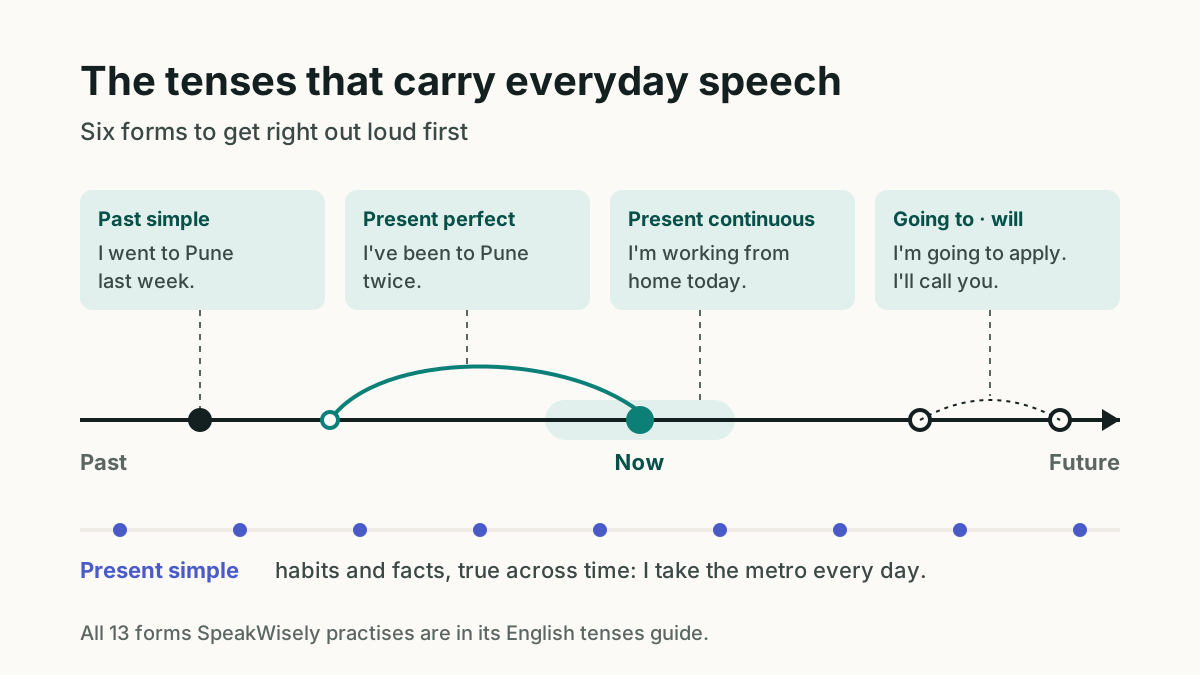
For everyday speaking, you can get a long way with six forms: the present simple, the present continuous, the past simple, the present perfect, and going to and will for the future. With those six you can talk about your routine, what is happening now, what you did, what you have done, and what you plan to do. Get them right out loud first; the rest can wait.
This guide shows where each one sits on the timeline, the mix-ups that most often give learners away, and how to practise tenses by speaking rather than by filling in blanks. For every form in one place, see the full English tenses guide, which covers all 13 tenses and time forms SpeakWisely practises.
Which tenses do you need most when speaking?
Think about what you actually talk about in a normal day: your job or studies, your plans for the weekend, something that happened yesterday, whether you have tried the new place near the office. Those topics map onto a small set of forms.
- Present simple: habits, routines and facts. "I work in Hyderabad. My office opens at nine."
- Present continuous: things happening now or around now. "I'm preparing for my bank exams these days."
- Past simple: finished actions at a finished time. "I joined the company in 2022."
- Present perfect: experiences and past actions that still matter now, with no finished time. "I've worked with three clients so far."
- Going to: plans you have already decided on. "I'm going to apply for a master's next year."
- Will: decisions made right now, predictions, promises and offers. "I'll send you the file tonight."
One more is worth adding early because it is so common in conversation: the present continuous for arrangements, for things already in the diary. "I'm meeting the client on Friday." It looks like the present but talks about the future.
How do you choose the right tense while you are speaking?
You do not have time to recite rules mid-sentence. Instead, ask one quick question about the time you mean, and let the time word guide you:
- Is it a habit or a fact? Present simple. Time words: usually, every day, on Sundays.
- Is it happening now, or these days? Present continuous. Time words: now, at the moment, this week.
- Is it finished, and do you say or know when? Past simple. Time words: yesterday, last year, in 2019.
- Is it an experience, or news, with no finished time? Present perfect. Time words: ever, never, already, yet, so far.
- Is it a plan? Going to, or the present continuous if it is fixed. Decided this second? Will.
Time words are your best friend here. If you have just said "yesterday", the verb almost has to be past simple. If you have said "so far", it almost has to be present perfect.
Which tenses do learners mix up most?
These are the slips that are easy to hear in conversation, and each one has a simple fix.
Present perfect with a finished time
The present perfect does not go with words for a finished time, such as yesterday, last week or in 2023. If you name the finished time, use the past simple. If the time does not matter, or the period is not over, use the present perfect.
- Weak
- I have completed my B.Com in 2023.
- Better
- I completed my B.Com in 2023.
- Weak
- I have visited Goa last year.
- Better
- I visited Goa last year. I've been there twice now.
A natural pattern in conversation is to open with the present perfect and then switch to the past simple for the details: "Have you ever been to Rishikesh?" "Yes, I went last December. We stayed near the river."
"I am knowing" and other -ing slips
Some verbs describe a state, not an action, and are not usually used in continuous forms. The common ones in speech are know, like, love, want, need, believe, understand, mean, own and have (when it means possess).
- Weak
- I am knowing him since college.
- Better
- I've known him since college.
- Weak
- I am having two brothers.
- Better
- I have two brothers.
The same verb can switch meaning. "I think it's a good idea" is an opinion, so it stays simple. "Wait, I'm thinking" is an action in progress, so the continuous is fine. Likewise "I'm having lunch" is correct, because "have" means eat there, not own.
Since and for with the present
When something started in the past and is still true, English uses a perfect form with since or for, not the present simple or continuous.
- Weak
- I am working here since 2021.
- Better
- I've been working here since 2021.
- Weak
- I live in Bengaluru for five years.
- Better
- I've lived in Bengaluru for five years.
Continuous for habits, and "did" with a past verb
- Weak
- Every day I am going to office by metro.
- Better
- Every day I go to the office by metro.
- Weak
- Did you went to the market?
- Better
- Did you go to the market?
After did, didn't, does or doesn't, the main verb goes back to its base form: did you go, she doesn't eat. The helping verb already carries the tense. Many of these slips come from how your first language builds verbs; if you speak Hindi at home, our guide to common English mistakes Hindi speakers make explains where they come from.
Knowing the rule is not the same as using it mid-sentence. SpeakWisely's tense practice asks you a question that calls for a particular tense, checks the verb forms you actually used, explains any slip and lets you try again.
Practise tenses out loudWhich tenses can wait?
The other forms are real and useful, but they come up less often in everyday talk, and getting the core six right will make a bigger difference to how you sound. Add them once the core feels automatic:
- Past continuous for the background of a story: "I was driving home when it started to pour." The first one to add if you like telling stories.
- Used to for past habits that have stopped: "I used to play cricket every evening."
- Present perfect continuous for something still going on: "I've been learning the guitar for two years."
- Past perfect for the earlier of two past events: "When I reached the station, the train had already left."
- Future continuous and future perfect for more precise future time: "This time tomorrow I'll be flying to Dubai." "By June I'll have finished my degree."
Each of these, with how it is built and examples of a statement, a negative and a question, is in the English tenses guide.
How should you practise tenses out loud?
- Use questions that force a tense. "What did you do last weekend?" needs the past simple. "What have you done this year that you are proud of?" needs the present perfect. "What are you going to do after your exams?" needs going to.
- Answer for 30 to 60 seconds and record it. Then listen back for the verbs only, not your accent or your vocabulary.
- Say the time word on purpose. Starting with "Last week…" or "So far…" commits you to the right tense before you reach the verb.
- Fix one mix-up at a time. Spend a week on present perfect versus past simple before moving on to the -ing slips.
- Mix tenses in one answer. Real answers move between times. Practising that switch is what makes it feel natural.
- Question
- Tell me about your job.
- Answer
- I work as a data analyst in Noida. I joined two years ago, straight after my degree. Since then I've moved to a bigger team, and these days I'm building reports for the sales side. Next year I'm going to apply for a senior role.
That one answer uses the present simple, past simple, present perfect, present continuous and going to. It is also close to the structure of a good interview answer, which we break down in how to answer "Tell me about yourself".
In SpeakWisely you pick a time frame, past, present or future, and answer out loud. Your mastery of each tense is tracked over time, so a weak spot shows up as "present perfect", not just "the present". For broader fluency work, such as fillers, pace and pauses, see English speaking practice, and if fillers creep in while you search for the right verb, try the routine in how to stop saying "um".
Common questions about tenses in speaking
How many tenses are there in English?
It depends how you count. School grammar often lists 12, from three times (past, present, future) and four forms of each. SpeakWisely's guide covers 13 forms, because it also includes structures such as "going to", "used to" and the present continuous for plans, which you use just like tenses when you speak.
Do I need the perfect tenses to speak fluently?
You need the present perfect early, because it comes up all the time when you talk about experiences and news. The past perfect and future perfect can wait until the core forms feel automatic.
Should I use "will" or "going to" for plans?
For a plan you have already made, "going to" usually sounds more natural: "I'm going to visit my cousins in Jaipur." Use "will" for a decision you make while speaking: "It's raining. I'll take an auto."
Is "I am having a car" wrong?
Yes, when you mean you own one. "Have" for possession is a state, so say "I have a car" or "I've got a car". "I'm having" is fine for actions, such as "I'm having dinner".
Your recording is processed and then deleted. It is never stored — only your transcript and results are kept.
Sources
Keep reading
- Common English mistakes Hindi speakers make, and how to fix them
Verb at the end, no "a" or "the", one "se" for since and for, one व for v and w. Ten patterns Hindi brings into English, and a drill for each.
- How to answer "Tell me about yourself" in an English interview
Present, past, future, in about a minute. A structure for the first interview question, three sample answers, and the phrases that weaken an answer.
- How to stop saying "um" and "like": a fluency practice routine
Fillers are the sound of planning out loud. Swap them for short silent pauses, keep a few thinking phrases ready, and track your fillers per minute for a week.