Does English increase your salary in India? What the evidence shows
By the SpeakWisely team · Published · 6 min read

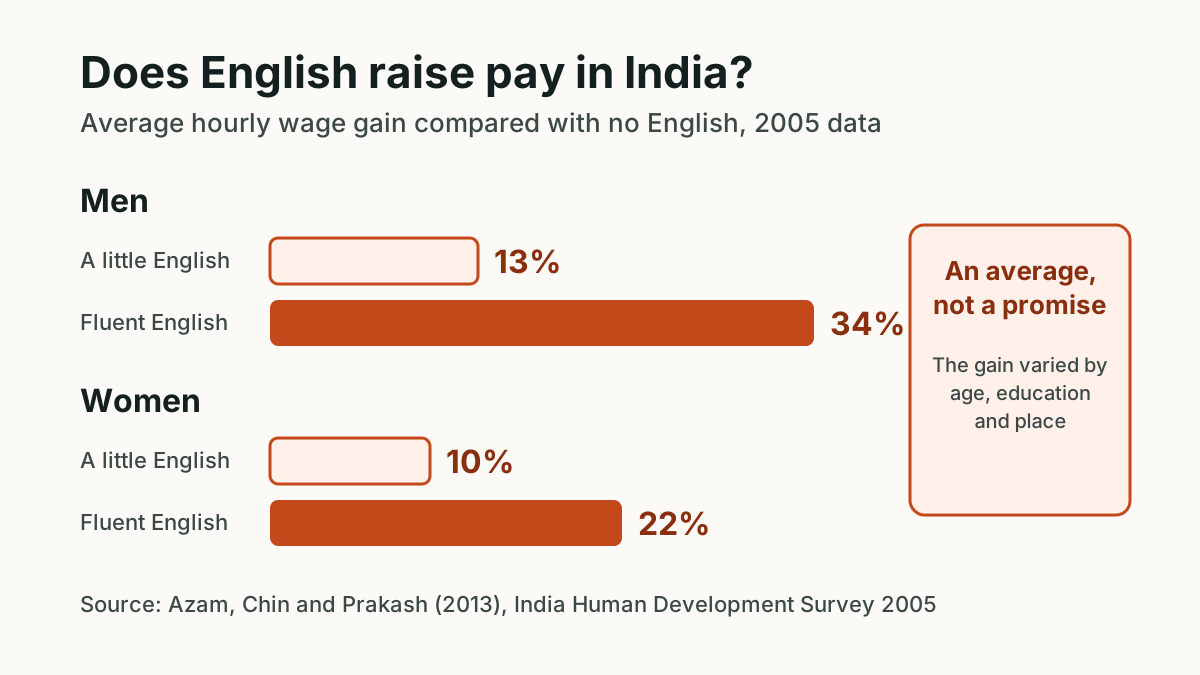
Yes, on average. The best-known study found that fluent English speakers in India earned about 34% more per hour if they were men and 22% more if they were women, compared with similar people who spoke no English. But those figures come from 2005 data, they are averages, and the gain varied widely by age, education and place. English can strengthen your position; it does not set your salary.
This post explains what that research found, why the raw gap you may have heard about is misleading, and what to do if you want your English to count at your next interview.
How much does it pay to speak English in India?
The figures most often quoted come from Mehtabul Azam, Aimee Chin and Nishith Prakash, published in Economic Development and Cultural Change in 2013. They used the India Human Development Survey of 2005 and compared people after controlling for age, social group, education, test performance, district and urban or rural location. Compared with speaking no English, average hourly wages were:
- Men: 34% higher with fluent English, 13% higher with a little English.
- Women: 22% higher with fluent English, 10% higher with a little English.
Notice the second number in each line. Even a little English was linked to a gain, which matters if fluency feels far away. To give a sense of scale, the authors say the return to fluency was about as large as the return to completing secondary school, and about half the return to an undergraduate degree.
Why do English speakers seem to earn so much more?
In the same survey, fluent men earned an average of Rs 42 an hour against Rs 10 for men with no English, and fluent women Rs 33 against Rs 6. Those are 2005 wages, and the gap looks enormous. The authors say such simple comparisons likely overstate what English itself is worth.
The reason is that English goes along with many other advantages. In the survey, 89% of people with a bachelor’s degree spoke some English, compared with 11% of those with five to nine years of schooling. Someone who speaks English is also more likely to have more education and to live in a better-paying area. Once the researchers controlled for those differences, a four-fold gap became a premium of around a third. Be wary of anyone who quotes the larger number.
Who gains most from speaking English?
The average hides large differences, and this may be the most useful part of the study. Among men, the premium for fluency looked like this:
- Older men without a degree: 53%.
- Older men with a degree: 28%.
- Younger men with a degree: 40%.
- Younger men without a degree: 13%.
So for younger workers in 2005, English was worth far more alongside a degree than without one. The study also found no gain from English for younger men who had not finished secondary school, and the authors caution that teaching English to adults "may not necessarily raise their wages".
Location mattered too. Returns were lower in districts where English had historically been more common, and in districts with IT firms, which have more English speakers. That fits a simple idea: a skill pays more where it is scarcer. It also suggests that as more Indians learn English, it may stand out less on its own.
Is there other evidence that English raises wages?
There is, though it is limited. A 2016 paper in the Economics of Education Review by Tanika Chakraborty and Shilpi Kapur Bakshi looked at a policy in West Bengal that abolished the teaching of English in public primary schools. People who were affected by the change earned, on average, 26% lower wages. The authors point to occupational choice as an important part of the reason, meaning that English seemed to change the kinds of work people could enter.
That is useful because it comes from a policy change and not just a comparison of different people. But it is one state, one generation and early schooling, so it tells you less about what happens when an adult improves their English today. Good evidence on that question is thin. Honest advice has to say so.
What is the salary for English speaking jobs in India?
There is no official salary figure for "English speakers", because English is a skill people use across every kind of job, not a job title. What you can do is look up the specific role you want. For example, Payscale’s India page, updated on 26 August 2026, gives an average base salary of ₹3,44,381 a year for a customer service representative, with most profiles between about ₹1.95 lakh and ₹6.02 lakh. It is based on 497 self-reported profiles, so treat it as a rough guide. It also does not tell you how much of that pay is due to English.
Look up pay by role, city and experience, and compare a few sources. If a course or an agent promises a specific salary jump just for learning English, ask to see the evidence. No study we found supports that kind of promise.
How can you make your English count at work?
Employers rarely pay for English in itself. They pay for what you can do with it: handle a client, explain a problem, lead a meeting or sell something. So tie your English to tasks that matter in your job. Practise describing your results in numbers you can stand behind, then practise asking about pay calmly. Many people lose out here not through weak grammar but through hurrying or avoiding the subject.
- Show value
- I handle most of our client calls now, including the ones with our Singapore team.
- Ask about pay
- Could you share the salary range for this role?
- Make your case
- Based on my experience and the market rate for this role, I was hoping for something closer to this figure.
- Buy time
- Thank you. Could I take a day to think about the offer?
Say these aloud until they feel ordinary. For the interview itself, our guide to job interview questions and answers in English covers what you are likely to be asked, and how to answer "Tell me about yourself" helps you begin well.
With Event prep in SpeakWisely, you describe what is coming up, such as an interview tomorrow, and get a rehearsal with likely questions, useful phrases and a partner who plays the other side.
Start practising freeCommon questions about English and salary
Does English increase salary in India?
Does it pay to speak a little English?
What is the average English speaking salary in India?
Is English more valuable than a degree?
Which jobs in India pay more for English?
English is a real advantage and worth working on, as long as you see it as one part of your case for better pay. For the wider picture of what it can and cannot do, read why English is important.
Your recording is used only to transcribe your answer, then deleted within 15 minutes. We keep your transcript and results, never the audio.
Sources
Keep reading
 English and careers9 min read
Why English is important: what it really opens up, and where it stops helping
English widens your options at work, in education, online and abroad. Here is the evidence, what it is worth in India, and where it stops helping.
 English and careers7 min read
English for BPO and call centre jobs: the test, the interview and real call phrases
BPO employers want to know you can be understood on the phone, follow fast speech and stay polite. Here is what they test and how to practise it at home.
 Spoken English8 min read
12 common job interview questions and answers in English
Every interviewer asks some version of the same dozen questions. Here is what each one is testing, a sample answer for freshers and professionals, and how to rehearse out loud.
 Spoken English8 min read
How to answer "Tell me about yourself" in an English interview
Present, past, future, in about a minute. A structure for the first interview question, three sample answers, and the phrases that weaken an answer.