How to learn to speak English with AI: what AI feedback can and can't tell you
By the SpeakWisely team · Published · 7 min read
You can learn to speak English with AI by using it as a practice partner you talk to out loud every day. AI is good at the parts of practice that are hard to get from people: it never gets tired, it is there at midnight, and it can measure your pace, pauses and filler words exactly and quote the grammar slips you actually made. It cannot give you an official score, it sometimes mishears you, and it does not replace talking to real people. Use it for daily repetitions, and use people for the real thing.
If you searched "english bolna kaise sikhe", the honest answer is the same in any language: speak more, out loud, every day, and get specific feedback on what you said. This guide explains what AI feedback can tell you, what it cannot, and a 15-minute routine that fits around college or work.
What is AI actually good at when you practise speaking?
A patient partner who never runs out of time
Most learners in India read and write English well but get few chances to speak it without someone watching. A friend will listen to two or three answers before the conversation moves on; a tutor costs money by the hour. An AI partner will hear the same question answered ten times in a row, at your pace, without judging you. That repetition is what builds fluency.
Measuring what you cannot hear yourself
While you speak, you are busy thinking of the next word, so you do not notice how often you say "um" or how long you go silent. A speech recogniser can mark when each word starts and ends. From those timings, software can count things precisely rather than guess:
- Pace: how many words you say per minute.
- Pauses: how many times you stopped, where, and for how long.
- Filler words: every "um", "uh", "you know" and "I mean".
- Repetition: words you said twice in a row while searching for the next one.
These are the habits that make a speaker sound hesitant, and they are hard to fix if you cannot count them. Our guide on how to stop saying "um" shows what to do once you know the number.
Quoting your own mistakes back to you
General advice such as "work on your tenses" is easy to agree with and hard to act on. Good AI feedback quotes the exact words you said, shows the correction and gives a one-line reason. You remember a mistake much better when it is your own sentence.
- You said
- Yesterday I go to office and my manager is telling me about the new project.
- Better
- Yesterday I went to the office and my manager told me about the new project.
- Why
- Yesterday is finished time, so both verbs go into the past simple.
There when you need it
An interview tomorrow morning, a client call after lunch, a viva next week: the moment you most want to rehearse is rarely when a tutor is free. AI is available whenever you are, which makes it easier to practise little and often instead of all at once.
What can AI feedback not tell you?
AI feedback is useful only if you know where it stops. These are the limits that matter most.
- An AI score is an estimate, not an official result. An AI band for IELTS or any other exam is a practice estimate. Only the real test gives you a real score. If you want to see how one tool turns your speech into a band, read how SpeakWisely estimates your IELTS Speaking band.
- Transcription can mishear you. Every piece of feedback starts from the words the recogniser heard. A noisy room, a weak microphone or a name it does not know can produce a word you never said. If a "mistake" looks wrong, check the transcript first.
- Accent is not an error. An Indian accent is a normal way to speak English. What matters is whether you are easy to understand. Be wary of any tool that tells you to "sound American".
- It cannot replace real conversations. People interrupt, change the subject, look bored, laugh and ask follow-ups you did not expect. Practising with AI makes those moments easier, but you still need them.
- It only knows what you tell it. AI does not know you have an interview at a bank or that your manager prefers short updates unless you say so.
What does a 15-minute daily speaking routine look like?
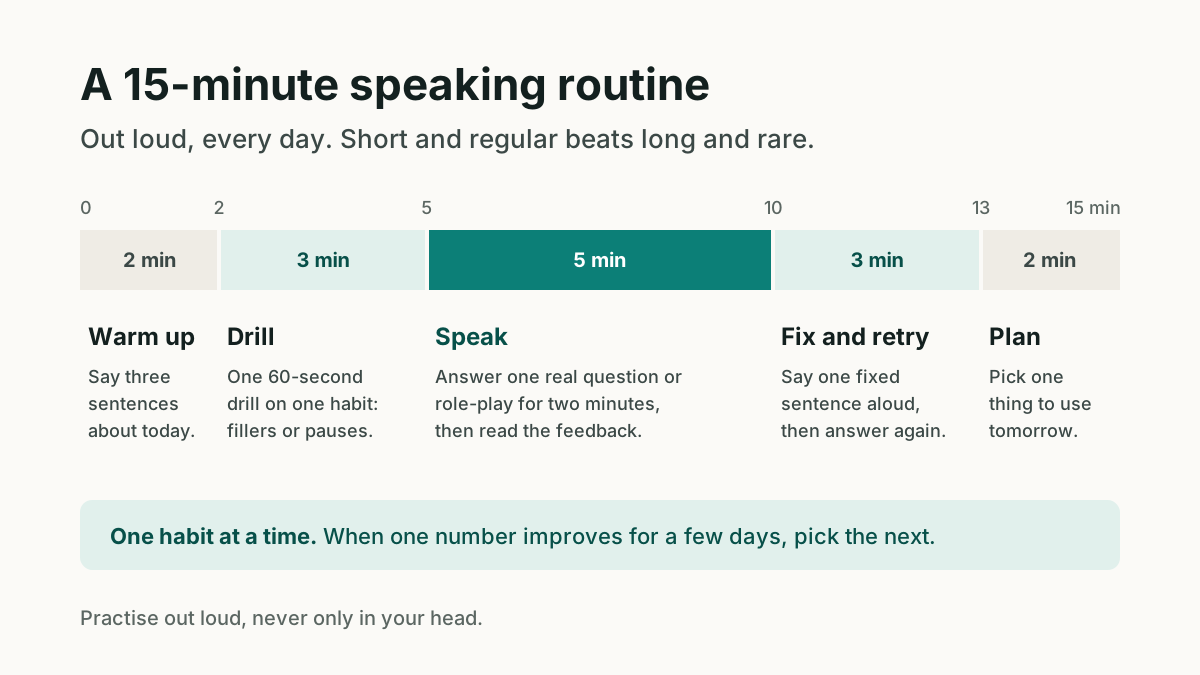
Fifteen minutes every day does more for your speaking than two hours on a Sunday, because fluency comes from regular repetition. Here is a routine that works with any AI speaking tool, or with a phone recorder and a timer.
- Warm up, 2 minutes. Say three sentences out loud about your day so far. No feedback, just get your mouth moving in English.
- One drill, 3 minutes. Pick one habit, such as fillers, long pauses or pace, and speak for 60 seconds while aiming only at that. Do it twice and compare the number.
- One real task, 5 minutes. Answer one real question or do a short role-play for about two minutes, then read the feedback carefully.
- Fix and retry, 3 minutes. Take one corrected sentence and say it aloud three times. Then answer the same question again and see what changed.
- Plan, 2 minutes. Write down one phrase or one fix you will use in a real conversation tomorrow.
- Warm-up
- This morning I took the bus to college. It was more crowded than usual, so I stood the whole way. I'm planning to finish my assignment tonight.
Keep to one habit at a time. If you try to fix fillers, tenses and vocabulary in the same week, none of them moves. When one number has improved for a few days running, pick the next.
SpeakWisely gives you one speaking task a day, picked from what you most need to work on. You answer out loud, the coach asks a follow-up question about what you said, and you see what to fix.
Start today’s speaking taskHow does SpeakWisely fit into that routine?
SpeakWisely is an AI English speaking coach that runs in your browser. Each part of the routine above has a matching tool in it:
- A daily coach task. One speaking task a day, chosen from your skill profile, with a follow-up question about your answer and feedback on communication skills such as fluency, grammar, vocabulary and organising ideas. Try it again to see what improved.
- 60-second drills. Short drills that each aim at one habit, such as filler words, pace or pauses, so you can watch one number move.
- Role-play. Situations such as a job interview, a visa interview, a client call or small talk, with an AI partner whose level moves with you. You can choose a British, American, Australian or Indian accent for the partner.
- Pronunciation pairs. Minimal pairs such as "vest" and "west", judged by which word was heard. This checks how clearly you are understood, never your accent.
- First-language-aware explanations. Choose your first language, including Hindi and Gujarati, and mistakes can be explained by their likely cause. For Hindi and Gujarati you can turn on an "Explain in" button under corrections to read the explanation in your own language.
Your recording is processed and then deleted; only the transcript and results are kept. You can read more about the tools on the AI English speaking practice page.
Which mistakes will AI catch most often for Hindi and Gujarati speakers?
Many slips come from how your first language works, not from carelessness. Hindi and Gujarati have no words for "a" and "the", put the verb at the end of the sentence and use postpositions after the noun, so these patterns turn up again and again:
- Articles
- I am working in bank. → I work in a bank.
- Continuous
- I am having two brothers. → I have two brothers.
- Prepositions
- I am going to office. → I am going to the office.
Knowing the cause makes the fix stick. See the full lists in common English mistakes Hindi speakers make and common English mistakes Gujarati speakers make. If tenses are your main problem, English tenses for speaking covers the ones you actually need in conversation.
Common questions about learning English with AI
Can AI really help me speak English fluently?
It can help a lot with practice: it gives you unlimited chances to speak, measures your pauses and fillers, and quotes your mistakes. Fluency still comes from you speaking regularly, and you need real conversations too.
Is AI feedback on my speaking accurate?
Measurements such as pace, pauses and filler words are reliable when the transcript is right. Judgements about word choice or style are suggestions. If something looks wrong, check whether the recogniser misheard you.
Will AI mark my Indian accent as a mistake?
It should not, and SpeakWisely never treats accent as an error. What matters is whether your words came through clearly, not whether you sound British or American.
How long should I practise speaking every day?
Fifteen focused minutes, out loud, every day is a realistic start. Regular short practice works better than one long session a week.
Do I need to learn grammar before I start speaking?
No. Start speaking now and fix grammar from your own mistakes as they come up. Learning a rule is easier when you have just used it wrongly.
Your recording is processed and then deleted. It is never stored — only your transcript and results are kept.
Sources
Keep reading
- How to stop saying "um" and "like": a fluency practice routine
Fillers are the sound of planning out loud. Swap them for short silent pauses, keep a few thinking phrases ready, and track your fillers per minute for a week.
- Common English mistakes Hindi speakers make, and how to fix them
Verb at the end, no "a" or "the", one "se" for since and for, one व for v and w. Ten patterns Hindi brings into English, and a drill for each.
- How SpeakWisely estimates your IELTS Speaking band (and its limits)
Your speech is measured, the AI finds quoted evidence, and a fixed rubric with no AI in it sets the band. Here is every step, and what an estimate cannot tell you.