How to practise speaking English alone, with nothing but your phone
By the SpeakWisely team · Published · 7 min read
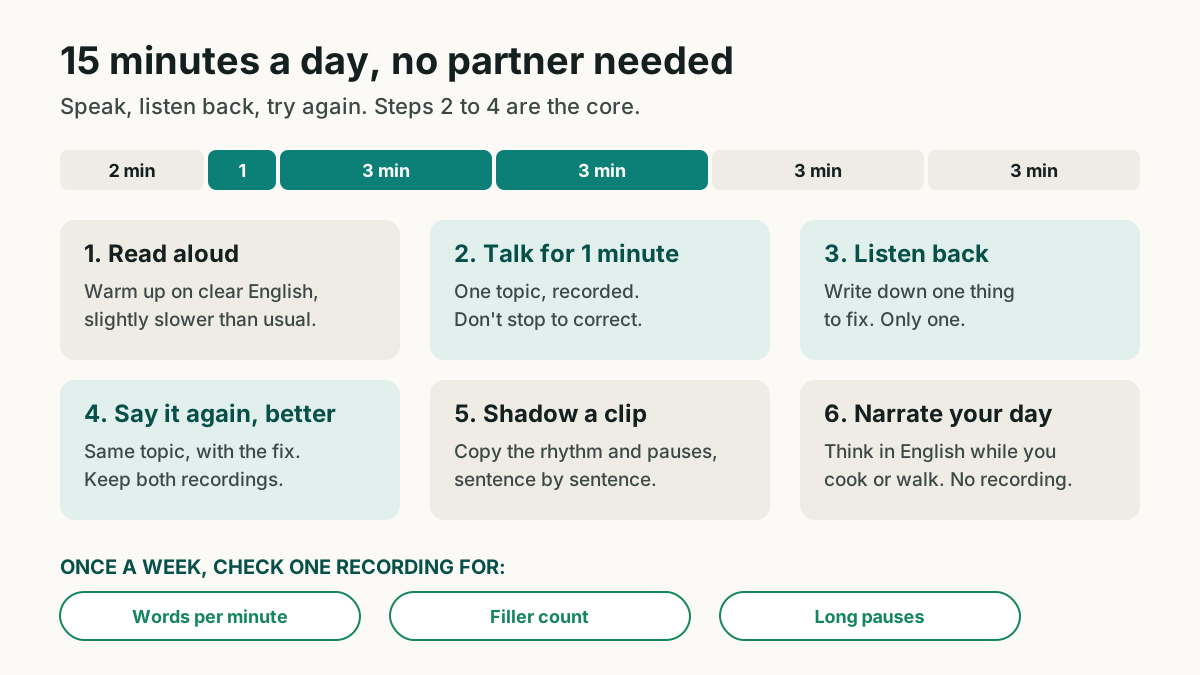
Yes, you can get better at speaking English without a partner. Speaking is a skill you build by producing English out loud, and you can do that alone, every day, in fifteen minutes. The routine below does it in six short steps: read aloud, talk for a minute, listen back, say it again better, shadow, then narrate. It works because it gives you the three things a partner would: a reason to speak, a way to notice mistakes, and a second try.
Many learners in India read English well and understand films without subtitles, but freeze when they have to speak. That gap is normal. Reading and listening train understanding; only speaking trains the fast, automatic production that conversation needs. If you can practise alone, the lack of a partner, a class or a confident friend stops being the reason you are not improving.
The 15-minute routine
Do the steps in this order: the first warms up your mouth, the middle three are the core, and the last two build fluency without pressure. All you need is a phone that records audio.
1. Read aloud (2 minutes)
Read a paragraph of a news article, a book or anything in clear English, out loud and slightly slower than feels natural. This is a warm-up: it gets you into English and lets you focus on pronunciation without having to think of words. Pause at commas and full stops, and give the important words a little more weight.
2. Talk for one minute and record it (1 minute)
Pick one topic from the list below, give yourself ten seconds to think, start recording and talk for one full minute. Don't stop to correct yourself; if you get stuck, say "what I mean is…" and keep going. This is the most important step: it is the closest you can get alone to answering a real question.
3. Listen back and note one thing (3 minutes)
Play the recording once and write down one thing to improve: a word you were missing, a tense you mixed up, a filler you repeated, a sentence that went nowhere. Only one. Trying to fix everything at once is how routines die after a week. If you do not know the English word you needed, look it up now.
4. Say it again, better (3 minutes)
Record the same topic again, using the fix. Then a third time if there is time. This is where the improvement happens: the second attempt is usually noticeably smoother, and that difference is your progress for the day. Keep both recordings; in a month, comparing a week-one recording with a week-four one is the most motivating thing you can do.
5. Shadow a clip (3 minutes)
Play a short clip of someone speaking clear English, such as an interview, a podcast or a talk. Pause after each sentence and say it back, copying the speed, the pauses and which words are strong. You are not copying an accent; you are borrowing a natural rhythm. Our guide to English pronunciation for Indian speakers explains what to listen for.
6. Narrate your day (3 minutes)
Without recording, describe out loud what you did today, what you are doing now, or what you will do tomorrow. Do it while cooking, walking or getting ready. This step trains thinking in English: there is no time to translate from Hindi or Gujarati, so you start reaching for English phrases directly. Simple sentences are fine. "I'm making tea. I'm out of sugar, so I'll have to buy some later."
The Daily coach gives you one speaking task a day, chosen from your skill profile, and a follow-up question about what you said: steps 2 to 4 with feedback on your own words.
Try the Daily coach free30 topics to talk about for one minute
Rotate through these. The first ten are about you, the next ten are about opinions, and the last ten need you to explain or compare, which is harder and closer to an interview or the IELTS Speaking test.
- About you: your morning routine; your favourite food and why; your hometown; a friend you have known for years; your job or studies; a hobby you would like to start; your last holiday; a film you watched recently; your phone and how you use it; a typical weekend.
- Opinions: is it better to live in a city or a small town; should children have phones; is working from home a good idea; do festivals cost too much; is cricket overrated; should college be free; are online friends real friends; is it better to rent or buy a home; should everyone learn to cook; is social media good for news.
- Explain or compare: how to make your favourite dish; how your city has changed in ten years; trains versus flights for a long trip; how to prepare for an exam; your parents' generation versus yours; how you would spend ₹1 lakh; a problem in your area and a solution; the best advice you have received; a skill you taught yourself; what you would change about your school.
How do you know you are getting more fluent?
Fluency is how well you keep speaking at a normal speed without too much hesitation, as ielts.org puts it, and it is measurable. Once a week, take one of your one-minute recordings and check three things:
- Words per minute. Write out what you said and count the words. The number matters less than the trend: it should rise slowly as you hesitate less, without rushing.
- Fillers. Count "um", "uh", "like", "basically", "actually" and "so". Fewer over time is the goal; zero is not. Our guide on how to stop saying "um" and "like" has a seven-day plan for this.
- Long pauses. Count the silences of more than about two seconds. Short pauses between ideas are natural; long ones in the middle of a sentence are what you are trying to reduce.
Write the three numbers down each week. Progress in speaking is slow enough that you will not feel it day to day, but you will see it in a notebook after a month.
Mistakes that make solo practice stop working
- Practising in your head. Thinking the words is not the same as saying them. If your mouth is not moving, it is not speaking practice.
- Only reading aloud. Reading trains pronunciation, but someone else chose the words. You need to build sentences yourself, which is why step 2 matters most.
- Memorising answers. A memorised speech feels fluent but falls apart on a slightly different question. Talk about the same topic in new words each time.
- Stopping to correct every mistake. In real conversation you keep going. Save corrections for step 3.
- Skipping the second try. Listening back without saying it again is noticing without improving.
- Doing an hour once a week. Fifteen minutes every day beats a long session on Sunday, because speaking is partly a habit your mouth has to learn.
Where AI feedback helps, and where it does not
The weak point of practising alone is step 3: it is hard to hear your own grammar mistakes, especially ones your first language makes feel natural, like "I am having two brothers". An AI speaking coach can fill that gap by transcribing what you said and pointing at specific sentences. It cannot replace real conversations with people, and it can mishear words, so treat its feedback as a second opinion. Our guide to learning English with AI covers what it does well and badly, with a version of this daily routine built around AI feedback.
With SpeakWisely, the Daily coach and Drills cover steps 2 to 4: you speak, read feedback on your own sentences, and try again. Drills are 60-second rounds that each aim at one habit, such as filler words, pace or pauses, so you can watch one number move instead of counting by hand. If you would rather practise with nothing scored at all, Rehearse lets you speak freely, and the audio stays in your browser.
Questions about practising English speaking alone
Can I really improve my spoken English without a partner?
Yes. A partner gives you a reason to speak, feedback and a second try; the routine here recreates all three with a phone recorder. You will still want real conversations eventually, but solo practice means you arrive at them more fluent.
Is talking to yourself in English a good idea?
Yes. Narrating what you are doing is one of the simplest ways to start thinking in English, because there is no time to translate. Keep the sentences simple and do it daily.
How long will it take to become fluent?
There is no honest single answer: it depends on your starting level, how much you practise and what fluent means for you. What you can control is consistency. Measure your words per minute, fillers and pauses every week, and judge progress by the trend.
Should I practise in front of a mirror?
It can help with nerves before an interview, but a recording is more useful, because you can listen back and count your fillers and pauses. If you use a mirror, record as well.
Your recording is used only to transcribe your answer, then deleted within 15 minutes. We keep your transcript and results, never the audio.
Sources
Keep reading
- How to stop saying "um" and "like": a fluency practice routine
Fillers are the sound of planning out loud. Swap them for short silent pauses, keep a few thinking phrases ready, and track your fillers per minute for a week.
- How to learn to speak English with AI: what AI feedback can and can't tell you
AI is a patient practice partner that can measure your pauses and quote your mistakes. It cannot give you an official score or replace real conversations. Here is how to use it well.
- How to answer "Tell me about yourself" in an English interview
Present, past, future, in about a minute. A structure for the first interview question, three sample answers, and the phrases that weaken an answer.