12 common job interview questions and answers in English
By the SpeakWisely team · Published · 8 min read
Most job interviews in English are built from the same dozen questions: tell me about yourself, why this job, your strengths and weaknesses, a time you solved a problem, where you see yourself, why you are leaving and what salary you expect. Prepare a short, true story for each, structure the behavioural ones with STAR (situation, task, action, result), and rehearse them out loud rather than in your head. That is what makes you sound confident on the day, not perfect grammar.
This guide takes the 12 questions one by one: what the interviewer is really checking, a sample answer you can adapt (for freshers and for people with experience), the phrases that help, and a rehearsal routine you can do with your phone the evening before.
What are interviewers really testing?
Behind every question sit three simpler ones. Can you do the job? Will you fit the team? Can you explain yourself clearly? The third is where English matters, and it is the one candidates worry about most. But interviewers rarely reject someone for a missing "the". They do lose interest when an answer wanders, has no example, or is so memorised it sounds like a recording.
So the goal is not flawless English. It is answers that are short, specific and spoken naturally. A Hyderabad recruiter hiring for a support team will forgive "I have did" far sooner than a two-minute answer with no point.
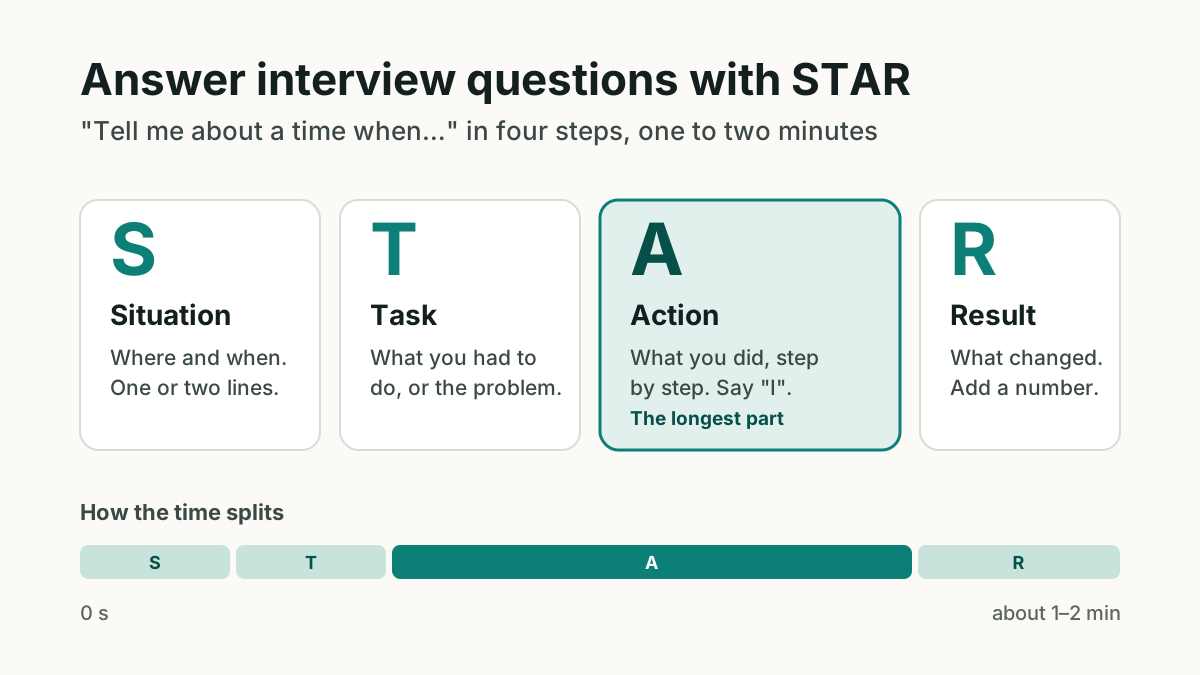
How do you structure an answer? The STAR method
Many questions start with "Tell me about a time when…". These are behavioural questions: the interviewer believes what you did before predicts what you will do again. STAR keeps your answer in order so you never get lost halfway:
- Situation: where and when. One or two sentences. "Last March, during our year-end audit…"
- Task: what you had to do, or what the problem was.
- Action: what you did, step by step. This is the longest part. Say "I", not "we", for your own work.
- Result: what changed. A number if you have one: time saved, complaints reduced, marks improved.
What are the most common interview questions, and how do you answer them?
1. "Tell me about yourself."
Almost always first. Use present, past, future in about a minute: who you are now, one or two relevant achievements, why this role. We have a full guide with three sample answers: how to answer "Tell me about yourself".
2. "Why do you want to work here?"
They are checking whether you looked them up, or applied to fifty companies with one click. Name one specific thing about the company and connect it to you.
- Sample answer
- I've been following your expansion into tier-two cities. I grew up in Nashik, so I understand those customers well, and I'd like to work on a team that's building for them.
3. "What are your strengths?"
Pick one or two strengths that matter for this job and prove each with an example. An adjective without evidence is just a claim.
- Weak
- I am hard-working, sincere and a quick learner.
- Better
- I learn new tools quickly. In my internship I had to use Power BI, which I had never touched, and within two weeks I built the weekly sales dashboard the team still uses.
4. "What is your greatest weakness?"
Avoid the fake weakness ("I work too hard"); interviewers have heard it a thousand times. Choose a real, small weakness that does not sink the job, and say what you are doing about it.
- Sample answer
- Public speaking used to make me nervous, especially in English. So I started volunteering to present in our weekly team meeting, and I practise out loud before each one. It's much easier now, though I still prepare carefully.
5. "Tell me about a challenge you faced and how you handled it."
The classic STAR question. Choose a real problem with a clear ending, and spend most of your time on the action.
- Situation
- In my second year at a bank in Lucknow, our branch got a lot of complaints about long queues on salary days.
- Task
- My manager asked me to find a way to cut the waiting time.
- Action
- I tracked the queue for two salary days and found most people only needed passbook updates. So I suggested moving those to the self-service machine and put one staff member there to help older customers use it.
- Result
- Average waiting time on the next salary day dropped from about forty minutes to fifteen, and complaints fell sharply.
6. "Tell me about a time you worked in a team."
They want to hear how you behave with other people: do you listen, share credit, handle disagreement? Mention one moment where you made the team work better, not just that a team existed.
7. "Where do you see yourself in five years?"
They are checking ambition and whether you will stay. Talk about skills and responsibility in this field, not a job title at a rival company.
- Sample answer
- In five years I'd like to be leading a small team, and to know this product well enough to train new people on it. That's one reason this role appeals to me: there's a clear path from analyst to team lead here.
8. "Why are you leaving your current job?"
Never criticise your current employer, even if they deserve it. Talk about what you are moving towards.
- Weak
- My manager is very bad and there is no growth.
- Better
- I've learnt a lot in three years, but the role has stayed the same. I'm looking for more responsibility and a chance to work with bigger clients, which this position offers.
9. "Why should we hire you?"
Your 30-second summary. Match two or three things from the job description to proof from your experience, then stop. This is not the moment for modesty.
10. "What are your salary expectations?"
Research the range for the role and city first. Then give a range, not one number, and stay flexible.
- Sample answer
- Based on my experience and what similar roles pay in Bengaluru, I'm looking at something in the range of eight to nine lakh per annum. But I'm open to discussing the full package.
11. "Can you explain this gap in your CV?"
Be honest and brief, then move to what you did or learnt. Preparing for exams, caring for a family member, a health break or a course are all normal. The problem is only a vague or nervous answer.
12. "Do you have any questions for us?"
Always say yes. Having no questions sounds like no interest. Two good ones are enough:
- Ask
- What does a typical day look like in this role?
- Ask
- What would you expect me to achieve in the first three months?
- Ask
- How is the team structured, and who would I work with most?
Reading answers is not the same as saying them under pressure. In SpeakWisely's practice lab, tell it what is coming up, such as an interview tomorrow, and you get a rehearsal role-play, likely questions and useful phrases. The job interview role-play has a friendly but probing interviewer who follows up on vague answers.
Rehearse your interview out loudWhich English phrases help you sound confident in an interview?
Confidence in an interview is mostly about not getting stuck. A few ready phrases buy thinking time and keep the answer moving:
- To think
- That's a good question. Let me think for a second.
- To clarify
- Just to make sure I understand, do you mean…?
- To give an example
- Let me give you an example from my last role.
- To link ideas
- The main reason is… The other thing is…
- To finish
- So that's how I handled it, and what I learnt was…
- If you did not hear
- Sorry, could you repeat the question, please?
And a few that are worth dropping, because they sound less natural than people expect:
- "Myself Rahul." Say "I'm Rahul" or "My name is Rahul."
- "I am having five years of experience." Say "I have five years of experience."
- "I have done my graduation in 2020." Say "I graduated in 2020." A finished year takes the past simple.
- "Basically…" at the start of every answer. It is a filler; a short pause is stronger. Our routine to stop saying "um" helps here.
If grammar slips like these worry you, our guide to common grammar mistakes in spoken English covers the ones listeners notice most.
How should you practise interview answers out loud?
- Pick five questions. "Tell me about yourself", why this job, one strength, one weakness and one STAR story cover most interviews.
- Write keywords, not scripts. Three or four words per answer. A full script tempts you to memorise, and memorised answers sound flat.
- Record each answer once. Use your phone. Aim for about a minute, up to two for STAR stories.
- Listen back for three things: is there an example, does it end clearly, and how many fillers.
- Say it again with different words. Keep the facts, change the sentences. On the day it will sound fresh, not recited.
- Practise the follow-up. Ask yourself "Why?" and "What would you do differently?" after each answer, and answer out loud.
In SpeakWisely you can set Job interviews as your goal when you start, so daily practice focuses on answering clearly, giving examples and sounding confident. You can choose a British, American, Australian or Indian accent for your partner, and the 60-second drills help with the habits that make nervous answers sound rushed: fillers, long pauses and pace. Read more about English speaking practice with AI.
Common questions about interviews in English
How long should an interview answer be?
About a minute for most questions, and up to two minutes for a STAR story. If you are still talking after two minutes, you have probably lost the point. It is better to stop and let the interviewer ask a follow-up.
What if my English is not very good?
Interviewers care more about clear, specific answers than perfect grammar. Speak a little slower than usual, use short sentences and give examples. Rehearsing your main answers out loud beforehand is the single biggest help.
Is it okay to ask the interviewer to repeat a question?
Yes. "Sorry, could you repeat that, please?" or "Do you mean…?" is far better than answering the wrong question. Interviewers expect it, especially on video calls.
What are the most common interview questions for freshers?
Tell me about yourself, why this company, your strengths and weaknesses, a project or internship you are proud of, how you handle pressure, where you see yourself in five years, and whether you have any questions. Use college projects and internships for your STAR stories.
Should I memorise my answers?
Memorise the structure and the key facts, not the sentences. A word-for-word answer tends to sound recited, and if you forget one line it is hard to recover.
Your recording is used only to transcribe your answer, then deleted within 15 minutes. We keep your transcript and results, never the audio.
Sources
Keep reading
- How to answer "Tell me about yourself" in an English interview
Present, past, future, in about a minute. A structure for the first interview question, three sample answers, and the phrases that weaken an answer.
- How to stop saying "um" and "like": a fluency practice routine
Fillers are the sound of planning out loud. Swap them for short silent pauses, keep a few thinking phrases ready, and track your fillers per minute for a week.
- 12 common grammar mistakes in spoken English, and quick fixes
Spoken grammar is not exam grammar. These are the 12 slips listeners actually notice, each with a one-line rule, a better sentence and a quick drill.