IELTS Speaking Part 1: common questions with natural sample answers
By the SpeakWisely team · Published · 7 min read
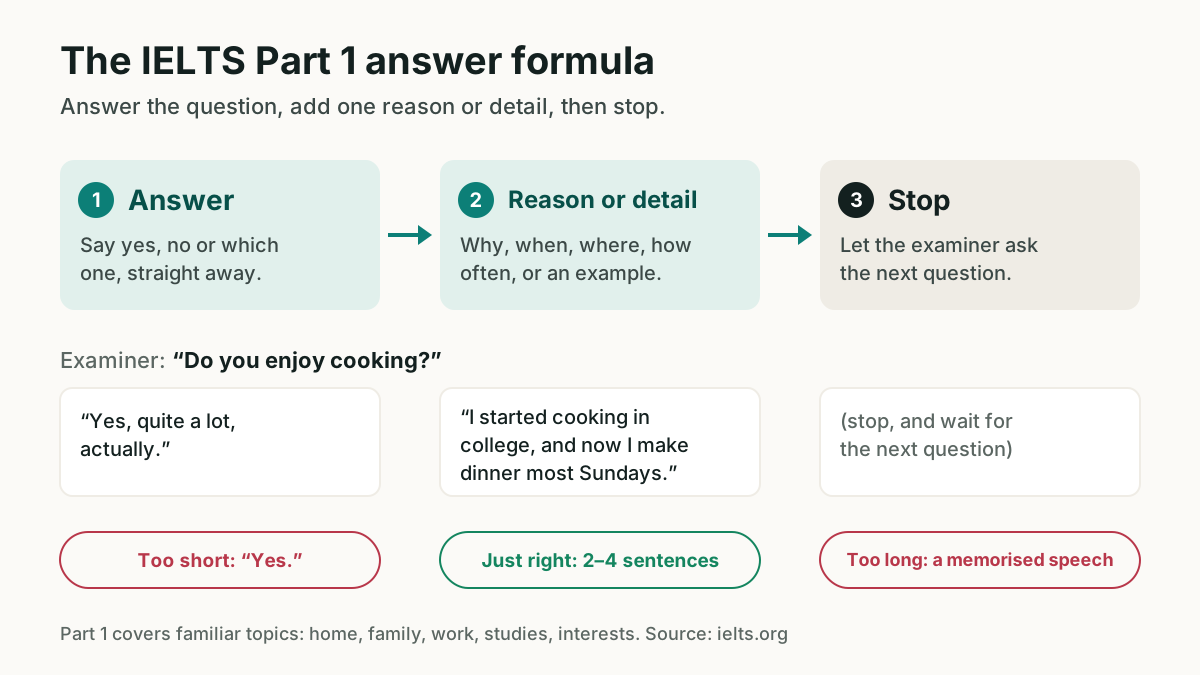
IELTS Speaking Part 1 lasts 4 to 5 minutes. The examiner introduces themselves, checks your identity and asks short questions about familiar topics such as your home, family, work, studies and interests. A strong answer is two to four sentences long: answer the question directly, add a reason or a detail, then stop. Below are typical questions on those familiar topics, with natural sample answers you can adapt.
One thing to be clear about: these are not "the" questions from the current test. Nobody outside IELTS can tell you which questions you will get, and lists that promise them are guessing. These are typical of the everyday topics the official format describes, which is what makes them useful practice. The sample answers are illustrations written for an Indian learner; swap in your own details.
What happens in IELTS Speaking Part 1?
Part 1 is the first part of the test. It checks how well you give information and opinions on everyday topics and common experiences, with simple, personal questions such as "Where are you from?" or "Do you enjoy cooking?". There are no right or wrong answers, and the examiner is not checking facts. Part 1 is marked on the same four criteria as the rest of the test, and your band reflects your performance across all three parts.
For how Part 1 fits with the long turn and the discussion that follow, see the IELTS Speaking test format.
How long should a Part 1 answer be?
Two to four sentences, which is roughly fifteen to thirty seconds. Use a simple three-step formula:
- Answer. Say yes, no, or which one, in the first few words.
- Add a reason or a detail. Why, when, where, how often, or a quick example. One or two sentences.
- Stop. Let the examiner ask the next question. Part 1 has several questions to get through, and you will be moved on anyway.
- Examiner
- Do you enjoy cooking?
- Answer
- Yes, quite a lot, actually.
- Reason or detail
- I started cooking in college, and now I make dinner for my family most Sundays, usually something simple like rajma chawal.
That is the whole shape. For variety, you can sometimes add a contrast ("…but on weekdays I don't have time") or a change over time ("I used to…, but now…"), which also shows a range of tenses. Our guide to English tenses for speaking covers the handful you need here.
Work or studies
Expect a question about whether you work or study, then follow-ups about whichever you do.
- Examiner
- Do you work or are you a student?
- Answer
- I work. I'm an accounts executive at a logistics company in Pune, so most of my day goes on invoices and checking payments.
- Examiner
- Why did you choose that job?
- Answer
- Mainly because I studied commerce and wanted something practical. I also like that the work is very clear: at the end of the day, the numbers either match or they don't.
- Examiner
- What do you find most difficult about your studies?
- Answer
- Probably managing my time. My engineering course has a lot of lab work, so in exam season it's hard to fit in revision as well as assignments.
Your hometown
- Examiner
- Where is your hometown?
- Answer
- I'm from Rajkot, a mid-sized city in Gujarat. It isn't as well known as Ahmedabad, but it has great food and a very relaxed pace of life.
- Examiner
- What do you like most about it?
- Answer
- Honestly, the people. Everyone seems to know everyone, so you can't walk to the market without stopping for a chat at least twice.
- Examiner
- Has your hometown changed much in recent years?
- Answer
- Quite a bit. There are many more flyovers and malls than when I was a child, though the old part of the city still feels much the same.
Your home
- Examiner
- Do you live in a house or a flat?
- Answer
- A flat. We live on the fourth floor of a building in a fairly quiet area, me, my parents and my younger brother.
- Examiner
- Which room do you like most?
- Answer
- The balcony, if that counts as a room. It's where I have my tea in the morning, and in the monsoon it's the best place in the house.
Daily routine
- Examiner
- What is your daily routine like?
- Answer
- On weekdays it's fairly fixed. I'm up by seven, at work by nine, and I usually get home around seven in the evening, so evenings are mostly dinner and a bit of TV.
- Examiner
- Are you a morning person?
- Answer
- Not really. I can get up early when I have to, but I do my best thinking late at night, which isn't ideal with a nine o'clock start.
Reading answers helps; saying them helps more. Clara asks Part 1 questions out loud and listens to your answers. In Help me as I go mode she gives tips and corrections after each one, and a band 7+ version of any answer when you ask.
Practise Part 1 with ClaraHobbies and free time
- Examiner
- What do you do in your free time?
- Answer
- Mostly I play badminton. A few friends and I book a court twice a week, and it's the one thing I don't skip, however busy I am.
- Examiner
- Did you have the same hobbies as a child?
- Answer
- Not exactly. As a child I was much more into drawing, but I stopped when school got busier. I've been thinking about starting again, actually.
Food
- Examiner
- What kind of food do you like?
- Answer
- I'm a big fan of South Indian food, especially dosas. They're light and quick, and there's a place near my office that makes really good ones.
- Examiner
- Do you prefer eating at home or eating out?
- Answer
- At home, generally. Eating out is fun once in a while, but my mother's cooking is hard to beat, and it's a lot healthier.
Weekends
- Examiner
- How do you usually spend your weekends?
- Answer
- Saturdays are for errands and catching up with friends. Sundays I try to keep free, so I mostly rest, call my grandparents and get ready for the week.
- Examiner
- Do you prefer busy or relaxing weekends?
- Answer
- Relaxing, definitely. My weekdays are busy enough, so I like at least one day when I don't have to be anywhere at a fixed time.
What are the most common Part 1 mistakes?
- One-word answers. "Yes." "Rajkot." "Badminton." They are correct, but they give the examiner almost nothing to assess. Always add at least one reason or detail.
- Memorised speeches. A prepared paragraph about your hometown sounds rehearsed and often answers a slightly different question. The examiner wants to hear whether you can hold a natural conversation, so prepare ideas and useful phrases, not scripts.
- Answering at great length. A one-minute answer in Part 1 is not more impressive; it just delays the next question. Save long answers for Parts 2 and 3.
- Sounding too formal. Words like "furthermore" and "moreover" sound odd in a chat about breakfast. Use spoken linkers: "actually", "mainly because", "to be honest", "but".
- Answering a different question. If you are asked whether you like your hometown, say whether you like it, not what it is famous for.
- Guessing when you did not understand. If you did not catch a question, say "Sorry, could you repeat the question?" It is normal, and much better than answering the wrong thing.
How should you practise Part 1 questions?
- Answer out loud, not in your head. Pick a topic, ask yourself three questions and answer each in two to four sentences.
- Record yourself and listen back. Check that each answer starts with a direct answer and ends cleanly, without "so… yeah… that's it".
- Change the details every time. If your answer comes out word for word the same on the third try, you are memorising it. Talk about a different detail.
- Watch your fillers. Part 1 answers are short, so three "um"s in one answer stand out. Our guide on how to stop saying um can help.
With SpeakWisely you can practise Part 1 on its own in a few minutes, or as part of a full mock that takes about fifteen minutes. Clara asks four short questions about you out loud, and you answer out loud. In Help me as I go mode you get tips and corrections after each answer; in Exam conditions mode she stays neutral and saves her notes for the end. Either way, the report gives an estimated band on the four criteria, which the IELTS Speaking band descriptors in plain English help you make sense of.
Questions about IELTS Speaking Part 1
Are these the real IELTS Part 1 questions?
No. They are typical questions on the familiar topics the official format describes: home, family, work, studies and interests. Nobody outside IELTS can tell you which questions you will get.
Can I ask the examiner to repeat a question?
Yes. Asking for a question to be repeated is normal, and better than answering a question you did not understand.
What if I don't have a hobby, or don't like my hometown?
Say so honestly and give a reason. "To be honest, I don't have much free time these days because…" is a perfectly good answer. The examiner is assessing your English, not your lifestyle.
Does Part 1 count as much as Parts 2 and 3?
You are rated on your average performance across the whole test rather than part by part, so Part 1 is part of the picture. Because it comes first, it is also your chance to settle in.
AI-estimated assessment inspired by IELTS speaking criteria. Not an official IELTS or IDP result.
Your recording is processed and then deleted. It is never stored — only your transcript and results are kept.
Sources
Keep reading
- IELTS Speaking test format: Parts 1, 2 and 3 explained
Eleven to fourteen minutes, three parts, one examiner. What happens in each part, how long you speak, and what to practise for each.
- IELTS Speaking Part 2 cue cards: how to plan in one minute and speak for two
A note layout that fits in the one-minute preparation, a full worked cue card with a two-minute model answer, and what to do when you run dry.
- The English tenses you actually need for speaking
Six forms carry everyday conversation. Which ones they are, the mix-ups that give learners away, and how to practise them out loud.