IELTS Speaking topics 2026: 32 practice cue cards, Part 1 questions and model answers
By the SpeakWisely team · Published · 10 min read

IELTS does not publish its Speaking questions in advance, so no list can promise you the real topics for 2026. The useful way to prepare is to practise the kinds of topic the official format describes: familiar subjects in Part 1, a task card in Part 2 and broader issues in Part 3. Below you will find 32 cue cards grouped by theme, six Part 1 question sets and three model answers.
To be plain about it: the SpeakWisely team wrote every question on this page. They are our own practice questions, not leaked, recent or predicted exam questions, and we do not claim any will appear in your test. The themes are our own grouping, not a ranking of what comes up most.
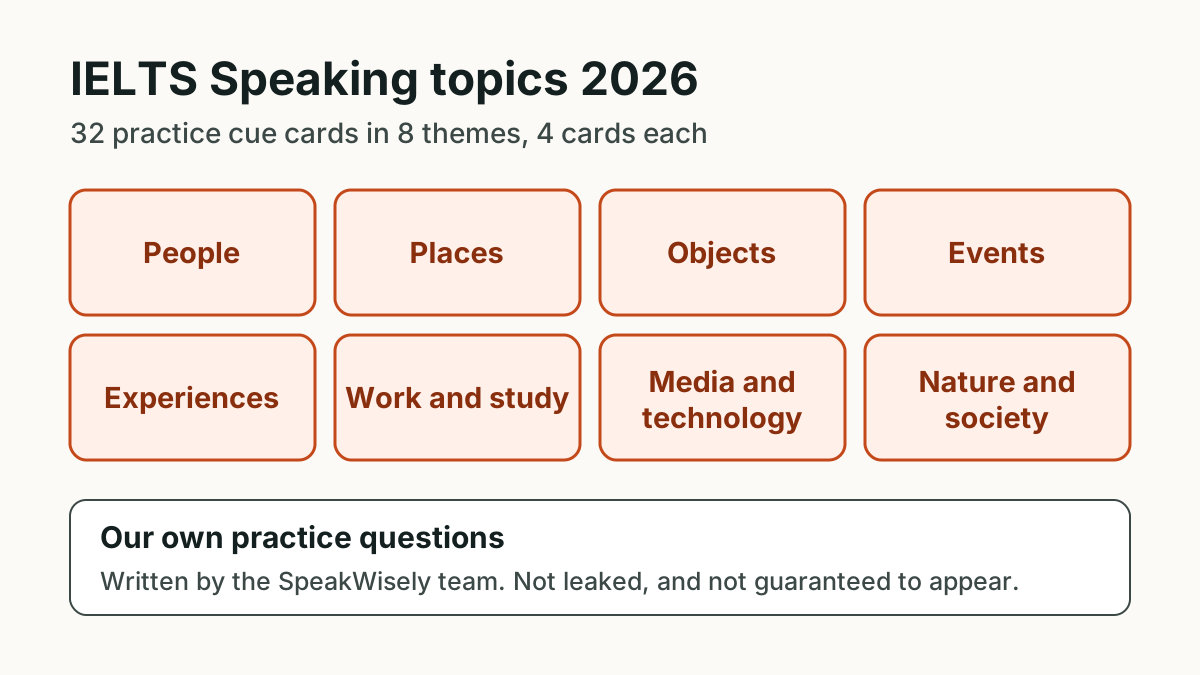
Are there real IELTS Speaking topics for 2026?
Not that anyone outside IELTS can give you. What is public is the format. According to ielts.org, the Speaking test lasts 11 to 14 minutes. Part 1 covers familiar topics such as home, work, studies and interests. Part 2 gives you a task card, one minute to prepare and about two minutes to speak. Part 3 moves to broader, more abstract issues linked to the Part 2 topic. Speaking is the same in IELTS Academic and General Training, so this page works for both. Our guide to the IELTS Speaking test format goes through each part.
Which IELTS cue card topics should you practise?
We have shortened the prompts to save space. Cover them in order and finish on the last one, which is where your reasons and opinions go.
People
- Describe a person who helped you at an important moment. Say who they are, what they did, and why it stayed with you.
- Describe an older person you enjoy talking to. Say how you know them, what you talk about, and why you enjoy it.
- Describe a neighbour you know well. Say how you met, what they are like, and how they have affected your life.
- Describe a teacher or manager who changed how you work. Say who they were, what changed, and whether you still work that way.
Places
- Describe a quiet place you go to when you need to think. Say where it is, when you go, and why it helps.
- Describe a town you visited and would like to see again. Say where it is, what you did there, and why you want to return.
- Describe a market or shopping street you know well. Say where it is, what is sold there, and what makes it memorable.
- Describe a building in your city that interests you. Say where it is, what it is used for, and why it interests you.
Objects
- Describe something you bought with your own money and were proud of. Say what it was, how you chose it, and how you felt.
- Describe an old object your family has kept. Say what it is, where it came from, and why nobody has thrown it away.
- Describe a gift that was hard to choose. Say who it was for, what you chose, and why it was difficult.
- Describe an app or website you use almost every day. Say what it is, what you use it for, and what you would do without it.
Events
- Describe a family celebration you helped to organise. Say what it was for, what you did, and how it went.
- Describe a festival you enjoy. Say how people celebrate it, how you take part, and what it means to you.
- Describe a time you were late for something important. Say what it was, why you were late, and what you learned.
- Describe a time your plans changed at the last minute. Say what the plan was, what you did instead, and how you felt about it.
Experiences
- Describe something you taught another person. Say what it was, how you did it, and how you felt when they got it right.
- Describe advice you ignored and later wished you had followed. Say who gave it, why you ignored it, and what happened.
- Describe a decision that took you a long time. Say why it was hard, who you asked, and whether you still agree with it.
- Describe a time you spoke in front of a group. Say who was listening, what you talked about, and how it went.
Work and study
- Describe a school subject you found boring but later found useful. Say why it bored you, when it became useful, and what changed your mind.
- Describe a job you would like to try for one year. Say what it involves, what you would need to learn, and why it attracts you.
- Describe a team project that did not go to plan. Say what it was, what went wrong, and how you dealt with it.
- Describe a goal you are working towards. Say what it is, what you have done so far, and why it matters to you.
Media and technology
- Describe a book or article that changed your mind. Say what it was, what it argued, and what you think now.
- Describe a film or series you would recommend to a friend from another country. Say what happens, who it suits, and why you would choose it.
- Describe a news story you followed closely. Say what it was about, how it ended, and why it held your attention.
- Describe a time technology failed at a bad moment. Say what went wrong, how you managed, and what you did differently afterwards.
Nature and society
- Describe a natural place you would like to protect. Say where it is, what threatens it, and why it is worth protecting.
- Describe a healthy habit you have tried to build. Say when you started, what made it hard, and whether you have kept it up.
- Describe a rule in your city or college that you would like to change. Say who it affects, what you would do instead, and why.
- Describe a change in your neighbourhood in recent years. Say what changed, how people reacted, and whether it was a good thing.
Clara, our AI examiner-tutor, asks questions out loud and listens to your answers, and the report gives an estimated band on the four criteria. It is an AI estimate, not an official IELTS result.
Start practising freeWhat IELTS Speaking Part 1 questions should you practise?
These sets go beyond the work, hometown, home, food and weekend questions in our guide to IELTS Speaking Part 1, which also explains the right length for an answer. We wrote these for practice too.
- Music: What kind of music do you listen to? When do you usually listen to it? Did you learn an instrument as a child? Has your taste in music changed?
- Your phone: How much do you use your phone in a day? Which app could you not give up? Do you prefer calling or messaging? Have you ever tried to use it less?
- Getting around: How do you usually travel to work or college? Do you enjoy long train journeys? Is public transport good where you live? Would you like to learn to drive?
- Weather and seasons: What is your favourite season? Does the weather change your mood? What do people in your city do during the monsoon? Would you like to live somewhere colder?
- Friends: Do you have many close friends? How do you usually keep in touch? Are you still in contact with school friends? What do you do when you meet?
- Reading: Do you read much for pleasure? Do you prefer paper books or a screen? What did you like reading as a child? Is there a book you have read more than once?
What does a good cue card answer look like?
Here are answers to three cards above. They are illustrations written by the SpeakWisely team, with invented speakers and details. No examiner has marked them, so we make no claim about their band. Read them for shape: each follows the prompts, adds a specific scene and ends on the explanation.
- Card
- Describe a quiet place you go to when you need to think.
- Model answer
- The place I'd like to talk about is the terrace of my aunt's building in Vadodara. It isn't famous and there's nothing special to look at, just water tanks, a few plants and a view of the railway line. I started going up there in my final year at college, when our flat was full of relatives and I couldn't hear myself think. I usually go in the evening, about half an hour before it gets dark, and I go alone. I leave my phone downstairs, which took some getting used to. What I like is that the noise of the city is still there, but it feels further away. Trains go past, someone's pressure cooker whistles on the floor below, and after ten minutes my head starts to clear. So it matters to me not because it's beautiful, but because nobody needs anything from me for a while.
- Card
- Describe a decision that took you a long time.
- Model answer
- A decision that took me far too long was whether to leave my engineering course after the second year. It was hard mainly because everyone around me assumed I'd finish, and my parents had already paid a lot in fees. On paper I was doing fine, but I'd started to dread going to class, and I was spending all my free time helping a friend's small design business. I must have asked about ten people. My father said to stay, my cousin said to leave, and my favourite lecturer asked what I'd regret more at forty, which annoyed me because I had no answer. In the end, I took almost a year to decide, and I did finish the degree, but I also started taking design work on the side. Looking back, I still agree with it, although I'd spend less time asking other people. I think I already knew, and I was really just waiting for permission.
- Card
- Describe a time technology failed at a bad moment.
- Model answer
- This happened about two years ago, during an online interview for a job I really wanted. We were maybe ten minutes in, and I was halfway through explaining a project, when my screen froze. The router had stopped working, and of course the whole building seemed to have lost its connection at the same moment. Then I switched to mobile data, rejoined from my phone and apologised, but by then I was sitting on the stairs, because that was the only spot with a decent signal. Rather than pretend nothing had happened, I made a small joke about it and carried on. They were kind about it, and I still got a second round. Since then, I always keep my phone charged and test the connection an hour before any call. Mostly, though, it taught me that how you recover matters more than the problem itself.
How should you use these topics to practise?
Treat each card as a short drill with the same timing as the test. This is our suggested routine, not an official method.
- Pick a card at random and prepare for one minute. Write keywords, not sentences. Our guide to the Part 2 cue card has a simple note-making method.
- Speak for two minutes and record it.
- Listen back for one thing only: long pauses, one repeated grammar error, or an idea that did not go anywhere.
- Say it again, fixing that one thing.
- Answer a broader question on the same theme. After the terrace card, try "Why do people in cities find it hard to get time alone?" Our guide to Part 3 questions shows how to develop these answers.
For a timer and a card chosen for you, use our IELTS cue card practice tool. For a fuller session, IELTS speaking practice with Clara runs Parts 1, 2 and 3 out loud.
Questions about IELTS Speaking topics
What are the IELTS Speaking topics for 2026?
Are these real or leaked IELTS cue cards?
How many cue cards should I practise?
Start with one card today and record it, even if the first attempt feels clumsy. When you want to see how your answers line up against the marking criteria, read how to get band 7 in IELTS Speaking.
AI-estimated assessment inspired by IELTS speaking criteria. Not an official IELTS or IDP result.
Your recording is used only to transcribe your answer, then deleted within 15 minutes. We keep your transcript and results, never the audio.
Sources
Keep reading
 IELTS speaking9 min read
IELTS Speaking Part 2 cue cards: how to plan in one minute and speak for two
A note layout that fits in the one-minute preparation, a full worked cue card with a two-minute model answer, and what to do when you run dry.
 IELTS speaking7 min read
IELTS Speaking Part 1: common questions with natural sample answers
Typical Part 1 questions on familiar topics, natural two-to-four-sentence answers, and the simple formula that keeps every answer the right length.
 IELTS speaking11 min read
IELTS Speaking Part 3: question types, an answer structure and sample answers
The six kinds of Part 3 question, a four-step structure that turns a short reply into a developed answer, and sample answers to say aloud.
 IELTS speaking7 min read
How to get band 7 in IELTS Speaking, and what band 8 asks for on top
The official band 7 wording, the few phrases that separate it from band 6, what to practise for each criterion, and what band 8 asks for on top.