English for BPO and call centre jobs: the test, the interview and real call phrases
By the SpeakWisely team · Published · 7 min read

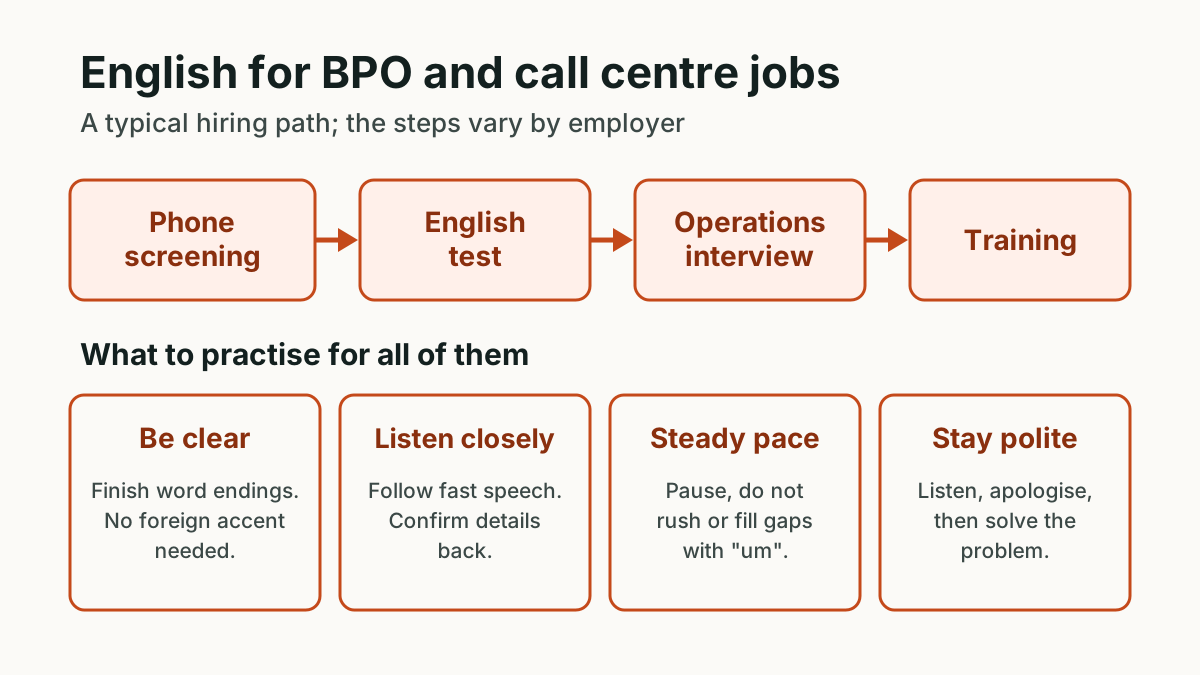
To get a BPO or call centre job, you need to be easily understood on the phone, follow fast speech, keep a steady pace and stay polite under pressure; you do not need a foreign accent or perfect grammar. Voice-process hiring usually includes a spoken English check, sometimes automated, and an interview. All of this can be practised at home with nothing more than a phone.
This guide covers what those tests measure, what interviewers usually ask, what a real call sounds like and how to train for it. Hiring steps differ between companies, so ask your recruiter what to expect.
What level of English do you need for a BPO job?
There is no single standard. Each employer sets its own bar, and it varies with the work. A process that serves customers in the US or UK usually expects more than a domestic process run partly in Hindi or a regional language, and a non-voice process focused on chat or email cares more about writing.
A useful test of your readiness is practical: can a stranger on a phone understand you the first time, without seeing your face? With no gestures to help, habits that pass unnoticed in person, such as dropping word endings or speaking too fast, can cause real problems. If you are not sure where you stand, try the English speaking level check.
What is in a BPO English test?
Formats differ, but some employers use an automated spoken test, and Versant by Pearson is a well-known example. Pearson’s product sheet describes the Versant English Test as about 15 minutes and 63 questions, taken by phone or computer and scored automatically, with recruiting listed among its uses. If you are sent a test link, check its name and current format, as there are several versions. The sheet lists these question types:
- Reading sentences aloud.
- Repeat: saying back exactly what you heard.
- Short questions that need a quick answer.
- Sentence builds: putting jumbled phrases in the right order aloud.
- Story retelling: hearing a short story and telling it in your own words.
- Open questions: giving your view for a short time.
It gives an overall score from 20 to 80, with subscores for sentence mastery, vocabulary, fluency and pronunciation, plus an Intelligibility Index, which reflects how easy you are to understand. Fluency scoring looks at your rate of speech, the position and length of your pauses, your rhythm and your phrasing. So a smooth answer in simple words is likely to do better than a hesitant answer with long ones. Pearson’s sheet does not set a passing score; the employer decides that.
What do they ask in a BPO English interview?
Questions vary, but they tend to check your communication, attitude and willingness to work the shifts. You will often be asked to introduce yourself, explain why you want this work, and say how you would handle an angry customer. Sometimes there is a short mock call. These are practice-style answers written by us. Change them so that they are true for you.
- Why BPO?
- I enjoy talking to people and solving their problems. I also want to build my communication skills and grow into a team lead role over time.
- Night shifts?
- Yes, I am comfortable with rotational shifts. I have spoken to my family, and I can manage my travel and sleep around them.
- Angry customer?
- First, I would listen without interrupting and apologise for the trouble. Then I would confirm the problem, explain what I can do, and follow it through.
- Why you?
- In my college placement cell, I handled calls with recruiters every week. I stay calm, and I always confirm the details.
For more help, see how to answer "Tell me about yourself" and our list of job interview questions and answers in English.
What does a call centre English conversation sound like?
Most calls follow the same shape, and the wording matters. Companies have their own scripts, but this practice call shows the general stages. Say it aloud, and pay attention to the tone as much as the words.
- Greeting
- Thank you for calling. My name is Riya. How may I help you today?
- Customer
- My order was supposed to come yesterday, and it still has not arrived.
- Empathy
- I'm sorry about that. I understand it's frustrating when an order is late. Let me check it for you.
- Verify
- May I have your order number, please? ... Thank you. Could you confirm your email address?
- Hold
- May I place you on hold for about two minutes while I check this?
- Return
- Thank you for holding. Your order is with the courier, and it should reach you by tomorrow evening.
- Closing
- Is there anything else I can help you with today? Thank you for calling, and have a good day.
Some small phrases solve most problems on a call. "Could you spell that for me, please?", "Let me repeat that to make sure I have it right" and "I can see why you're upset" are all worth having ready. It also helps to get the question forms automatic, because agents ask questions all day.
How can you do call centre English speaking training at home?
A paid course can help if it gets you speaking, but you can do the core of it yourself. This routine takes about twenty minutes a day:
- Read aloud for five minutes. Use a news article or script, and finish every word ending. Record it, then listen.
- Repeat and retell for five minutes. Listen to one sentence from a video, pause, and repeat it exactly. Then retell a short clip in your own words, which is what many tests ask for.
- Do one mock call. Use the stages above, with a new problem each day: a late delivery, a wrong bill, a forgotten password.
- Fix one thing. Choose one habit from your recording, such as speed or filler words. Our guides to pronunciation for Indian speakers and how to stop saying "um" can help.
SpeakWisely’s Role-play puts you in real situations with an AI partner, and 60-second Drills aim at one habit such as filler words, pace or pauses. Its Pronunciation lab checks how clearly you are understood, never your accent.
Start practising freeIs a BPO job still worth it with AI?
It depends on what you want from it, and nobody knows exactly how this will go. Gartner predicted in 2025 that agentic AI will resolve 80% of common customer service issues without human help by 2029. The same firm also predicted that by 2027, half of the organisations that expected to significantly cut their customer service staff will abandon those plans. These are forecasts, not facts, and they are not specific to India. Together they suggest that routine calls are most at risk, while complicated or sensitive problems will still need people.
On pay, set your expectations with real figures. Payscale’s India page, updated in August 2026, gives an average base salary of ₹3,44,381 a year for a customer service representative, based on 497 self-reported profiles, with most between about ₹1.95 lakh and ₹6.02 lakh. Your offer will depend on the process, the city and the company. If an offer needs you to go overseas, read it carefully. In May 2024, India’s Ministry of External Affairs warned about fake "Customer Support Service" jobs in Southeast Asia that were linked to call centre fraud.
Daily calls in English and customer skills carry over to other careers. Never pay an employer or agent to be given a job.
Common questions about English for BPO jobs
What is the BPO English test?
What is a good Versant score for a call centre job?
Can I get a BPO job with average English?
Do I need to change my accent for call centre work?
How can I practise call centre English at home?
Calls are a skill, and they get easier with repetition. Start with one mock call today. If you would like to practise on your own, our guide to practising English speaking alone has more ideas, and our post on remote jobs for English speakers shows where this experience can lead.
Your recording is used only to transcribe your answer, then deleted within 15 minutes. We keep your transcript and results, never the audio.
Sources
- Versant English Test product information sheet (Pearson)
- Agentic AI expected to resolve 80% of common issues by 2029, Gartner prediction (Call Centre Helper, March 2025)
- Half of organizations will stop CX workforce reductions due to AI, Gartner prediction (CRM Magazine, July 2025)
- Customer Service Representative (CSR) salary in India (Payscale)
- MEA advisory on job scams in Laos and Cambodia (India TV, May 2024)
Keep reading
 Pronunciation7 min read
English pronunciation for Indian speakers: stress, rhythm and being understood
Why you do not need to lose your Indian accent, and the stress, rhythm and sound habits that really decide whether a listener understands you.
 Spoken English8 min read
12 common job interview questions and answers in English
Every interviewer asks some version of the same dozen questions. Here is what each one is testing, a sample answer for freshers and professionals, and how to rehearse out loud.
 English and careers6 min read
Remote jobs for English speakers: what is real, and how to apply from India
Remote jobs that run in English are real, but many are limited by country. Here is how to check, what entry-level looks like, and how to avoid the scams.
 Spoken English8 min read
How to stop saying "um" and "like": a fluency practice routine
Fillers are the sound of planning out loud. Swap them for short silent pauses, keep a few thinking phrases ready, and track your fillers per minute for a week.