How to speak English fluently: 7 steps and an honest 30-day routine
By the SpeakWisely team · Published · 10 min read

To speak English fluently, practise saying things you already know out loud, repeat them a little faster each time, and then use them with real people. Fluency is not a big vocabulary or a foreign accent. It is how smoothly you turn what you know into speech, and it grows through short daily speaking far more than through another grammar book. You may hear a change within weeks on topics you have practised. Ease on any topic takes much longer, often more than a year.
Many learners in India read English comfortably and follow films without trouble, yet stall when someone asks them a question. That gap is normal, because reading and listening do not train fast production. This guide covers what fluency means, seven steps to build it, a four-week routine, and what you can honestly expect at the end of it.
What does it mean to speak English fluently?
Paul Nation, a researcher in language teaching, describes fluency work as "a time for getting good at using what is already known". That is the most useful definition for a learner, because it changes what you practise. You are not chasing new words. You are making old words come out faster, with fewer stops.
The Common European Framework of Reference (CEFR) gives a practical target. At B2, a speaker can "interact with a degree of fluency and spontaneity that makes regular interaction with native speakers quite possible without strain for either party". Notice what that does not say. Three things are often mistaken for fluency:
- An accent. You can be fluent with a clearly Indian accent. Being understood matters; sounding British or American does not. Our guide to English pronunciation for Indian speakers covers what actually affects clarity.
- Perfect grammar. Fluency and accuracy are related but separate. Fluent speakers still make slips and keep going.
- Speaking fast. Racing usually adds mistakes and loses the listener. Fluency is steady speech with short pauses in sensible places.
What are the steps to speak English fluently?
These seven steps go roughly in order, though you will come back to all of them. Each one has one job.
1. Decide what you need English for
Fluent for a client call, a viva and a family trip are three different goals. A Cambridge University Press paper on learning time makes this point directly: travel, social conversation and business discussions each need a different mix of skills. Write down the three situations that matter most to you this year, and practise those first.
2. Build a small stock of ready-made phrases
Nation writes that, especially early on, "there is value in becoming fluent with a repertoire of useful sentences and phrases". Whole phrases save you from building every sentence from zero. Start with our list of daily use English sentences, and pick twenty you would really say this week.
3. Talk about what you know before what you do not
Nation sets out four conditions for fluency practice: the material is largely familiar, your focus is on meaning, there is some push to go faster, and there is a lot of it. His test is blunt: "If the activity involves unknown vocabulary, it is not a fluency activity." So begin with your family, your work, your town and your plans, where the words are already yours.
4. Tell the same story again, in less time
This is the step most learners skip, and it has some direct evidence behind it. In the "4/3/2" technique, you give the same talk for four minutes, then three, then two. A 2011 experiment by de Jong and Perfetti, with 24 ESL students, found that fluency improved for everyone during training, but only those who repeated their speeches kept the gain on later tests. It was a small study, so treat it as encouraging, not as proof. A shorter version of two minutes, ninety seconds and one minute is easier to fit into a day.
5. Fix one thing at a time
Record yourself, listen, and choose one repeated problem: a tense, a filler, a word you keep missing. Our guides to common grammar mistakes in spoken English and how to stop saying "um" give you specific fixes. Correcting everything at once usually means correcting nothing.
6. Stop building sentences through Hindi or Gujarati
Translating every sentence in your head costs time and produces odd English. You do not have to stop all at once. Our guide on how to think in English gives small daily habits that reduce it.
7. Talk to real people every week
Solo practice builds speed, but only people interrupt you, misunderstand you and ask something you did not expect. Start small: one question at a shop, one comment in a meeting. If the idea makes your stomach tighten, read our guide to the fear of speaking English first.
How can a beginner start speaking English fluently?
If you struggle to make simple sentences, spend your first weeks on a small base rather than on fluency drills: present and past tenses, common questions and a set of sentence frames. Our English tenses pages and the guide to asking questions in English cover the base. Not sure where you stand? The English speaking level check is a quick place to start. Then fill in frames like these, out loud, with your own details:
- About you
- I live in ___ with my ___.
- About you
- I work at ___. / I study ___ at ___.
- Yesterday
- Yesterday I went to ___ because ___.
- Tomorrow
- Tomorrow I'm going to ___.
- Opinion
- I like ___, but I don't like ___ because ___.
How can you improve your English speaking skills at home?
You do not need a partner or a class. Our guide to practising English speaking alone has a complete 15-minute routine with a phone recorder and 30 topics, and we will not repeat it here. On top of that routine, three small habits fit easily into a day at home:
- Retell something. After a cricket match, a news item or a web series episode, explain it aloud in English in one minute, as if to a friend who missed it.
- Explain your work. Describe one task you did today to an imaginary new colleague.
- Send a voice note. Agree with one friend to swap a 30-second WhatsApp voice note in English each day. It feels more real than talking to yourself, and you can delete and retry.
Do not drop listening and reading. Nation suggests that fluency work should be about a quarter of learning time, with the rest shared between understanding English, using it to say new things, and studying the language itself. Input gives you the phrases that fluency practice then speeds up.
What does a 30-day English speaking routine look like?
Allow about 20 minutes a day. Do your solo practice at the same time each day if you can, and keep a record. On day 1, record yourself answering one question for a minute: "What do you do, and do you enjoy it?" Save the file and do not delete it.
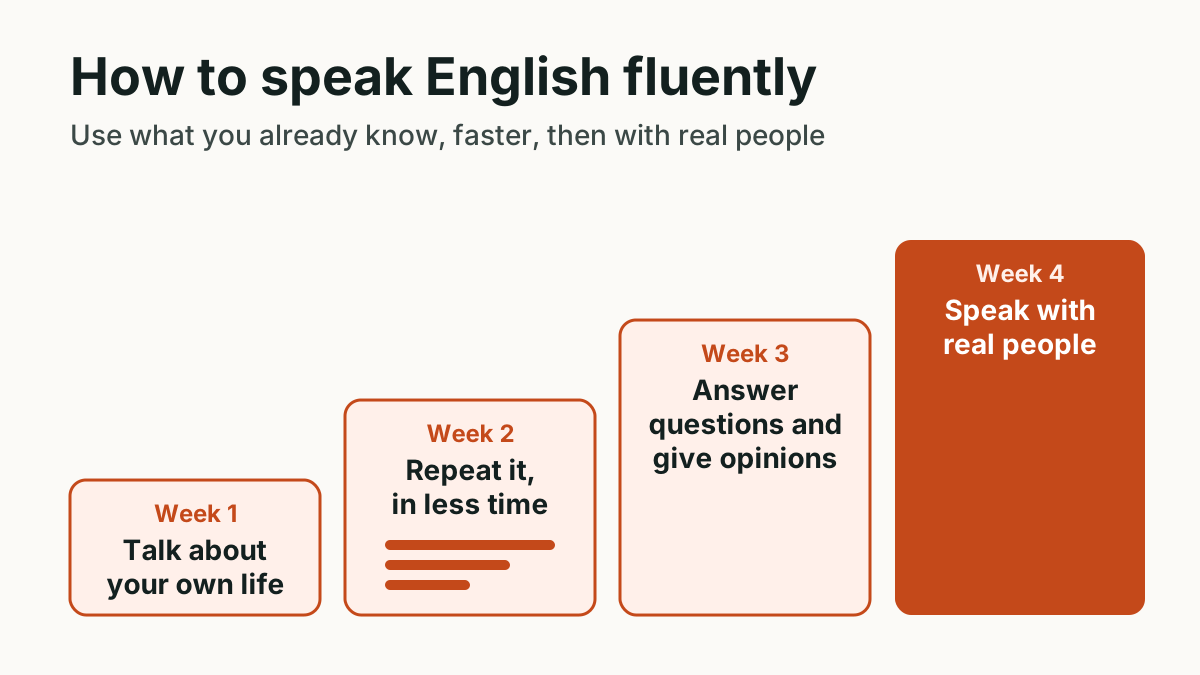
Week 1: your own life
Each day, talk for two minutes about one familiar topic: your family, your job or studies, your town, your food, your routine. Note one word you missed and look it up. The aim is to keep talking, not to sound good.
Week 2: the same talk, in less time
Choose one topic from week 1 each day and tell it three times: two minutes, ninety seconds, one minute. Keep the content, and let the words get tighter. The third round should feel noticeably smoother than the first.
Week 3: questions and opinions
Move from describing to answering. Take questions from our list of English conversation practice questions and answer each with a point, a reason and an example, the structure in how to speak wisely. Answer each question twice.
Week 4: real people
Keep up the daily talk, and add at least three real conversations in English during the week: a colleague, a friend, a shopkeeper, a phone call. Prepare your first sentence beforehand. On day 30, answer the day 1 question again, then play both recordings. That comparison is your result.
- To start
- Can I practise my English with you for a few minutes?
- When stuck
- What I mean is, it was a kind of training programme.
- To check
- Sorry, did you mean this week or next week?
- To finish
- That's about it, really. Thanks for listening.
What can you honestly expect after 30 days?
Twenty minutes a day for 30 days is 10 hours. For scale, Cambridge estimates about 90 to 100 guided learning hours just to reach A1 from zero, and about 500 to 600 to reach B2, so 10 hours will not move you up a level. Our guide on how long it takes to learn English does the full arithmetic. We have no study that predicts your individual result, so read these as reasonable expectations, not promises.
You can reasonably expect:
- Smoother speech on topics you have practised, and stories you can tell without much searching.
- Being more comfortable starting to speak, because it has become routine.
- Clearer knowledge of your own repeated mistakes.
- A day 30 recording that sounds different from day 1.
Do not expect:
- Ease on unfamiliar topics. Fluency on a new subject still needs new words.
- Grammar without mistakes. Old habits often return when you are tired or nervous.
- A new accent, or a big jump in any test score.
- Progress you can feel every day. It tends to show up only when you compare recordings.
SpeakWisely fits around this routine. The Daily coach gives you one short speaking task a day with a follow-up question about what you said, and Drills are 60-second rounds aimed at one habit, such as filler words, pace or pauses.
Start practising freeHow do you speak English fluently and confidently?
Fluency and confidence tend to grow together, because each makes the other easier. You speak more when you are less worried, and you worry less once you have spoken more. So do not wait to feel confident before you start. Set a target small enough to do while nervous, such as one sentence in one meeting, and repeat it until it stops being a big event. SpeakWisely also has Rehearse, where you speak with nothing scored and the audio stays in your browser unless you ask to see your words, which suits the early, nervous stage.
Questions about speaking English fluently
How can I speak English fluently and confidently?
How can a beginner speak English fluently?
How can I improve my English speaking skills at home?
Can I become fluent in English in 30 days?
How many hours a day should I practise speaking English?
Do I need a British or American accent to be fluent?
Start today with one recording, one minute long, and keep it. For the next step, read our guide to practising English speaking alone, or see how to learn English with AI if you want feedback on what you say.
Your recording is used only to transcribe your answer, then deleted within 15 minutes. We keep your transcript and results, never the audio.
Sources
- Nation, P. (2007). The four strands. Innovation in Language Learning and Teaching
- de Jong, N. and Perfetti, C. A. (2011). Fluency training in the ESL classroom. Language Learning
- How long does it take to learn a foreign language? (Cambridge University Press, 2018)
- Introductory Guide to the CEFR for English Language Teachers (Cambridge University Press, 2013)
Keep reading
 Spoken English7 min read
How to practise speaking English alone, with nothing but your phone
No partner needed: a six-step, 15-minute routine for speaking English alone at home, with 30 topics to talk about and a simple way to measure progress.
 Spoken English7 min read
How to think in English and stop translating in your head
Thinking in English is not a switch you flip. It grows with use. Here are six small habits that reduce translating, and an honest look at what the research says.
 Spoken English7 min read
How long does it take to learn English? An honest answer in hours
From zero, Cambridge estimates about 500 to 600 guided learning hours to reach B2. Here is what that means in months, and what 30 days or 3 months can really do.
 Spoken English7 min read
Fear of speaking English: why it happens and how to speak without it
Freezing when you have to speak English is common and has been studied for decades. Here is why it happens, and a ladder of small steps for speaking with less fear.