Common English mistakes Hindi speakers make, and how to fix them
By the SpeakWisely team · Published · 9 min read
Most English mistakes Hindi speakers make are not random. They come from Hindi itself: the verb goes at the end, there is no word for "a" or "the", one postposition, "se", does the work of both "since" and "for", and one sound, व, covers both v and w. Once you know the cause, each fix is small, and saying the right version out loud a few times a day is what makes it stick.
Below are ten patterns, each with how Hindi does it, the common English version, the natural English, and a short drill. They are tendencies, not facts about every speaker: you may recognise three of them or none. And none of this is about losing your accent. An Indian accent is not a mistake; the aim is only to remove the slips that confuse a listener. If you searched "english bolna kaise sikhe" and landed here, this is a good first step: notice the habits Hindi brings with it, then practise speaking every day.
Why does the verb drift to the end?
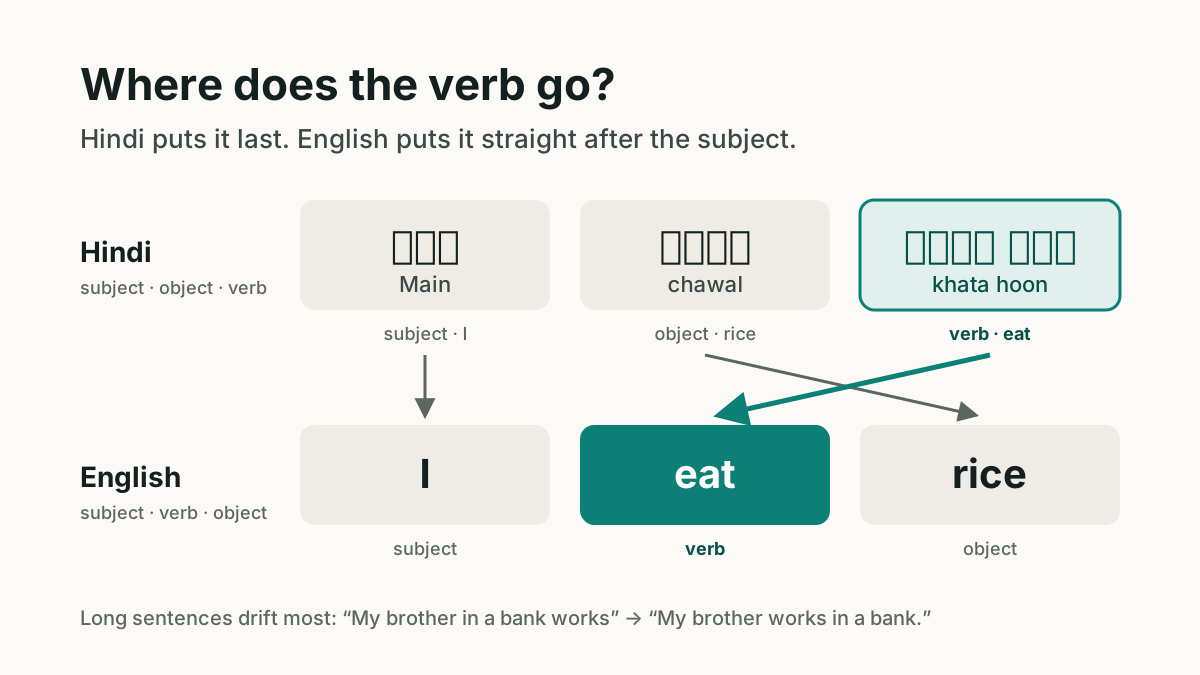
Hindi is a subject–object–verb language: the verb comes last. English is subject–verb–object: the verb comes straight after the subject. Short sentences rarely go wrong, but in long ones, especially when you are thinking while you speak, the verb can slide back towards the end, the way it would in Hindi.
- In Hindi
- Main chawal khata hoon. (मैं चावल खाता हूँ।) Word for word: I rice eat.
- Common
- My brother in Pune in a bank works.
- Natural English
- My brother works in a bank in Pune.
- Say it aloud
- My sister teaches maths. My father drives to work. I drink tea every morning.
The habit to build: say the subject, then the verb immediately, then everything else. Place and time go at the end.
When do you need "a" and "the"?
Hindi has no articles. "Ek" (एक, one) sometimes does the job of "a", but most of the time a Hindi noun stands on its own. So in English "a" and "the" are easy to leave out, and sometimes, when you are trying hard to remember them, easy to add where English does not want one.
- In Hindi
- Main engineer hoon. (मैं इंजीनियर हूँ।)
- Common
- I am engineer. He is best player in team.
- Natural English
- I'm an engineer. He's the best player in the team.
- Common
- The life is very busy in the Mumbai.
- Natural English
- Life is very busy in Mumbai.
- Say it aloud
- I work at a school in Indore. The school is near the station. Life there is quiet.
A rule that covers most speech: a/an the first time you mention one of something ("I bought a phone"), the when the listener knows which one ("The phone is great"), and nothing for ideas in general and for most names of people, cities and countries.
Since or for? "I am working here since two years"
Hindi uses "se" (से) for both: "2024 se" is since 2024 and "do saal se" is for two years. Hindi also uses the present continuous for something that started in the past and is still going on. Translate it word for word and you get a sentence any listener understands, but that does not sound like natural English.
- In Hindi
- Main do saal se yahan kaam kar raha hoon. (मैं दो साल से यहाँ काम कर रहा हूँ।)
- Common
- I am working here since two years.
- Natural English
- I've been working here for two years. I've been working here since 2024.
- Say it aloud
- I've lived in Jaipur for ten years. I've been learning English since school. I've known her for a long time.
For goes with a length of time (two years, six months, ages). Since goes with a starting point (2024, January, Monday, I was a child). Because the action began in the past and continues now, English uses the present perfect: "I have lived", "I've been working". Our guide to the tenses you actually need for speaking covers this with more examples.
Why is "I am understanding" wrong?
The continuous form reaches further in Hindi than in English. "Main samajh raha hoon" (मैं समझ रहा हूँ) is everyday Hindi for "I understand" or "I'm following you", so "I am understanding" feels natural. English keeps verbs that describe a state rather than an action, such as know, understand, want, need, believe, like and have (meaning own), in the simple form.
- In Hindi
- Main samajh raha hoon. (मैं समझ रहा हूँ।)
- Common
- I am understanding your point. She is having a new car.
- Natural English
- I understand your point. She has a new car.
- Say it aloud
- I know. I understand. I need a minute. I have a question.
"Have" can be an action too: "I'm having lunch" and "We're having a meeting" are correct, because eating and meeting are things you do. If you could swap "have" for "own", use the simple form.
Reading a fix is the easy part; saying it while you think is the hard part. SpeakWisely asks for your first language when you start, listens to what you actually say, and when a slip like these appears in your own speech, explains it by its cause.
Practise speaking with feedbackWhy does "Where you are going?" sound wrong?
Hindi makes a question without moving any words. "Tum kahan ja rahe ho?" (तुम कहाँ जा रहे हो?) is the statement "Tum ja rahe ho" with "kahan" (where) added, and a yes/no question can be just "kya" (क्या) at the start or a rising voice. English moves the helping verb, such as is, are, do, did or can, in front of the subject.
- In Hindi
- Tum kahan ja rahe ho? (तुम कहाँ जा रहे हो?)
- Common
- Where you are going? Why you didn't call me?
- Natural English
- Where are you going? Why didn't you call me?
- Say it aloud
- Where are you going? What did you eat? Why didn't you come? When does it start?
The same habit shows up in tag questions. Hindi adds "na?" (ना?) or "hai na?" (है ना?) to almost any sentence, so "isn't it?" can become an all-purpose tag in English: "You are coming tomorrow, isn't it?" English matches the tag to the helping verb: "You're coming tomorrow, aren't you?", "She lives here, doesn't she?" In conversation, "right?" fits after any statement and is always correct.
Angry on, married with: which preposition?
Hindi uses postpositions, which come after the noun: "mez par" (मेज़ पर, on the table), "ghar mein" (घर में, in the house). Most map neatly onto English, but some fixed Hindi phrases use a different word from the English expression, and the Hindi one comes through.
- In Hindi
- Woh mujh par gussa hai. (वह मुझ पर गुस्सा है।)
- Common
- He is angry on me.
- Natural English
- He's angry with me.
- In Hindi
- Usne Priya se shaadi ki. (उसने प्रिया से शादी की।)
- Common
- He married with Priya.
- Natural English
- He married Priya. He is married to Priya.
- Say it aloud
- I'm angry with him. She's married to a doctor. I'm good at maths. It depends on the weather.
No rule predicts these, so learn the ones you use often as whole chunks: angry with someone, married to someone, good at something, depend on, discuss a plan (no "about"), reach home (no "to").
"He go", "she don't": why does the -s disappear?
Hindi verbs change for gender and number: "woh jaata hai" (वह जाता है) for a man, "woh jaati hai" (वह जाती है) for a woman. English works differently: in the present simple it adds -s only after he, she, it and singular nouns. That one sound carries little meaning, so it is the first thing to drop when you speak fast.
Notice too that "woh" (वह) means both "he" and "she"; in Hindi, gender shows on the verb, not the pronoun. That is one reason "he" and "she" can swap in fast English even when you know exactly who you mean.
- Common
- My father go to work at nine. She don't like coffee.
- Natural English
- My father goes to work at nine. She doesn't like coffee.
- Common
- My sister lives in Delhi. He is a doctor.
- Natural English
- My sister lives in Delhi. She is a doctor.
- Say it aloud
- He works. She lives. It costs. My brother plays. She doesn't. He doesn't.
Vest or west? The v and w sounds
Hindi has one sound, व, where English has two. Many Hindi speakers say it somewhere in between, with the lips close but not rounded, so "vest" and "west" or "vine" and "wine" can sound the same. Context usually rescues you, but not always, and "very well" coming out as "wery vell" is something listeners notice.
For v, rest your top teeth lightly on your bottom lip and push air through so it buzzes. For w, round your lips into a small circle with your teeth touching nothing, then open them.
- Can sound like
- "Wery vell" for "very well"; "vest" for "west".
- Clear English
- Very well. We visited a village in the west.
- Say it aloud
- vest, west · vine, wine · vet, wet · very well, thank you
Thin or tin? The th sounds
Hindi has no "th" sound as in "think" or "this". The nearest Hindi sounds are त, थ and द, made with the tongue touching the back of the teeth rather than between them. So "thin" can sound like "tin", "three" like "tree", "thought" like "taught" and "they" like "day". The "th" in romanised Hindi, as in "saath", is an aspirated t, which is a different sound.
- Can sound like
- "I taught about it" for "I thought about it".
- Clear English
- I thought about it for three days.
- Say it aloud
- thin, tin · three, tree · thought, taught · they, day · this, those
For both th sounds, put the tip of your tongue lightly between your teeth. For "think", "three" and "thank", just blow air. For "this", "they" and "mother", let your voice buzz.
How do you make the fixes stick?
- Pick two patterns, not ten. Choose the two you notice most in your own speech and work only on those for a week.
- Say the drills out loud. A fix you have only read stays on paper. Your mouth needs the repetitions, especially for v, w and th.
- Record yourself. Talk for a minute about your day, then listen for your two patterns. They are much easier to hear on a recording than while you speak.
- Count self-corrections as progress. Catching "I am knowing… I know him" mid-sentence means the new habit is forming.
SpeakWisely's English speaking practice is built for exactly this. You choose your first language when you start, Hindi among them, and the coach mentions a Hindi pattern only when your own words show it. The pronunciation lab starts Hindi speakers with v and w, then the th sounds, and checks which word was heard, never your accent. Slips that keep coming back across sessions appear in your mistakes fingerprint with their likely cause, and your own corrected sentences become review cards. New to practising with AI? Read how to learn English with AI.
Gujarati shares many of these patterns with Hindi; see English mistakes Gujarati speakers make for the differences.
Common questions
Do I need to lose my Indian accent?
No. Everyone speaks English with an accent, and having one is not a mistake. What matters is clarity: v and w or th are worth fixing only because swapping them can change the word a listener hears.
Will these mistakes lower my IELTS Speaking score?
Grammar slips such as missing articles or "since two years" count under grammatical range and accuracy. Sounds count under pronunciation, which is about how easy you are to understand, not your accent. See the IELTS Speaking band descriptors in plain English.
Which mistake should I fix first?
The one you hear most often in a recording of yourself. If you are not sure, start with articles or the -s on verbs: they come up in almost every sentence, so fixing them improves the most speech.
I think in Hindi and translate. Is that the problem?
Translating is how almost everyone starts, and it is why these patterns appear. It fades with speaking practice: the more often you say a natural English sentence, the less you need to build it from Hindi. Short daily practice tends to help more than one long session a week.
Your recording is processed and then deleted. It is never stored — only your transcript and results are kept.
Sources
Keep reading
- Common English mistakes Gujarati speakers make, and how to fix them
Verb at the end, one "thi" for since and for, one વ for v and w, no z of its own. Ten patterns Gujarati brings into English, and a drill for each.
- The English tenses you actually need for speaking
Six forms carry everyday conversation. Which ones they are, the mix-ups that give learners away, and how to practise them out loud.
- How to learn to speak English with AI: what AI feedback can and can't tell you
AI is a patient practice partner that can measure your pauses and quote your mistakes. It cannot give you an official score or replace real conversations. Here is how to use it well.