12 common grammar mistakes in spoken English, and quick fixes
By the SpeakWisely team · Published · 8 min read
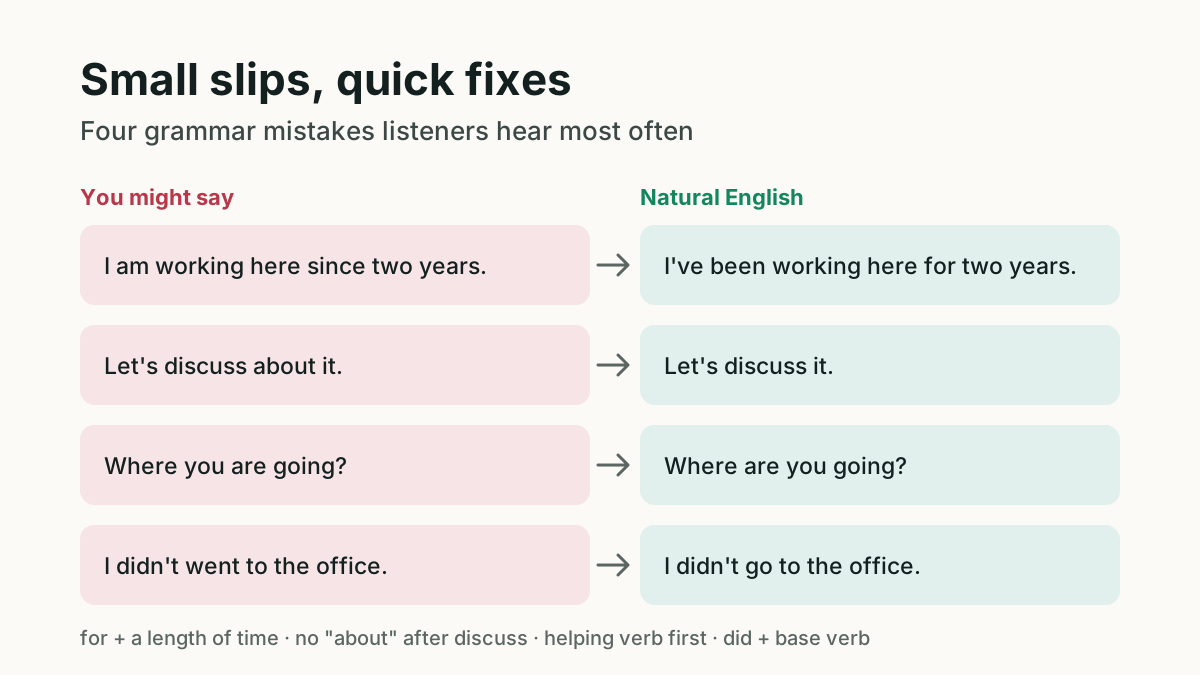
The most common grammar mistakes in spoken English are small and repeated: a missing "a" or "the", "since" where English wants "for", the wrong tense with a finished time, questions without the helping verb moved, "-ing" on verbs like "know" and "have", and extra words such as "discuss about" or "return back". Fixing the handful you make most often does more for how you sound than learning a hundred new rules.
This guide lists the 12 slips listeners notice most, each with a one-line rule, a weak and a better sentence, and a line to say aloud. At the end you will find a simple way to catch your own mistakes while you speak, without freezing mid-sentence.
Why is spoken grammar harder than written grammar?
On paper you can stop, reread and fix. When you speak, you are choosing ideas, words and grammar at the same time, at about two words a second. Your brain falls back on the patterns it has said most often, and if those patterns are slightly off, they come out first. That is why someone can score well in a grammar test and still say "I am knowing him since college" in conversation.
The fix is the same for everyone, whatever your first language: notice your two or three habits, learn the correct version as a whole chunk, and say it aloud until it becomes the new default.
The list below is ordered roughly by how often these slips turn up in everyday speech. The first few appear in almost every conversation, so they are worth checking first. The later ones are less frequent, but each is a fixed phrase that is quick to learn once you have noticed it. You do not need to work through them in order: skim the list, mark the two you recognise in your own speech, and start there.
What are the most common grammar mistakes in spoken English?
1. Missing "a", "an" and "the"
Rule: a singular countable noun needs a word before it: a, an, the, my, this.
- Weak
- She is doctor. I bought new phone yesterday.
- Better
- She's a doctor. I bought a new phone yesterday.
- Say it aloud
- I'm an engineer. It's a good idea. The meeting is at four.
2. "Since" and "for"
Rule: for + a length of time (two years, a week); since + a starting point (2022, Monday, childhood).
- Weak
- I am working here since two years.
- Better
- I've been working here for two years. I've been working here since 2024.
- Say it aloud
- I've lived in Surat for ten years. I've known her since school.
3. Present perfect with a finished time
Rule: when you say when it happened (yesterday, in 2020, last week), use the past simple, not "have done".
- Weak
- I have completed my MBA in 2021. I have seen him yesterday.
- Better
- I completed my MBA in 2021. I saw him yesterday.
- Say it aloud
- I've been to Goa twice. I went last December.
The present perfect is for the experience or result without a time ("I've been to Goa"); the past simple tells the story with a time ("I went last December"). Our guide to the English tenses you need for speaking goes further.
4. Questions without the helping verb moved
Rule: in a question, the helping verb (is, are, do, did, have, can) comes before the subject.
- Weak
- Where you are going? Why you didn't call?
- Better
- Where are you going? Why didn't you call?
- Say it aloud
- What do you do? When did you arrive? How long have you lived here?
Questions are such a common trouble spot that we wrote a whole guide on how to ask questions in English.
5. "-ing" on state verbs
Rule: verbs for states, not actions, stay simple: know, understand, believe, want, need, like, own, and "have" when it means possess.
- Weak
- I am knowing him. I am having two brothers. I am not understanding.
- Better
- I know him. I have two brothers. I don't understand.
- Say it aloud
- I need a minute. I'm having lunch. (Eating is an action, so -ing is fine.)
6. Forgetting the -s after he, she and it
Rule: in the present simple, add -s after he, she, it and one person or thing: he works, she lives, it costs.
- Weak
- My manager don't like delays. She work from home on Fridays.
- Better
- My manager doesn't like delays. She works from home on Fridays.
- Say it aloud
- He goes. She has. It depends. My father drives.
7. "Did" plus a past form
Rule: after did or didn't, the verb goes back to its base form. "Did" already carries the past.
- Weak
- I didn't went to office. Did you saw the match?
- Better
- I didn't go to the office. Did you see the match?
- Say it aloud
- I didn't know. Did she call? We didn't eat.
8. Uncountable nouns with -s
Rule: some nouns are uncountable in English and never take -s or "a": information, advice, feedback, luggage, furniture, equipment, news.
- Weak
- Can you give me some informations? He gave me a good advice.
- Better
- Can you give me some information? He gave me some good advice.
- Say it aloud
- Thanks for the feedback. I have a lot of luggage. Here is a piece of advice.
9. Extra prepositions: "discuss about", "reach to"
Rule: some verbs take their object directly, with no preposition: discuss, reach, enter, attend, answer, contact, marry.
- Weak
- Let's discuss about the plan. I'll call you when I reach to home.
- Better
- Let's discuss the plan. I'll call you when I reach home.
- Say it aloud
- We discussed the budget. Please contact the HR team. She attended the meeting.
10. Prepositions of time: in, on, at
Rule: at a clock time, on a day or date, in a month, year or part of the day.
- Weak
- The interview is on 10 am in Monday.
- Better
- The interview is at 10 am on Monday.
- Say it aloud
- at six o'clock · on Friday · on 15 August · in June · in 2026 · in the evening
11. Doubled words: "return back", "repeat again"
Rule: some verbs already contain the meaning of "back" or "again", so adding it says the same thing twice.
- Weak
- I'll return back tomorrow. Can you repeat it again?
- Better
- I'll be back tomorrow. Could you repeat that, please?
- Say it aloud
- I returned on Sunday. Please reply by Friday. Let me revise the plan.
12. "Myself" instead of "I" or "me"
Rule: use "myself" only when you do something to yourself ("I hurt myself") or for emphasis ("I did it myself"). Not to introduce yourself.
- Weak
- Myself Ankit, from the sales team. Please send it to myself.
- Better
- I'm Ankit, from the sales team. Please send it to me.
- Say it aloud
- Hi, I'm Ankit. Could you send it to me? I'll do it myself.
Rules stick when you use them. SpeakWisely listens to what you actually say and, when a slip like these appears in your own words, explains it. Tense practice asks a question that calls for a particular tense, checks the verb forms you used, explains any slip and lets you try again.
Practise speaking with feedbackHow can you correct your grammar while you speak?
You cannot check every word in real time, and trying to will make you freeze. Instead, train your ear in practice so the right form comes out on its own in conversation:
- Record one minute a day. Talk about your day, your job or your plans for the weekend.
- Listen for only two mistakes. Choose two from the list above and count how often they appear. Ignore everything else for now.
- Say the correct version three times. Out loud, as a whole sentence, not just the word you got wrong.
- Re-record the same topic. Your aim is fewer of your two mistakes, not a perfect minute.
- Switch after a week. When your two mistakes are rare, pick the next two.
When you do catch a mistake mid-sentence in real conversation, just fix it and carry on: "I didn't went… didn't go there." Quick self-corrections sound natural, and native speakers do them all the time. What sounds unnatural is stopping completely to think about grammar.
Some mistakes come from your first language, and knowing the cause makes them easier to fix. If you speak Hindi, read English mistakes Hindi speakers make; for Gujarati, see English mistakes Gujarati speakers make. And our English tenses guide shows how each tense is built, with spoken examples.
Common questions about spoken English grammar
Which grammar mistake should I fix first?
The one you hear most often in a recording of yourself. If you are not sure, start with articles or the -s after he and she: they appear in almost every sentence, so fixing them improves the most speech.
Do grammar mistakes affect my IELTS Speaking score?
Yes. Grammatical range and accuracy is one of the four criteria in IELTS Speaking. Occasional slips are expected even at higher bands, but frequent basic errors hold the score down. See the IELTS Speaking band descriptors in plain English.
Should I stop speaking until my grammar is perfect?
No. Grammar improves through speaking, not before it. Speak, notice your two most common mistakes, fix them, and move on to the next two. Waiting for perfect grammar means waiting forever.
Is "I am having a meeting" wrong?
No, it is correct. "Have" is a state verb when it means own or possess ("I have a car"), but an action verb in phrases like have a meeting, have lunch, have a shower. Actions can take -ing.
How long does it take to stop making these mistakes?
It depends on how often you practise. With a minute or two of recorded speaking a day, most people notice their chosen mistakes becoming rarer within a few weeks. Keeping them away under pressure takes longer.
Your recording is used only to transcribe your answer, then deleted within 15 minutes. We keep your transcript and results, never the audio.
Sources
Keep reading
- The English tenses you actually need for speaking
Six forms carry everyday conversation. Which ones they are, the mix-ups that give learners away, and how to practise them out loud.
- Common English mistakes Hindi speakers make, and how to fix them
Verb at the end, no "a" or "the", one "se" for since and for, one व for v and w. Ten patterns Hindi brings into English, and a drill for each.
- How to ask questions in English: word order, do/does/did and polite forms
Most question mistakes come from one missing step: putting the helper verb before the subject. Learn the pattern once, then the polite and tag forms that build on it.