English-speaking jobs abroad: Germany, the Netherlands, Ireland, the UK and Japan
By the SpeakWisely team · Published · 7 min read

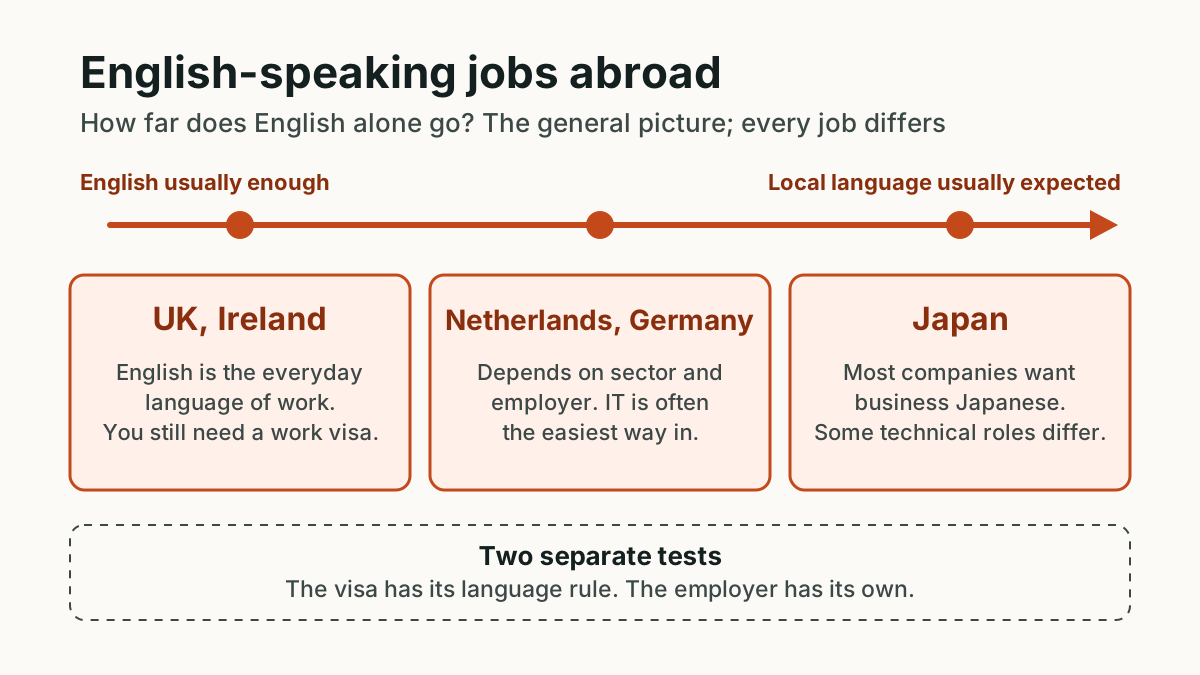
Yes, English-speaking jobs abroad are real, but they are mostly skilled jobs with an employer willing to sponsor you, and in many countries English alone will limit your options. In the UK and Ireland, English is the everyday language of work. In Germany and the Netherlands it depends heavily on your sector and employer. In Japan, most companies still expect good Japanese.
One point confuses many people: a visa that has no language rule does not mean the job has none. The visa is the government’s test. The employer sets its own. This guide covers both, country by country. Rules and salary thresholds change, so confirm every figure on the official page before you make a plan.
Are there English-speaking jobs in Germany?
Yes, particularly in IT and technical roles, but far fewer than in German. On the legal side, the Make it in Germany chart dated January 2026 shows no legal German requirement for the work visa for qualified professionals, the EU Blue Card, or the visa for professionally experienced workers, which includes IT specialists. The job-seeker Opportunity Card (Chancenkarte) on its points route needs German at A1 or English at B2.
The employer side is less relaxed. Germany’s Federal Employment Agency says plainly: "Many companies expect at least basic German language skills" and "English alone is often not enough." German is mandatory by law in some regulated professions. If your profession is regulated, as medicine is, confirm the language rule with the agency before you plan anything else.
For the EU Blue Card, The Local reported the 2026 minimum as €50,700 a year, or €45,934.20 for shortage occupations, citing provisional Federal Foreign Office figures. The government’s employer brochure says the lower level applies to fields such as engineering, natural sciences, healthcare and IT, and that IT professionals without a degree can qualify with three years of relevant experience in the last seven. German still helps later: Blue Card holders can apply for a settlement permit after 27 months with A1 German, or after 21 months with B1.
You may also have read that Germany offers 90,000 visas to Indians. In October 2024, Prime Minister Modi announced 90,000 skilled worker visas a year, up from 20,000, alongside a German strategy that includes more German teaching in Indian schools. That is a visa figure, not a list of job openings. You still need an employer.
Are there English-speaking jobs in the Netherlands?
Yes. The Netherlands is a realistic option, and the EF English Proficiency Index 2025 ranks it first in the world, though EF’s test takers are self-selected. Still, Work in NL says only that "in some cases, you can also work if you speak English", and that learning Dutch makes it easier to find work and take part in daily life. Roles that deal with local customers or patients are likely to need Dutch.
For non-EU workers, the route to look at first is the highly skilled migrant permit. The Immigration and Naturalisation Service (IND) requires an employer that is a recognised sponsor, and that employer makes the application. The permit page mentions no language requirement. The 2026 gross monthly salary minimums are:
- Highly skilled migrant, 30 or older: €5,942.
- Highly skilled migrant, under 30: €4,357.
- Reduced salary criterion: €3,122.
- European Blue Card: €5,942, or €4,754 on its reduced criterion.
These amounts change every 1 January. The reduced criteria apply only in particular cases, so read the conditions on the IND page. Practically, this means you should search for employers on the IND’s public register of recognised sponsors, because an employer not on it cannot use this route.
Which English-speaking countries in Europe offer visa sponsorship?
Ireland and the UK are the obvious places where English alone is normally enough for office work, though both have clear rules.
- Ireland: the Critical Skills Employment Permit needs a two-year job offer. Occupations on the critical skills list need a relevant degree and at least €40,904 a year, or €36,848 if you qualified within the last 12 months. Most other eligible occupations need over €68,911.
- UK Skilled Worker visa: you need a job offer from an approved employer, usually a salary of at least £41,700 or the going rate if higher, and English at CEFR B2. Medium-skilled jobs qualify only in limited cases.
- UK India Young Professionals Scheme: for Indian citizens aged 18 to 30 with a degree-level qualification and £2,530 in savings. It allows up to 24 months of living and working in the UK, but you must first be selected in a ballot.
If you are comparing these with Canada or Australia, where the test score is often the first hurdle, see our guide to IELTS score requirements for Canada, the UK and Australia.
Can English speakers find jobs in Japan?
Yes, but it is the hardest of these five on English alone. The usual status for professionals, Engineer/Specialist in Humanities/International Services, covers roles such as engineers, interpreters, designers, corporate language teachers and marketing staff, and Japanese ability is not a general condition of it. So a technical employer that works in English can hire you, if you meet the other conditions of that status.
The market is another matter. A job-hunting guide from JASSO, Japan’s student services organisation, cites a December 2024 Career-tasu survey: about 70% of companies seek at least intermediate business Japanese from international students at the time of a job offer, and about 90% after they join. That survey is about international students looking for jobs, not workers hired from abroad, but it shows the general expectation.
Japan’s immigration agency also now asks for language evidence in some cases. For applications from 15 April 2026 in Categories 3 and 4, applicants who will mainly use language in dealing with people, such as interpreters or hotel front desk staff, must show CEFR B2-level ability in the language used for that work. For Japanese, JLPT N2 or above is one way to show this.
How do you avoid fake overseas job offers?
Be careful with any offer that seems easy. In May 2024, India’s Ministry of External Affairs warned about offers for roles such as "Digital Sales and Marketing Executives" and "Customer Support Service" at companies in Laos’s Golden Triangle Special Economic Zone, linked to cryptocurrency and call centre fraud, with some people forced into cybercrime after arrival. It advised verifying the recruiting agent or company first and noted that a visa on arrival in Thailand or Laos does not permit employment.
A sensible check for any country: find the job on the employer’s own website, confirm the visa route on the government’s page, and be suspicious of anyone who wants money to guarantee placement.
How should you prepare your English for working abroad?
Expect a video interview, often with people who speak fast and in accents you may not be used to. Practise explaining your work simply, and asking about language directly, because it saves everyone’s time. It is better to learn early that a role needs German than after you have accepted it.
- Language
- What language does the team use day to day, and would I need German in this role?
- Sponsorship
- I am an Indian citizen, so I would need visa sponsorship. Is that something your company offers?
- Your work
- In my current role, I look after our payment system. Last year, I led the move to a new provider.
- Checking
- Sorry, could you repeat that? I want to be sure I understood correctly.
For more interview practice, see our job interview questions and answers in English.
SpeakWisely’s Role-play and Event prep let you rehearse an interview out loud with an AI partner in your browser, then read notes on what you actually said.
Start practising freeCommon questions about English-speaking jobs abroad
Can I get a job in Germany with only English?
Do I need Dutch to work in the Netherlands?
Which European countries have English-speaking jobs with visa sponsorship?
Are there jobs for English speakers in Japan without Japanese?
Does knowing English guarantee a job abroad?
English can open real doors abroad, but it works best when paired with an in-demand skill and, often, some of the local language. If you are still weighing up where to go, read about the countries where English is spoken.
Your recording is used only to transcribe your answer, then deleted within 15 minutes. We keep your transcript and results, never the audio.
Sources
- Required German Language Skills Depending on the Type of Visa (Make it in Germany, January 2026)
- How well do I need to know German? (Federal Employment Agency, Germany)
- Possibilities of skilled worker immigration (Federal Ministry for Economic Affairs and Energy, February 2026)
- The salary you need in Germany in 2026 to get an EU Blue Card (The Local)
- Germany’s plan to attract skilled Indian workers (The Local)
- EF English Proficiency Index
- Finding work (Work in NL)
- Highly skilled migrant residence permit (IND)
- Required amounts and income requirements (IND)
- Critical Skills Employment Permit (Department of Enterprise, Ireland)
- Skilled Worker visa: your job (GOV.UK)
- Skilled Worker visa: knowledge of English (GOV.UK)
- India Young Professionals Scheme visa (GOV.UK)
- India Young Professionals Scheme visa: eligibility (GOV.UK)
- Engineer/Specialist in Humanities/International Services (Immigration Services Agency of Japan, in Japanese)
- Job Hunting Guide for International Students 2027 (JASSO)
- MEA advisory on job scams in Laos and Cambodia (India TV, May 2024)
Keep reading
 English and careers6 min read
Countries where English is spoken: main language, official and widely used
There are three different answers: where English is the main language, where it is official, and where people simply use it widely. Here are all three.
 IELTS speaking7 min read
IELTS score requirements for Canada, the UK and Australia: what the official pages say
What IRCC, UK Visas and Immigration and Australian government pages say about IELTS scores, which version of the test each route wants, and why your lowest band often decides it.
 Spoken English8 min read
12 common job interview questions and answers in English
Every interviewer asks some version of the same dozen questions. Here is what each one is testing, a sample answer for freshers and professionals, and how to rehearse out loud.
 English and careers9 min read
Why English is important: what it really opens up, and where it stops helping
English widens your options at work, in education, online and abroad. Here is the evidence, what it is worth in India, and where it stops helping.